The Ground Truth: India Is Losing a Frontier to Tents, Names, and Silence
China and India are in ongoing face-offs along the Arunachal Pradesh frontier, the ITBP chief confirmed on Oct. 22, 2026. Seven days later, the state's Chief Minister called the same border "transgression, not intrusion" and said there was no matter of tension. On Nov. 2, 2026, a 36-hour bandh shut Upper Siang against the 11,200-MW Siang dam with mobile internet suspended in the district, and a BJP MLA from the affected seat said his own government had not explained the project to the villages. An investigation into the tents, the names, the dam, and every office that stands between a soldier and the border.
Updated Nov. 2, 2026 - added the 36-hour bandh that shut Upper Siang on Nov. 2 with mobile internet suspended in the district, the state Congress’s demand that the project be scrapped and the
APUAPAcases withdrawn, the Tuting-Yingkiong BJP MLA who backs the dam and says the government “has not explained it to villages well” and that livelihood assistance has not been paid, the former Chief Minister’s Nov. 1 ultimatum and his demand for a judicial inquiry into unproven payment allegations, and the unresolved count and assault allegations from the Delhi detentions. The Chief Minister’s storage arithmetic, the money the state says its dams will earn set against the 1,115 MW it has actually built, and Newzy.tech’s verdict of no are all in the record below. No new verified border development has landed since Oct. 31.Correction, Oct. 31, 2026. The Chinese Foreign Ministry’s “strictly abiding” statement was made on Oct. 26 and reported on Oct. 27; the gap from the MEA’s Oct. 23 remarks is 3 days, not 4. The Oct. 23 order extended 273 companies of the Delhi force through Oct. 31; that total is not a single mobilisation, and it sits on top of the 221 companies that held the capital from Oct. 8 to Oct. 12. The 26 arrests were East Siang only; the statewide figure is 69 arrests and 4 detentions under the Arunachal anti-terror law. On the locator map, Longju sat between Asaphila and Kibithoo and now carries its documented position northeast of Taksing, with Taksing and Asaphila sharing one marker at this scale. See the corrections log.
On Oct. 22, 2026, the chief of India’s border force confirmed face-offs along the frontier. On Oct. 23, the Home Ministry extended the posting of 39 of his companies inside Delhi. They were guarding one street.
On Oct. 30, it extended 270 companies in Delhi again, to Nov. 16. The 39 were not sent back.
On Oct. 29, asked about the face-offs at a tourism event in Tawang, the state’s Chief Minister said there was “no matter of tension.” On Oct. 31, several hundred people carried the Siang dam protest to Arunachal Bhawan in Delhi, and the police detained them.
The tents came first. Then the denials. Then a dam, a bandh, and a burning office in Pasighat.
The story in 30 seconds
- June to September 2026: Local groups in Taksing report PLA camps at 5 locations; satellite imagery confirms Chinese infrastructure expansion elsewhere on the frontier, but the Taksing tents remain unverified. China has issued 112 names since 2017; India has standardised 27.
- Oct. 22, 2026: ITBP Director General Shatrujeet Kapur confirms face-offs with Chinese forces at “several locations” in Arunachal Pradesh, and says the situation “still continues.”
- Oct. 23: The Ministry of External Affairs says the situation is disturbed when Chinese forces “deviate from established patrolling patterns.” The Army separately calls reports of “encroachment” incorrect and without any basis. The Home Ministry extends 273 CAPF companies, 39 of them ITBP, to Oct. 31; 221 companies, 25 of them ITBP, had been cleared for Delhi on Oct. 6.
- Oct. 23 to Oct. 26: The Siang dam protest turns violent in Pasighat; by Oct. 26 East Siang Police report 26 arrests, 5 of them juveniles, and 8 cases. On Oct. 26, Arunachal Pradesh Congress president Bosiram Siram alleges PLA troops have advanced 40 to 50 km into Upper Subansiri and hold the hilltops; Chief Minister Pema Khandu denies it.
- Oct. 27 to Oct. 31: The statewide Siang count reaches 69 arrests and 4 detentions under the Arunachal anti-terror law; Khandu calls the face-offs “transgression, not intrusion” and says there is “no matter of tension”; the Army debunks a deepfake attributed to Lt Gen Girish Kalia; Sanjay Singhal takes additional charge of the ITBP as Kapur retires; the Home Ministry extends 270 companies in Delhi to Nov. 16, and a former bureaucrat asks the Delhi High Court to review it.
- Oct. 30 to Oct. 31: Police file an application seeking search warrants against 4 people, among them the senior journalist Tongam Rina, and the state’s 2 press bodies condemn it; several hundred people gherao Arunachal Bhawan in Delhi and Khandu answers the dam question with storage arithmetic; a second fake Rajnath Singh video is debunked; the Buddha’s relics return to Tawang after 13 years.
- Nov. 1 to Nov. 2: A 36-hour bandh shuts Upper Siang and parts of East Siang, with mobile internet suspended in Upper Siang; the Siang superintendent of police says his district is unaffected. The state Congress demands the project be scrapped. A BJP MLA from the affected seat says the government “has not explained it to villages well”, and a former Chief Minister calls it a corrupt decision and asks the Chief Minister to resign.
- As of Nov. 2, 2026: The ITBP is led by a chief who also runs a second border force; the 39 ITBP companies are still in Delhi; the SUMP pre-feasibility report is unfinished; no inquiry into the tear gas has been announced; no office has published a coordinate, an incident log, or the search-warrant order; and Newzy.tech’s verdict on the dam is no.
India’s border force chief confirmed on Oct. 22 that patrols are clashing with Chinese forces at “several locations” in Arunachal Pradesh and that the confrontation “still continues”, at the same moment his government was negotiating with Beijing over trade and telling its own citizens that reports of encroachment were false. In the same state, on the other side of the same crisis, state police were firing tear gas at residents of the Siang valley who are protesting the government’s counter-dam project. This article tells both stories at once, and refuses to tell either government’s version of either.
How this investigation was done
This article is a documentary synthesis. It verifies every claim against primary documents, official statements, established independent journalism, academic analysis, and geospatial reporting. It does not carry rumour from social media except as a corroborated lead. It does not treat a single report repeated by many outlets as independent confirmation.
Each claim carries a label: Documented, Alleged, Analysis, or Opinion. The evidence base closes at 11 a.m. IST, Nov. 1, 2026. Later events arrive only as dated additions to the timeline, and corrections publish with a dated note, never as a silent edit.
It conducted no interviews and made no site visits. That limit shapes what follows: the evidence table and the lists of what is known, what is suspected, and what still cannot be proved.
The week the frontier came back
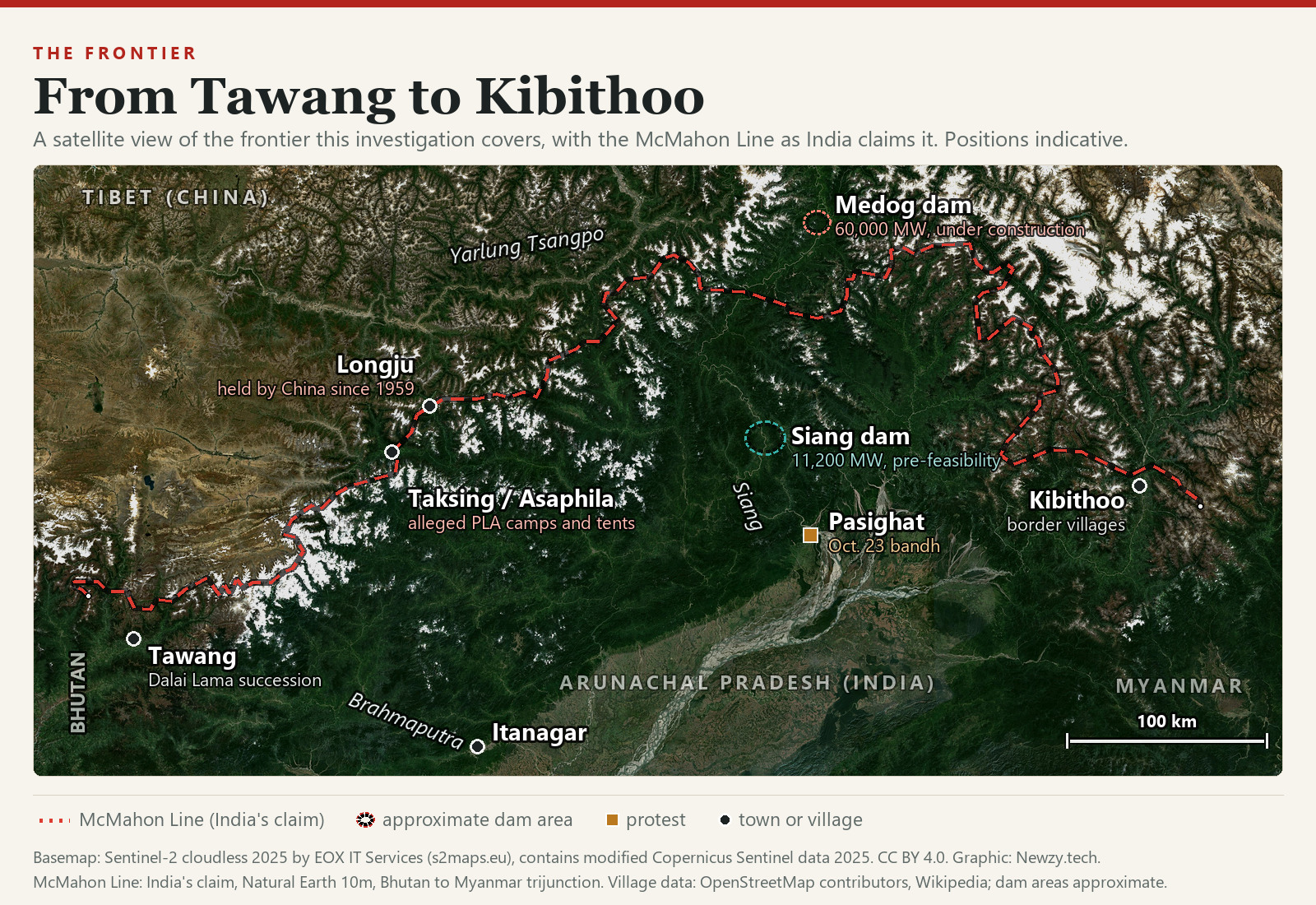
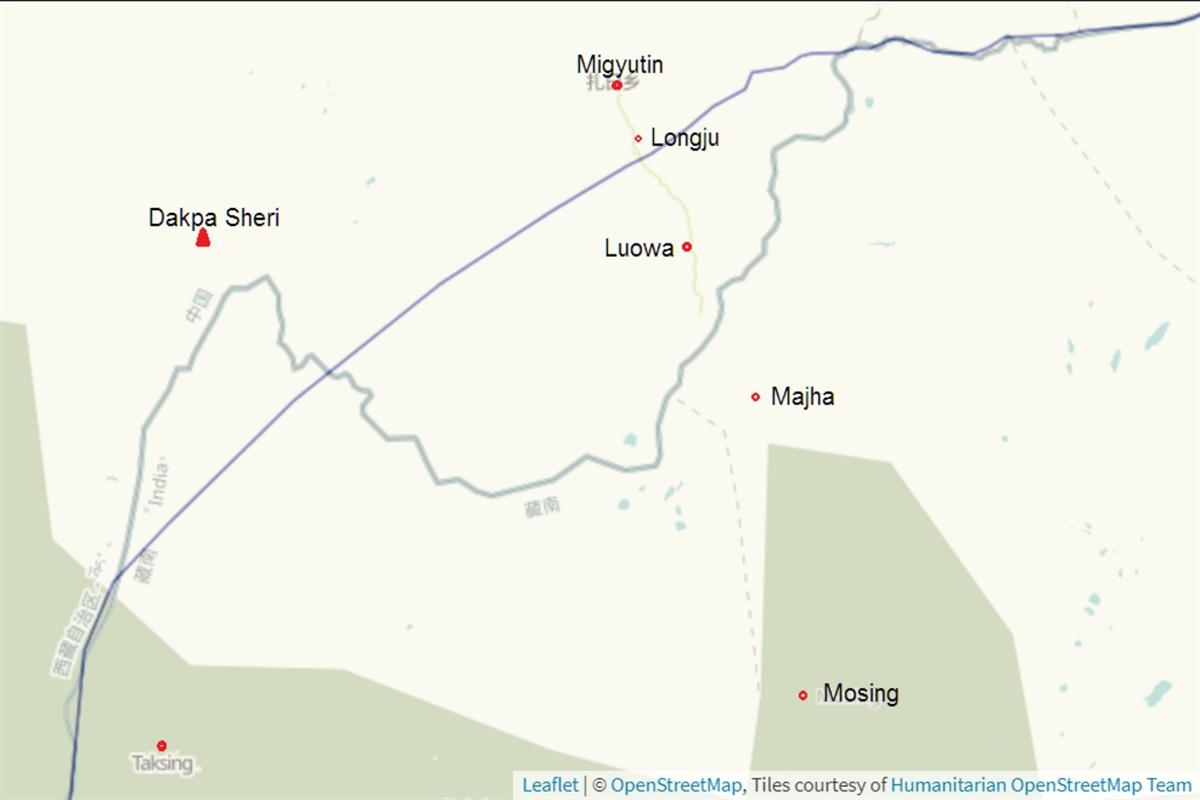
The frontier this investigation covers, from Tawang through the Taksing, Asaphila, and Longju cluster to Kibithoo. The dashed line is the McMahon Line as India claims it; Taksing and Asaphila share one marker at this scale, and the two dam areas are approximate, not exact sites.
Documented. On Oct. 22, 2026, the Director General of the Indo-Tibetan Border Police, Shatrujeet Kapur, told reporters that Indian and Chinese forces were engaged in face-offs at “several locations” along the Arunachal Pradesh border and that the situation “still continues.” He did not name China in his quoted remarks. He did not give locations. He did not mention casualties.
The next day, the Ministry of External Affairs spokesperson Randhir Jaiswal addressed the matter in the language Delhi prefers for this frontier: the situation becomes disturbed, he said, when Chinese forces “deviate from established patrolling patterns.” It is a sentence designed to be technically accurate and practically useless. It concedes disruption without conceding change. It names no place, no date, no number of tents, no number of incidents.
The Indian Army struck a contradictory note. Reports of Chinese “encroachment” in the sector, it said, were “incorrect and without any basis.” The statement was not reconciled with the ITBP Director General’s, and neither service nor ministry explained which specific reports were false. Members of the public were left to decide whether there was a crisis, an absence of one, or something in between that no office would describe. The Army had used the same phrase nearly 4 months earlier. On June 29, when the first reports from the Nah community surfaced, it called them “incorrect and without any basis.” The phrase did not become truer with repetition.
Documented. The denial has a documented shelf life. On Aug. 11, government sources called reports of “slow encroachment” in Arunachal Pradesh “attention-seeking ploys”, and in the same brief admitted that Longju has been in Chinese possession since 1959. On Aug. 12, China’s Foreign Ministry called the border “generally stable at the moment.” On Oct. 22, the state’s own border force chief confirmed the face-offs those sources had dismissed as a ploy.
Documented. On Oct. 23, inside Parliament, the Leader of the Opposition, Mallikarjun Kharge, demanded answers, citing 47 days that had passed since a Corps Commander-level meeting at the Wacha-Damai border meeting point on Sept. 6, a meeting held in Anjaw district, far from the disputed areas, and citing the absence of any public readout of what was agreed. A day earlier, the government had been confirming face-offs on the record. The timeline matters: the military-to-military engagement closest to the crisis did not end it.
Documented. The record was edited while it was being confirmed. On Oct. 23, The Hindu reported that the video of Kapur’s Alwar speech had been deleted from the ITBP’s YouTube channel, after the newspaper reported the face-offs. The MEA had confirmed the substance the same day. Kapur is set to retire on Oct. 31. On Oct. 24, Raising Day, the Prime Minister praised the Himveers’ “exceptional valour” and “selfless service.” Congress’s Pawan Khera said the government was suppressing information: “The fact that China has entered our territory does not bother [the government]; what bothers them is that this has been reported.” The speech was gone; the greeting was live. The video was deleted; the border was not.
Documented. The succession was settled on Oct. 27. The Home Ministry assigned Sanjay Singhal, the director general of the Sashastra Seema Bal, additional charge of the ITBP from Oct. 31, the day Kapur superannuates, The Hindu reported. The frontier force will be run by a chief who is already running a second border force, in the week its outgoing Director General’s own remarks put the frontier on the front pages.
Documented. Seven days after his own border force confirmed the face-offs, the state’s Chief Minister was asked about them at a tourism event. The Union Tourism Ministry ran the 14th International Tourism Mart for the Northeast region in Tawang from Oct. 29 to Oct. 31, the town’s first hosting of it since the 2nd edition in 2013; the Union Tourism and Culture Minister Gajendra Singh Shekhawat and the Minister of State Suresh Gopi were listed for the inaugural programme on Oct. 29, with Khandu. On its first day, on the sidelines, Pema Khandu told reporters that the situation in the border areas was normal, that the Indian Army was guarding the frontiers effectively, and that there was “no matter of tension.” Asked whether the tensions would hurt tourism, he answered: “Sometimes these issues happen. From here also soldiers travel that side, and from their side also patrolling happens. This is transgression, not intrusion, and this is not a new thing.” He also said, without naming the incidents: “Transgression has happened, no doubt. But it keeps happening; it is not a new thing. Because there is no line demarcation at the border, it is not defined.” India TodayNE reported the remarks; PTI carried them on Oct. 30.
Documented. The reply came the next day. On Oct. 30, Congress general secretary (in-charge of communications) Jairam Ramesh said Khandu had dismissed reports of Chinese incursions in Taksing earlier in the summer and had now acknowledged that transgressions had taken place. “The issue is no longer just Chinese transgressions. It is the BJP’s growing tendency to treat them as normal,” he said in a post on X. He cited Kapur’s Oct. 22 remarks, the reported PLA camps and lost patrolling points, China’s renaming of places in India, the 60,000-MW dam at the Great Bend, and a “record USD 112.6 billion trade deficit.” That figure is the Congress’s; the trade ledger documented in this article, drawn from the Financial Express for Jan. to Sept., puts the deficit at $105.93 billion. The 2 numbers are not reconciled on the public record, and neither office has explained the difference.
Analysis. The sentence matters more than the numbers. A border force chief will not name the opposing force in his own quoted remarks, and the state’s Chief Minister answers a confirmed face-off with a tourism forecast. “Because there is no line demarcation at the border, it is not defined” is not an analysis of the LAC; it is an explanation of why nobody has to account for what happens there. If the line is undefined, no incursion can be measured, no patrol can be lost, and no official can be wrong. That is why the absence of coordinates is a policy instrument and not an oversight.
Analysis. Three signatures define the government’s handling of this week. First, abstraction: no coordinates, incident log, imagery, or sector names. Second, contradiction without correction: the Army denied “encroachment” while the ITBP confirmed continuing face-offs, and no one reconciled the 2 claims. Third, Kapur’s quoted remarks omitted China’s name while Delhi was hosting the aftermath of Xi Jinping’s BRICS visit and courting Chinese trade. None of those facts, alone, proves concealment. Together they leave the public with the same intolerable deficit: a crisis described in fragments by the institutions that possess the detail. In a border emergency, silence is not neutral. It is a decision about who gets to know what is happening on their own frontier.
The public record, in 6 rows:
| Actor | Public position | What it leaves unexplained |
|---|---|---|
| ITBP Director General | Face-offs at “several locations,” and the situation “still continues.” (Oct. 22) | No locations, no casualty count, no name of the opposing force in the quoted remarks. |
| Ministry of External Affairs | The situation is disturbed when Chinese forces “deviate from established patrolling patterns.” (Oct. 23) | No coordinates, no number of incidents, no acknowledgement that tents stand inside India’s perception of the line. |
| Indian Army | Reports of Chinese “encroachment” are “incorrect and without any basis.” (Oct. 23) | Does not reconcile the denial with the ITBP chief, or identify which reports are false. |
| Chinese Foreign Ministry | The border is “generally stable at the moment.” (Aug. 12) | Does not address the tents, the construction, or the face-offs. |
| Local organisations | PLA camps at 5 locations in Taksing since June. (June 26) | No independent verification, and no specific official confirmation or denial. |
| Chief Minister of Arunachal Pradesh | “Transgression, not intrusion,” and “no matter of tension.” (Oct. 29) | Says the line is undefined because there is no demarcation; names no incident, and does not answer whether the Taksing reports are true. |
That is the frame for everything that follows: not “who is right,” but “who refused to say what is happening, and what does the refusal cost the people on the ground.”
The correct job, and the 39 companies that never reached it
Documented. The job has a name and a statute. The Indo-Tibetan Border Police was raised as a mountain guerrilla force after the 1962 war and has carried permanent border guarding duty along the Chinese frontier since 2004. Its Director General said it himself, at a felicitation ceremony in Alwar, in the week the face-offs were confirmed, as reported by The Indian Express:
“We were given border guarding duty along China in 2004. We should not abandon our exact mandate.”
Director General Shatrujeet Kapur, ITBP, as reported by The Indian Express
Documented. That same week, the Home Ministry answered his mandate with arithmetic. On Oct. 6, it sanctioned 110 additional companies of central police forces for Delhi, on top of 111 it had kept available since July. From Oct. 8 to Oct. 12, 221 companies, roughly 23,000 personnel, stood in the national capital. The tranche was cleared for 30 days, while the “Jantar Mantar 2.0” agitation announced by the Cockroach Janta Party, styled CJP in Indian press reports, pressed for the resignation of Chief Election Commissioner Gyanesh Kumar over the Special Intensive Revision of electoral rolls. The additional tranche comprised 85 CRPF companies, 10 of the Sashastra Seema Bal, 7 of the Rapid Action Force, 7 of the ITBP, and 1 company of the Central Industrial Security Force. Among those pulled: 85 CRPF companies that had been deployed for the Amarnath Yatra, 20 of the 137 companies in the Jammu region, 40 of the 65 companies stationed in West Bengal since October last year, and 22 of the 157 companies on anti-Naxal duty in Chhattisgarh. Of the 221, the border police for China supplied 25 companies: 18 had been with the Delhi Police since the July protests, and 7 were new.
| The correct job | The blocker | The paper trail |
|---|---|---|
| Guard the line | The deployment desk in the Home Ministry | 221 companies issued to 1 city; 273 companies held to Oct. 31; 270 held to Nov. 16 |
| Supply the border force | The Election Commission’s law-and-order requisitions | 700 CAPF companies kept in 1 state after polling |
| Say what is happening | The Army, the MEA, and the ITBP chief | 3 contradictory documents in 48 hours |
| Build the road | A department transfer nobody re-examined | 2 agencies, 1 lifeline, 7 districts cut off |
| Fund the state | Creditors guarding their board rooms | World Bank lending blocked, per the Union minister |
The soldiers did not fail the border. The paperwork failed the soldiers.
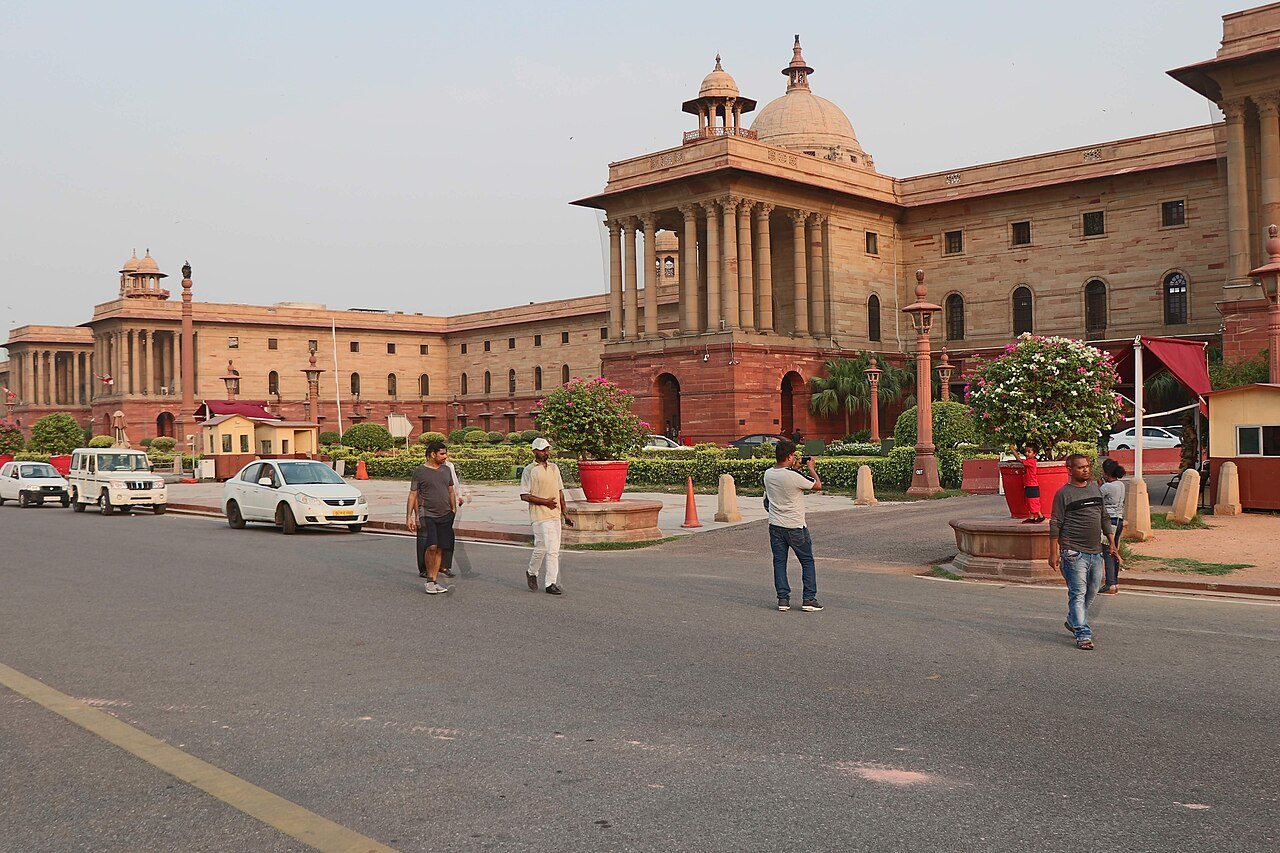
North Block, New Delhi. The ministry that extended the Delhi deployment also owns the border force.
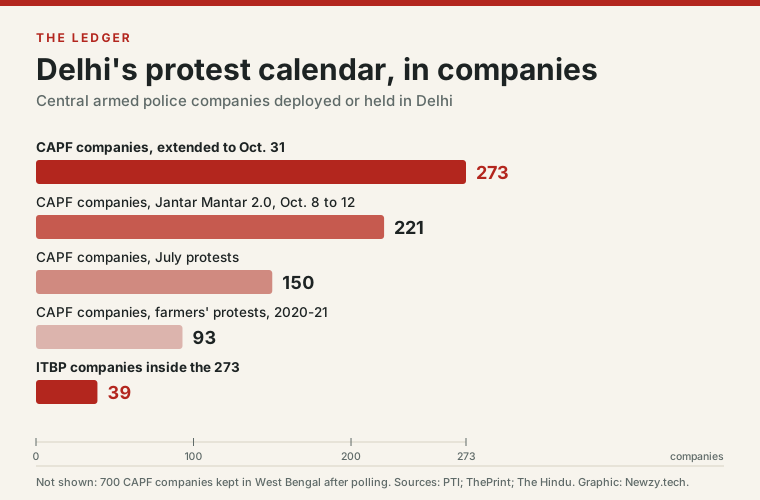
The Delhi ledger. Newzy.tech graphic.
The number that matters: 39 companies. That was the border force’s share of the 273-company deployment extended on Oct. 23, in the week its Director General said the face-offs were still continuing.
Documented. On Oct. 23, Press Trust of India reported that the Home Ministry had extended, for the 2nd time, the deployment of 273 CAPF companies in Delhi until Oct. 31, citing “flash protests” by political and other groups. The extension was approved at the Delhi Police’s request. The list is exact: 125 companies of CRPF, 20 of them all-women units, 20 of the Rapid Action Force, 46 of the Border Security Force, 31 of the Sashastra Seema Bal, 12 of the Central Industrial Security Force, and 39 of the Indo-Tibetan Border Police, the force whose charter begins at the watershed with China. A company carries a sanctioned strength of 100 personnel; its working strength is about 70 to 72. A day earlier, at a briefing in Alwar, the same force’s Director General said face-offs with Chinese troops were “still continuing” along the Arunachal Pradesh border.
Documented. On Oct. 30, the Home Ministry extended the deployment a 3rd time, to Nov. 16, ahead of an INDIA bloc rally. The new order covers 270 companies. It is the 3rd extension in 5 weeks. The border force did not get its 39 companies back. Oct. 31 is also the day Shatrujeet Kapur retires and Sanjay Singhal, chief of the Sashastra Seema Bal, takes additional charge of the force.
Documented. The extension was challenged in court. On Oct. 30, former civil servant Ashish Joshi asked the Delhi High Court to scrutinise the “large-scale deployment and repeated extensions” of central police companies in the capital during protests. The court has not ruled. The petition does not mention the frontier. It does not need to. The same 270 companies are the answer to both questions: who guards the capital, and who is not guarding the line.
Documented. The calendar had a name. The CJP, led by Abhijeet Dipke and Neha Bora, had spent the month mobilising against Chief Election Commissioner Gyanesh Kumar. It called its Oct. 10 protest “Jantar Mantar 2.0.” On Oct. 16, more than 150 of its workers were detained during a “Lehra Do Tiranga” march. Dipke was placed under preventive arrest; Bora was released. On Oct. 23, the group called a nationwide “Har gali mein Jantar Mantar” march. The 39 ITBP companies were not guarding a ridge. They were guarding the possibility of a slogan.
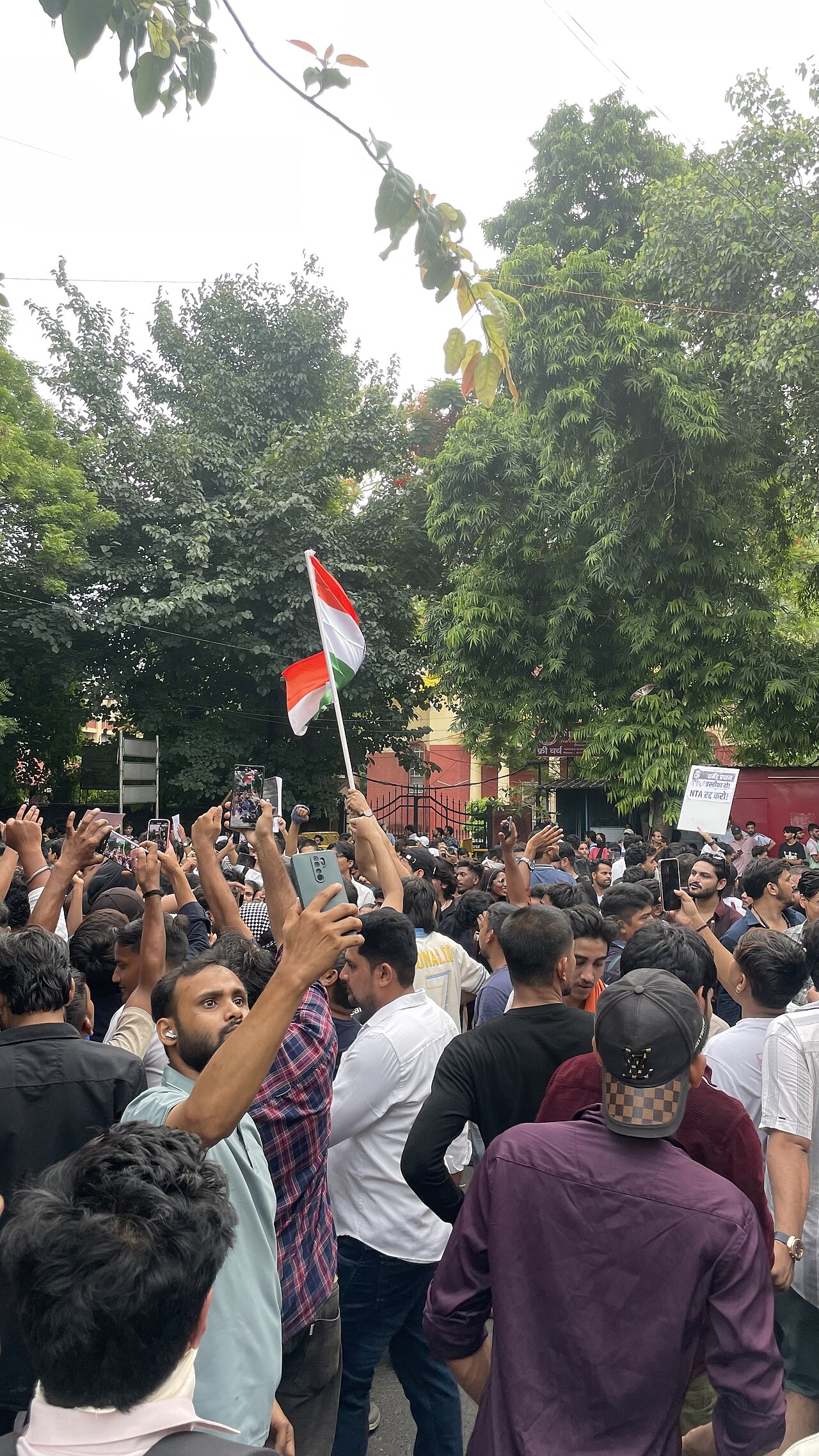
Documented. The scale is not an accident of one week. In July, the same protest movement required 150 CAPF companies, with contingents airlifted from West Bengal and Chhattisgarh. The farmers’ protests of 2020 to 2021 required 93. The G20 Summit required 236 companies and about 25,000 Delhi Police personnel. The BRICS Summit in September took 15,000 Delhi Police personnel alone. In April, the Election Commission kept 700 CAPF companies in West Bengal after polling for law and order. For the Chinese frontier, the same weeks produced a commander confirming face-offs and pleading not to be pulled off his mandate, while contributing 25 of his companies to the barricade detail.
Analysis. Do the arithmetic the ministry’s announcement leaves for readers to do. At about 70 working personnel per company, 273 companies amount to roughly 19,100 central personnel in one city. PTI put the full police and paramilitary deployment across central Delhi above 20,000. The force whose chief said the face-offs “still continue” supplied 39 of those 273 companies. The law did not force the Home Ministry to make this allocation; the ministry made it, then extended it twice more. That is not proof that Delhi’s deployment caused a border failure. It is proof of where this government’s operational calendar put a border force while its chief said the frontier remained unsettled. A civil protest absorbed a border force, and the border was told to wait until after the next rally.
Asaphila, Taksing, and the tents nobody will confirm
Alleged. On June 26, 2026, the Nah Welfare Society, a community organisation from Taksing circle in Upper Subansiri district, sent a letter to the state government and the Government of India. Signed by Keru Chader, it alleged that personnel of the People’s Liberation Army had set up camps at 5 locations in the Taksing area, and characterised the development as encroachment. The organisation sought intervention. 4 months later, no government statement has confirmed or denied the camps’ existence in specific terms.
Alleged. From Aug. 11 to Aug. 13, fact-finding teams organised through the People’s Party of Arunachal and local students’ unions visited Taksing and the Gelemo area. PPA leader Kaling Jerang reported that Shera 5, a forward post used earlier in the decade, had been abandoned since 2023, and that Indian patrols had not reached the area between April and October, the seasonal gap when monsoon makes approach difficult. Their account supports the claim that access lapsed before the current reports of camps; it does not verify the camps themselves.
Alleged. Around July 25, videos and photographs of what was described as a face-off near Asaphila, also in Upper Subansiri, began circulating on social media. Their provenance could not be established, and this article does not treat them as confirmation of the incident. Reuters and other agencies reported, citing government sources, that tents had appeared 6 to 7 kilometres inside India’s perception of the Line of Actual Control. The Hindu specified the site: an elevation near the Maja company operating base in Taksing circle, within the Asaphila stand-off area. These remain the most concrete public indications of the standoff’s location and scale. They are second-hand, unattributed by name, and unaccompanied by imagery the government has chosen to release.
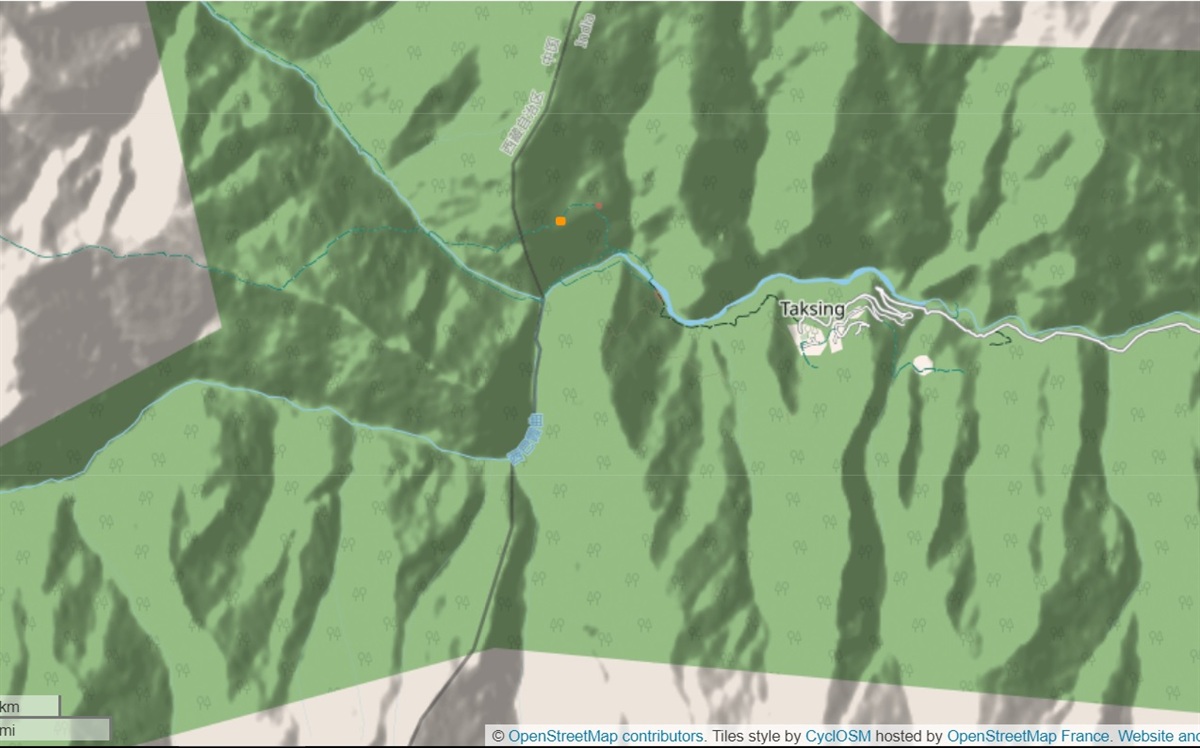
Alleged. On Oct. 26, the state Congress president and former education minister, Bosiram Siram, put the largest figure yet on the record. Chinese troops, he said, had advanced 40 to 50 km into Indian territory in Upper Subansiri and were holding the high ground. “Chinese PLA have already advanced 40 to 50 km into Indian territory,” the Times of India quoted him saying. “Today, Chinese PLA personnel are stationed up there, at intervals.” He said the account came from a Congress delegation that toured the district from Aug. 26 to Aug. 29, and that villagers had described restricted movement. Chief Minister Pema Khandu denied the claim. Neither the Army nor the Home Ministry published coordinates, imagery, or an incident record that would settle whether the figure is right, wrong, or partly both. The claim is unverified. So is the denial, which is a statement, not a survey.
Documented. On Oct. 29, Khandu put his own explanation on the record. He called the face-offs “transgression, not intrusion”. He said China does not consider the McMahon Line, that Indian soldiers go to the other side, and that Chinese patrol parties sometimes cross over to the Indian side. That is not a denial of encroachment. It is a description of a frontier neither army controls, offered by the state’s chief executive. It does not prove the 40 to 50 km claim. It does make the Army’s “incorrect and without any basis” formula look like a press office, not an assessment.
Documented. What is verifiable from imagery is elsewhere. Janes, working with Vantor satellite imagery reported by The Independent on Sept. 12, documented Chinese infrastructure expansion in Lhunze County, Tibet, opposite the Indian frontier, including helipads, new roads, and expanded facilities at Zhari town. The imagery confirms that construction and capacity-building on the Chinese side of the line is accelerating. It does not, and cannot, resolve whether tents stand in Taksing or Asaphila.
Documented. On Sept. 6, the 2 sides held a Corps Commander-level meeting at Wacha-Damai, on the Indian side of the line. The Ministry of External Affairs described it as 2 days long. 46 days later, the ITBP Director General confirmed that face-offs were continuing. No readout of the meeting was published. The reasonable inference, flagged in the evidence table below, is that the meeting did not achieve what the public was not told it was meant to achieve: disengagement or a restored status quo.
Analysis. Look at what this sequence does, whatever anyone intended by it. Villagers allege camps; the public gets no specific official answer. Fact-finders report that access lapsed through the monsoon; the Army issues a blanket denial of “encroachment” without addressing that claim. Satellite imagery documents Chinese construction elsewhere, but cannot establish what is happening at Taksing or Asaphila. The result is a trap made of two crude stories: “China has grabbed our land” or “nothing is happening.” The available record supports neither certainty. It supports something narrower, and damning enough: face-offs are confirmed, the alleged camps remain unverified, and the state has not published the information that could help the public distinguish one from the other.
Opinion. Taksing and Gelemo’s Nah residents are being handed an impossible civic assignment: report what they see, supply vigilance on the frontier, then accept neither confirmation nor a specific explanation of why they might be wrong. The state has the instruments to check their claims. The public record shows no published result. Communities on the line are asked to provide trust without information and bear the consequences without a straight answer.
The naming war
Documented. On Aug. 7, 2026, India’s Ministry of Home Affairs announced that it had standardised the names of 27 places in Arunachal Pradesh. The list included 21 land areas, 4 mountain passes, Dzo La, Riza La, Pukur La, and Thag La, a high-altitude lake called Sambho Sarovar, and a monument to the 1962 war figure Sher-e-Thapa. It also included Longju, a site China has controlled since the 1959 clash, and Maja, a village near the disputed line. The names were to be incorporated into Survey of India maps.
Nearly 4 months earlier, on Apr. 10, China’s Ministry of Civil Affairs had released its 6th batch of “standardised geographical names” for Arunachal Pradesh, 23 names, bringing its total since 2017 to at least 112. Beijing calls the state “Zangnan,” or South Tibet. India calls the Chinese exercise “fictitious.” China calls India’s exercise “self-deception.”
The numbers are easy to report and easy to weaponise. The 1st Chinese batch, in 2017, had 6 names. Then 15 in Dec. 2021, 11 in Apr. 2023, 30 in 2024, 27 in May 2025, and 23 in Apr. 2026. The Indian list of 27 was, in part, a reply. It was also a domestic signal: the BJP government could show that it was not passively accepting Beijing’s cartographic aggression. The Chinese response was equally performative. Chinese analysts quoted by Global Times said the Indian move was “self-deception” and ran counter to the improving momentum in bilateral relations. Beijing restated its claim to the entire state and its rejection of the McMahon Line.
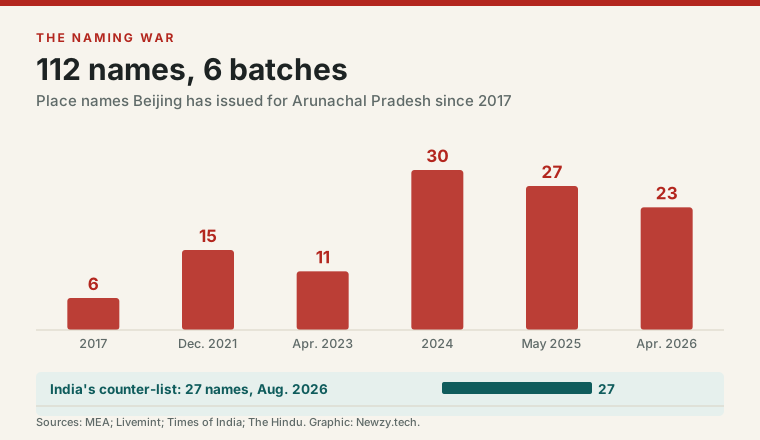
Beijing’s 6 batches, and India’s single counter-list. Newzy.tech graphic.
Documented. The legal history is older than either list. In 1914, British India, Tibet, and China negotiated the Simla Convention. The convention drew the McMahon Line between British India and Tibet. The Chinese representative did not sign the final agreement, and successive Chinese governments have rejected the line. India treats the McMahon Line as its border. China treats the whole of Arunachal Pradesh as Chinese territory. The 1962 war was fought, in part, over this disagreement; Chinese forces overran Tawang and withdrew. The 1959 clash at Longju, one of the places on India’s 2026 list, is a reminder that the dispute has been violent for longer than either republic has been independent. The contest now extends into international organisations. On Sept. 4, the UN General Assembly adopted the “Correct the Map” resolution, 164 to 1, with India’s vote. The text is about map projections, not borders. The world map that appeared on July 1, during the debate, still drew Arunachal Pradesh between an “Indian line” and a “Chinese line,” erased its border with Nagaland, and dropped the “claim lines” label used in 2011. India flagged the anomalies; no correction was reported.
The 2005 Agreement on Political Parameters and Guiding Principles was supposed to create a framework for a package settlement. It committed both sides to seek a fair, reasonable, and mutually acceptable solution, and it included protections for settled populations in the border areas. It did not resolve the line. It did not create a mechanism for agreeing on names. It did not stop either side from issuing maps that the other rejects.
Analysis. The naming war is real, and on the ground it is inert. A name does not move a patrol, change who controls Longju, shift the reported tents near Asaphila, or get Indian troops to Shera 5 in the monsoon. It creates no rights under international law and settles no boundary. What it does create is a public record that future negotiators may find harder to trade away. Each list raises the domestic cost of compromise. These governments are not only addressing each other; they are preparing their own publics to reject the other’s claims. The map has two lines. The microphone has none.
That is why the naming war is more dangerous than it looks. It is cheap. It is popular. It requires no troops and risks no casualties. It allows a government to look strong without doing anything that could be tested on the ground. And it makes the eventual compromise harder, because each side has now told its citizens that the other’s names are fraudulent.
There is also a human cost that neither capital acknowledges. The places on these lists are not empty cartographic units. They have local names, in Monpa, Tagin, Nah, Adi, Galo, and other languages. They are grazing grounds, pilgrimage routes, hunting areas, and villages. The NWS letter about Taksing was not about a name on a Chinese map; it was about land that people use. The Indian list includes Longju and Maja, but it does not tell the people who live near them what India will do to defend them. The Chinese list includes places Beijing claims, but it does not tell Tibetans or Arunachalis what China will do for them. Both exercises treat the frontier as a surface to be labelled, not a society to be consulted.
Opinion. Naming is the cheap theatre available when delineation, verification, and consent remain undone. 2 governments can perform sovereignty without answering the questions that would settle anything: Where is the line? Who patrols where? What has been traded? What happens to the people who live there? A map is not policy. A name is not a settlement. A list is not a strategy. And the people who live under those names are not props in either capital’s cartographic performance.
The 27 names and the 112 names will not decide the future of Arunachal Pradesh. The tents at Asaphila, the dam on the Siang, and the next round of talks will. The naming war matters only because it makes those decisions harder, and because it allows the people who make them to pretend that they have already been made.
The dam upstream
Upstream of Pasighat, where the Yarlung Tsangpo drops through the deepest canyon on earth, China is building the largest hydropower project in the world. It is called Medog. It is the reason the Siang dam exists, or at least the reason the Indian government says it exists.
Documented. China’s State Council approved the Medog hydropower project on Dec. 25, 2024. Construction began on July 19, 2025. When complete, it is expected to generate about 60,000 MW, nearly 3 times the capacity of the Three Gorges Dam, at a cost of roughly 1.2 trillion yuan, or about $137 billion at the exchange rate used by the Lowy Institute. It is described as a cascade of 5 stations, with projected completion in the mid-2030s to the 2040s.
Documented. The project has moved from approval to national plan. On July 23, 2026, China’s 15th Five-Year Plan for renewable energy named the Yarlung Zangbo Lower Reaches Hydropower Project among the major projects to advance, using Beijing’s phrase for it, the “project of the century.” On Aug. 26, a glacial collapse and flash flood on the Nepal-China border renewed questions about dam safety in the same seismic belt. The Hindu reported that the disaster was unlikely to sway Beijing. The dam is now written into the plan, not merely approved as a single project.
The river does not respect borders. It rises in Tibet, cuts through the Himalayas, enters Arunachal Pradesh as the Siang, and becomes the Brahmaputra in Assam before emptying into the Bay of Bengal. Millions of people in India and Bangladesh depend on its flows. The Medog project gives China the ability to regulate those flows, not necessarily to cut them off, but to change their timing, their sediment load, and their predictability. In a river system this large, timing is everything. A release during the planting season is different from a release during the flood season. A reservoir that holds back sediment can starve downstream farmland. A dam that changes the hydrograph can alter an entire delta.
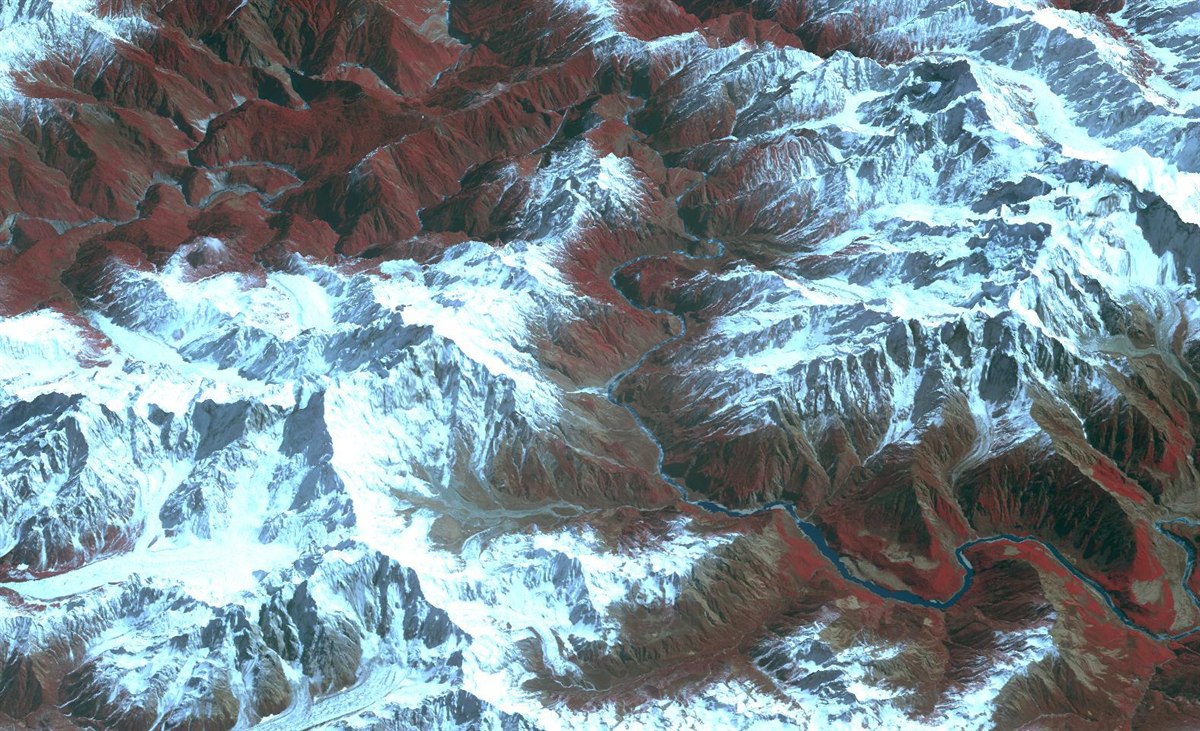
Documented. The Indian government has framed the project as an existential threat.
“China’s construction of the world’s largest hydropower dam on the Yarlung Tsangpo River poses significant risks to the water security, ecology, and livelihoods of millions of people downstream in Arunachal Pradesh, Assam, and Bangladesh.”
Pema Khandu, Chief Minister of Arunachal Pradesh, Jan. 2025
“The Siang dam project [is] of national importance and I am holding discussions with people regarding that. The project is needed to maintain our water security and if China uses their dam in future as a water bomb, we should be ready with our defence mechanism.”
Pema Khandu, Chief Minister of Arunachal Pradesh, Jan. 2025
That is the clearest public statement of the strategic logic behind the Siang Upper Multipurpose Project (SUMP). It is also a statement that mixes 3 different things: water security, energy generation, and military deterrence. A dam can serve all 3, but it cannot serve them in the same way. The government has not published the modelling that shows how an 11,200-MW project downstream would mitigate a 60,000-MW project upstream. It has not explained what “water bomb” means in hydrological terms. It has not said whether the SUMP is designed to store water for a shortage, release water for a flood, or simply generate electricity. Those are different engineering choices with different costs.
Analysis. “Water bomb” is the dramatic phrase; the less cinematic risk is more credible and harder to answer. Control over data, release schedules, and operating rules can make downstream planning uncertain without a spectacular act of weaponisation. India’s impulse to build storage is understandable. But a downstream reservoir cannot manufacture water withheld upstream. It can buffer a shortage for a limited time; it can absorb some surge, not shield every community. It cannot substitute for an agreement with the upstream state, and calling it a countermeasure does not repeal hydrology.
The government’s own numbers illustrate the mismatch. The SUMP is proposed to have about 9.2 billion cubic metres of live storage. Khandu has said the Medog project could hold about 5.5 billion cubic metres. Those figures are not directly comparable, they refer to different reservoirs, different operating rules, and different purposes, but they are enough to show that the Indian project is not a simple mirror of the Chinese one. It is a large project with its own logic, its own risks, and its own costs. The public has not been given the analysis that would allow it to judge whether those costs are worth bearing.
Documented. The diplomatic track on water has been thin. The Aug. 25, 2026 Special Representatives talks produced an 8-point consensus that included a commitment to hold the next meeting of the India-China Expert-Level Mechanism on Trans-Border Rivers in September and to “maintain communication on issues including hydrological data sharing, and renewal of the relevant MoUs.” That is the language of process, not of binding obligation. The public record does not show a new agreement on real-time data, operating rules, or notification of releases.
China has not published the operating rules for Medog. It has not published a downstream impact assessment. It has not committed to a notification regime that would give India and Bangladesh advance warning of major releases. It may be doing some of this through existing channels; the public does not know. That is the point. In a river system shared by more than 1 billion people, the absence of public information is itself a form of power.
Analysis. Medog is an engineering project and a test of whether the two countries can manage a shared river without turning uncertainty into pressure. The 2026 thaw produced a mechanism, a meeting date, and a paragraph in a joint statement. It did not produce public operating rules or third-party monitoring. Until those gaps are addressed, India’s water security rests on inference and worst-case planning. That is a brittle equilibrium: each side builds more storage, the costs and displacement rise, local resistance hardens, and the next agreement becomes more difficult to reach.
There is also a scientific risk that neither government discusses candidly. The Yarlung Tsangpo gorge is one of the most seismically active regions in the world. The project involves massive tunneling, slope cutting, and reservoir impoundment in a fragile mountain system. Chinese geologists have reportedly flagged fault-line concerns. The Indian government has its own seismic concerns about the SUMP. Neither side has published the full risk assessments. The people who live in the valley are being asked to accept both projects on trust.
Opinion. Medog is a real strategic challenge, and India is right to study it seriously. But SUMP is not a serious answer if it is sold as a slogan. A serious case would show the hydrological model, costs and benefits, seismic risks, resettlement plan, and diplomatic strategy for binding data-sharing. It would also admit that a downstream dam cannot solve an upstream problem by itself. The public has not been given that case. It has been given fear, a capacity figure, and a survey. That is not a water-security policy. It is the appearance of one.
The people of the Siang valley understand this better than the officials who lecture them about national interest. They know that the same river that is invoked to justify the dam is the river that would be altered by it. They know that the Chinese dam is upstream and the Indian dam is in their backyard. They know that the costs of “defence” are not distributed equally. And they know that when the government says “national importance,” it usually means that the people who bear the local costs are expected to be quiet.
They have not been quiet.
The dam downstream
Documented. The Siang Upper Multipurpose Project is proposed at 11,200 MW, with about 9.2 billion cubic metres of live storage. It is being developed by NHPC. The project is at the pre-feasibility stage; the government says current activity is limited to technical and environmental surveys for the pre-feasibility report. It has not been approved for construction. The government argues it is needed to store and regulate water in the Siang basin, manage seasonal floods, and strengthen water and energy security in the face of China’s Medog project.
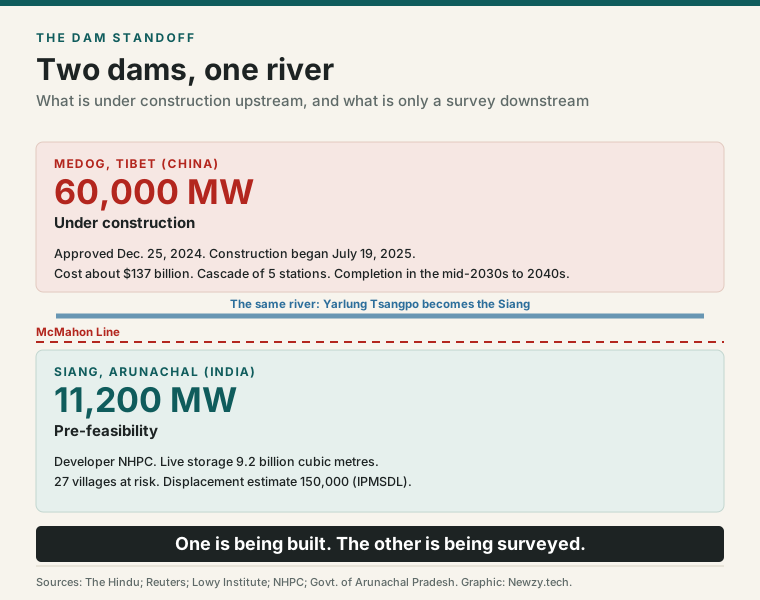
The two projects, compared. Newzy.tech graphic.
Analysis. China is building a 60,000-MW project. India is surveying an 11,200-MW proposal. The difference is not only capacity. It is certainty: one project is under construction; the other remains at pre-feasibility.
The dispute is not about whether the project should be studied. It is about how the study is being conducted, who is being consulted, and what the state is willing to do to people who object.
Documented. In May 2025, central armed police forces were deployed in Siang district to facilitate the survey. Residents of more than 27 villages opposed the project. The Adi Students’ Union condemned the deployment of armed forces in schools and colleges. The government said the forces were there to maintain law and order.
The 2026 escalation followed a familiar pattern. On Oct. 18, young people gathered in Pasighat for a consultative meeting. On Oct. 20, they marched from the Daying Ering School ground to Gandhi Chowk, despite the district administration refusing permission. On Oct. 22, a 24-hour sit-in began at Miracle Ground. On Oct. 23, a 12-hour bandh was observed across Siang, Upper Siang, and East Siang districts. The bandh was called by the Adi Bane Kebang United, the SUMP Affected Area Youth Association, the Siang Indigenous Farmers’ Forum Youth Wing, and the Adi Galo Welfare Society. The demands were specific: release the detained activists, reinstate the suspended gaon buras, withdraw the paramilitary and central forces, and stop the pre-feasibility surveys.
Documented. The bandh had a trigger. The Arunachal Times, citing the Assam-based Bhumi Odhikar, reported that it was called after the Upper Siang administration detained 4 local Adi community leaders under the Arunachal Pradesh Unlawful Activities (Prevention) Act, 2014.
The bandh was supposed to end at 5 p.m. It did not end the confrontation. Police say 200 to 300 people, some armed with machetes, lathis, and slingshots, tried to break barricades and threw stones at officers and a magistrate. The police used tear gas only after the crowd refused to clear the highway, according to Inspector-General Hibu Tamang. Protesters tell a different story.
“Suddenly, some explosives went off, and after that, we also became somewhat disoriented. Then stones started raining from both sides. After that, the situation escalated.”
A Siang protester, as reported by Down To Earth, Oct. 25, 2026
Documented. On Oct. 23, 4 women were injured in a clash with police at the protests against the Upper Siang power project, per The Hindu.
By 11 p.m., the NHPC office in Pasighat was on fire. A police station was torched. The office of the Adi Bane Kebang was ransacked. The homes of Mariyang MLA Oni Panyang, senior MLA Ninong Ering, and state BJP president Kaling Moyong were attacked. At least 9 police vehicles were damaged. Police said 40 officers were injured. By Oct. 24, 3 FIRs had been registered and 15 people arrested or detained. Ten people had already been arrested since Oct. 9, 4 under the Arunachal Pradesh Unlawful Activities (Prevention) Act, 2014.
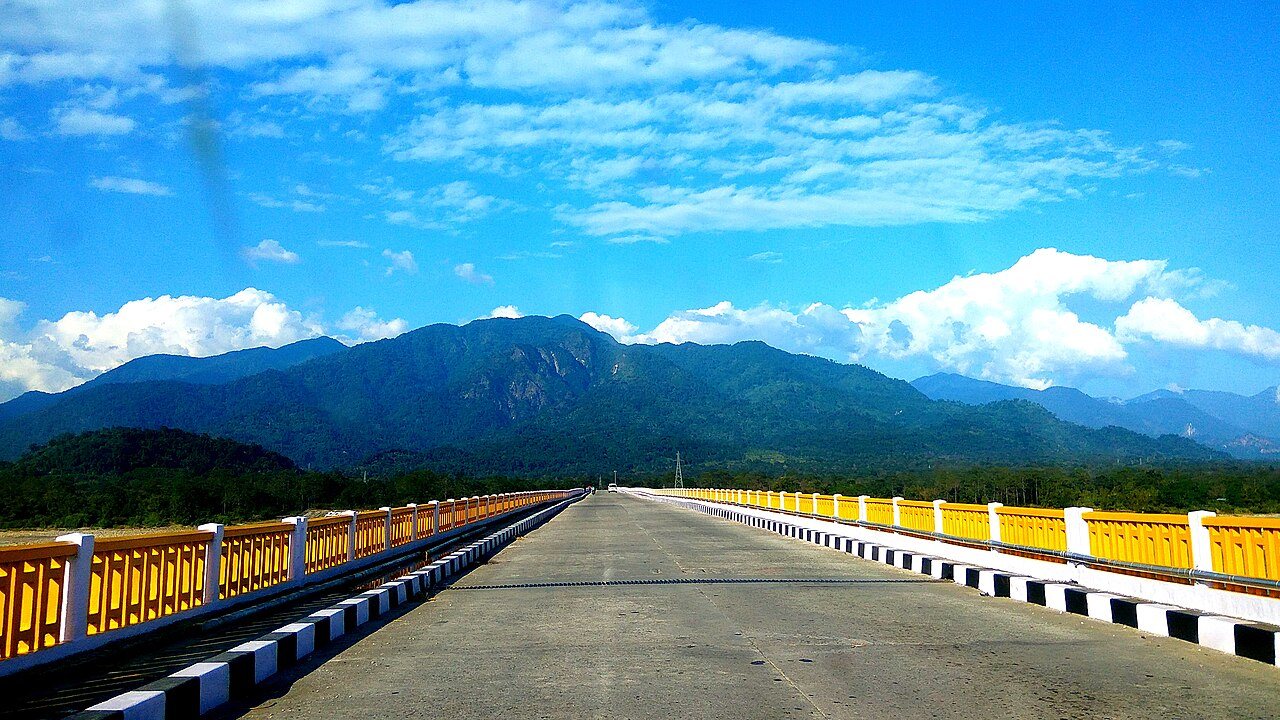
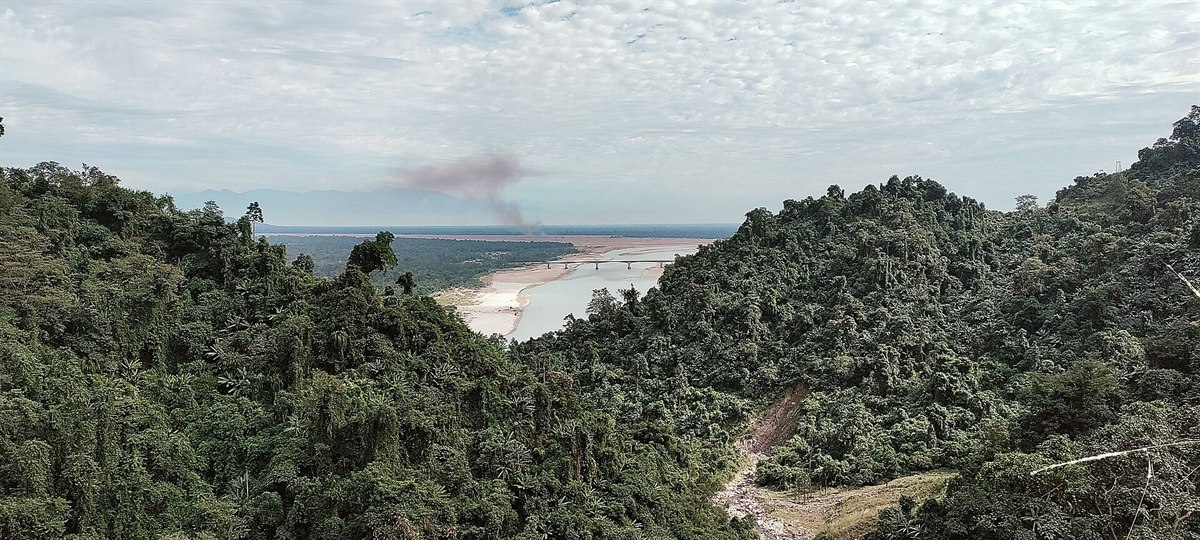
The bridge over the Siang at Pasighat. The Oct. 23 bandh ended in arson in the town.
Documented. The crackdown has a documented ledger that predates the bandh. On Sept. 28, villagers clashed with paramilitary forces in Geku. On Oct. 4, protesters in Uggeng village were reportedly lathi charged. News and broadcasts from the protest sites have been reportedly blocked since Oct. 5, per documentation compiled by the International Indigenous Peoples Movement for Self-Determination and Liberation, which also records the preventive detention of 4 named villagers under the state’s preventive law and estimates the project could displace about 150,000 people. On Oct. 24, the human rights lawyer Ebo Mili, whose SUMP-related social media account had been restricted days earlier, and youth leader Otul Jerang surrendered at the Pasighat police station and called for peace; a day later, Pasighat police arrested 3 prominent faces of the movement, among them Mili.
Documented. Chief Minister Pema Khandu said the bandh had been “largely peaceful” and that the violence occurred after it ended, continuing until 3.30 a.m. He condemned the vandalism, said the government remained open to talks, and insisted that “public consensus would remain central” to any decision on the project. He offered to meet representatives of the Siang organisations in Itanagar, Pasighat, or any location they chose. He also invited the youth wing of the Adi Bane Kebang and the Youth Association for talks, and said no decision on construction would be taken until the pre-feasibility report was completed: “At this stage, we are not discussing the construction of a dam; we are only focusing on the PFR.” He has separately claimed that 75 percent to 80 percent of the affected population supports the project, a figure farmers groups dispute, alleging that some village MoUs on the SUMP were signed under coercion. On Oct. 25, Khandu held separate meetings with MLAs, the Arunachal Indigenous Tribes Forum, and community organisations. He said the priority was to “protect national interests while respecting the rights and aspirations of the people of Siang Valley,” and blamed “misleading information and misconceptions” for the anxiety.
The Arunachal Pradesh Congress Committee demanded an independent inquiry into the use of tear gas, particularly against women, and called for a review of the security deployment. Human Rights of Arunachal demanded the removal of minister Ojing Tasing, accusing him of mishandling the situation, and sought a special investigation team. No independent inquiry had been announced as of the cutoff.
Documented. By Oct. 25, prohibitory orders under Section 163 of the Bharatiya Nagarik Suraksha Sanhita remained in force in parts of East Siang district, and officials said no fresh incidents of violence had been reported. The Centre ordered 2 Rapid Action Force companies, about 250 personnel, to be airlifted from Navi Mumbai to Pasighat, with deployment expected by Oct. 25. The local organisations opposing the project also demanded that it be scrapped, the armed forces withdrawn, 10 arrested activists released, and the suspended village chiefs reinstated.
Documented. The police ledger grew after the first week. On Oct. 26, East Siang Police said they had arrested 26 people, 5 of them juveniles, detained 6 more for questioning, and registered 8 cases over the Pasighat violence. By Oct. 27, Frontline put the number arrested over the preceding days at 35 to 40, and reported that protesters are being prosecuted under the Arunachal Pradesh Unlawful Activities (Prevention) Act, 2014, with detentions made without prior notice. The statewide count is higher. Inspector General Hibu Tamang told Scroll on Oct. 27 that 69 people had been arrested across Upper Siang, Siang and East Siang, and 4 detained under the Arunachal anti-terror law. The count has risen with each official release. The charge has risen with it: from rioting to a terror statute.
Documented. The deployment grew with it. On Oct. 27, Reuters reported that India had deployed hundreds of additional security personnel to the Siang Valley after the violence, following the 2 Rapid Action Force companies airlifted from Navi Mumbai. Prohibitory orders under Section 163 of the BNSS remained in force in parts of East Siang district. The Home Ministry has not published a consolidated figure for the forces now in the valley, and the state government has not explained how long they will stay.
Documented. The political cost spread outward. On Oct. 28, former Chief Minister Gegong Apang demanded that the SUMP be cancelled immediately, that the militarisation of the Siang region end, and that the arrested leaders be released. He is a former chief minister of the state, and his demand went further than the opposition’s, which had asked for an inquiry rather than cancellation. No government response was reported.
Documented. On Oct. 31 the protest left the state. Several hundred students and activists gheraoed Arunachal Bhawan in New Delhi, under the banners of Himkhand and Youth for Change, demanding withdrawal of the project, the unconditional release of everyone detained in the Siang region, and the removal of the central police forces deployed there. Delhi Police detained several demonstrators. Among them, Arunachal24 reported, was the Siang activist and environmental engineer Katon Moyong, known as Aborman, taken into custody while he was speaking to the press. A heavy police presence was deployed outside the Bhawan. No Delhi Police or Home Ministry account of the detentions was published in the window. The state’s answer to a protest it cannot arrest into silence is now a protest in the capital, and the capital’s answer is a van.
Documented. The argument from Itanagar moved, in the same week, from consensus to arithmetic. In an interactive programme in the Boleng area, reported on Oct. 31, Chief Minister Pema Khandu restated that nothing would be imposed and repeated the sentence his office had already used a week earlier: “We are not even talking about building the dam at this stage. All we need right now is the PFR.” He then answered the objection this article has raised in the Chief Minister’s own terms. How can an 11,200-MW project on the Siang moderate water from a 60,000-MW dam upstream? Because the comparison that matters is storage, not capacity: China’s Medog project is reportedly estimated at about 5.5 billion cubic metres of storage, he said, while the Siang project is planned with roughly 9.2 BCM of live storage. “More MW does not mean more stored water,” he said, and offered 2 examples from his own state’s pipeline: the Etalin project at 3,097 MW with about 7.5 million cubic metres of storage, and the Dibang project at 2,880 MW with around 4 BCM. He promised that after the feasibility study there would be “adequate public hearings,” that every local voice would be heard by the state and the Centre, and that construction would not begin without consultation and “the explicit consent of the local population.” He again invited the youth wing of the Adi Bane Kebang and the Adi Students’ Union to talks. The Siang Indigenous Farmers’ Forum spokesperson Tagori Mize questioned how dialogue could be meaningful in the circumstances, pointing to the arrests and demanding release, the withdrawal of cases, and the removal of the security forces.
Analysis. The storage argument is worth taking seriously, and it is worth testing. It is a real correction to a lazy comparison: megawatts measure how much power a drop of falling water can produce, and cubic metres measure how much water a valley can hold, and Medog’s extraordinary megawatt figure comes from the Grand Bend’s sheer drop, not from an extraordinary reservoir. But the Chief Minister’s own examples cut against the project he is defending. Etalin, at 3,097 MW, is planned with roughly 7.5 MCM of storage, a reservoir about a thousand times smaller than the one proposed on the Siang. Storage capacity is bought with submerged land, relocated villages, and a drowned river. The larger the number, the larger the price the Siang belt pays. So the 9.2 BCM that answers China is exactly the 9.2 BCM that the people of 27 villages are being told to accept, and the case for it still has not been put in front of them. What the Boleng answer does not contain is the modelling, the resettlement plan, or the seismic assessment. It contains a promise dated after the report.
Documented. On Nov. 2 the protest closed the valley. A 36-hour bandh called by the Siang Indigenous Farmers’ Forum and the SUMP Affected Area Youth Association, with student unions and community organisations behind it, began at 5 a.m. across Upper Siang, Siang and East Siang, and mobile internet services were suspended in Upper Siang, reported by India Today NE and Northeast Live. Tyres were burnt at several locations and buses stayed off the roads. The 2 organisations put 3 demands on the shutdown: release the arrested protesters, withdraw the security forces, suspend the survey work for the pre-feasibility report. Upper Siang Deputy Commissioner Ashok Tajo told The Assam Tribune that government offices, schools and shops were closed and that the bandh was “mostly effective” in Yingkiong town and Geku. Siang Superintendent of Police Kamdam Sikhom said the bandh had no impact in his district, where offices, shops and schools were “functioning normally”. The Centre’s line carried in the same reporting is that the PFR exercise is a preliminary feasibility assessment and does not constitute a decision to build, and that in Aug. 2024 it told Parliament the project was at the preliminary investigation stage and would need environmental clearances before construction could begin.
Documented. The state Congress joined the demand on Nov. 2, in the strongest terms any party in Arunachal Pradesh has used. The Arunachal Pradesh Congress Committee, whose president Bosiram Siram made the border claim the Chief Minister denied 2 weeks ago, called for the project to be scrapped, for the release of every arrested protester, for the withdrawal of the cases registered under the Arunachal Pradesh Unlawful Activities (Prevention) Act, 2014, for the suspension orders against government employees to be revoked, for the cases against gaon buras to be withdrawn, for additional security personnel to be pulled out of the project-affected areas, and for compensation, medical help and rehabilitation for those injured. Its statement said no development should be executed at the “cost of indigenous communities’ ancestral land, identity, culture and livelihood” and that prior consent from affected people was essential, and used the movement’s own slogan: “Different groups but one voice; different organisations but one collective resolve - Stop SUMP, Save Siang.” The suspension of government employees and the action against village headmen are new facts in this record, and neither has been explained on the record by the state.
Documented. The crack then opened inside the ruling party. Alo Libang, the BJP member of the Assembly for Tuting-Yingkiong, a seat inside the affected belt, told ThePrint on Nov. 2 that the government “has not explained it to villages well”. He said he had campaigned for the dam after the 2024 elections and that nothing followed, “even till 2025 nothing happened”. He said officials and outside delegations arrived to discuss the pre-feasibility report without informing local representatives: “People from Delhi, people from outside come without telling us. So obviously people will panic.” He said the livelihood assistance announced for households in the project-affected areas had not been paid out. He said police protection for residents who support the dam was withdrawn in May, after which homes and fields were damaged, and that “people are psychologically scared”. He backed the project, called the forum’s demand to withdraw the forces unnecessary, and said the force is there “to secure them only”. He also said the state must talk to the protesters “with consideration”, that it “should be a two-way street”, and that “we can’t forcefully suppress them”, and put the resistance in one sentence: “All they have in their mind is that this is their ancestral land and without this, they are nothing.” TheWire’s report from Pasighat the same day put senior BJP leaders in that town against the project, among them Oyem Dai of Yabgo village, who warned the party it could lose power.
Documented. The former Chief Minister Gegong Apang hardened his Oct. 28 demand into what The Arunachal Times reported on Nov. 2 as a “final ultimatum”, on an Itanagar dateline of Nov. 1: stop the pre-feasibility survey and cancel the project permanently, or the Chief Minister resigns. He also demanded a judicial inquiry, headed by a retired Supreme Court judge, into the corruption allegations made by the activist Katon Moyong, who has said the Chief Minister and his ministers and members of Parliament are pushing dams because dam builders paid them. Those allegations are unproven, no agency has investigated them, and the government has not answered them in the window. Apang’s formulation was not a finding but a dare: answer with an impartial inquiry or the public will be forced to believe the claim. He condemned the police action at Arunachal Bhawan and praised the young protesters from the state in the capital. The Asom Jatiya Parishad in Assam extended its support to the anti-dam movement on the same day, reported from Jonai.
Documented. What Delhi did to the protesters who travelled there is now disputed on the record. The Arunachal Times, from a Pasighat dateline of Oct. 31, reported that around 40 people were detained after the Arunachal Bhawan gherao, with 25 to 30 held at the Baba Haridas Nagar police station, and carried allegations from those released that they were assaulted in custody, including of being stripped and groped. Sabrang India reported the same account on the same allegations, and Maktoob Media published them on Oct. 31 without a total of its own; the gherao that produced the detentions was reported by Arunachal24 as involving several hundred people. Delhi Police has published no count of the detentions, no custody register for the night and no answer to the assault allegations, and has not denied them. The figures do not reconcile: around 40 detained, 25 to 30 at one station, and several hundred at the gate cannot all describe the same event. That is what the absence of a record does to a story, and it is the same absence that leaves the Siang arrests unnumbered in the state’s own ledger.
Analysis. Two of the 4 new accounts agree, and they come from opposite ends of the fight. The forum’s statement, reported from New Delhi on Nov. 2, said the government “never went to either the private landowners or the community landowners” and that “nobody was informed about the pre-feasibility survey”. The ruling party’s own MLA for a seat inside the affected belt said officials and delegations from outside came “without telling us”. One is the grievance of the displaced, the other is the complaint of a legislator who supports the project, and they describe the same omission. That is the only consent finding in this record that does not depend on either side’s opinion of the dam, because both sides state it and the party governing the state supplied one of them. The state’s answer to it has been an internet suspension in the district where the survey is contested, and the suspension of government employees and gaon buras who took part. A pre-feasibility report whose consultation cannot be described by the party’s own MLA, and whose objections are met by switching a district’s mobile network off, is not a consultation awaiting a result. It is a result awaiting a signature.
Analysis. On the assault allegations, this page states the position plainly: they are unproven, they are serious, and the institution that could end them has said nothing. A custodial complaint is answered with a custody register, not with silence. On the corruption allegations, the same standard cuts the other way: Katon Moyong’s claim that money bought the project has never been tested by any agency, and an unanswered allegation of that weight is not evidence, whatever Apang thinks it forces people to believe. Both sides are owed an answer and neither has been given one, which is the condition of the whole Siang file.
Documented. The protest also produced a confrontation over speech. On Oct. 4 to Oct. 5, the Arunachal Press Club and the Arunachal Pradesh Union of Working Journalists condemned restrictions on SUMP-related content on social-media platforms. They asked the government to disclose the legal basis for the restrictions. The account of lawyer-activist Ebo Mili was reportedly restricted. No public response from the government was reported.
“Journalism cannot be treated as an inconvenience merely because reports from the ground are uncomfortable, critical or contrary to an official narrative.”
Arunachal Press Club and Arunachal Pradesh Union of Working Journalists, as reported by Hindustan Times
The pressure on Mili has a documented spine. In Aug. 2024, he and the organiser of the Siang Indigenous Farmers’ Forum were detained for more than 10 hours after a protest. In May 2025, days after the Siang Deputy Commissioner filed a police complaint against him, Mili disappeared for days, an episode his community organisations never officially explained. By Oct. 25, 2026, he had surrendered, called for peace, and been arrested anyway. The state never told its citizens which of those steps had a lawful basis.
Documented. Nine days after the arson, the investigation reached the press. Police submitted an application dated Oct. 27 before the Chief Judicial Magistrate, East Siang, seeking search warrants under Section 96 of the Bharatiya Nagarik Suraksha Sanhita, 2023 against 4 named people: the senior journalist Tongam Rina, the advocate Sunny Tayeng, and the activists Otul Jerang and Tajong Talom. The application, reported on Oct. 30, seeks permission to search their residences and seize the clothing allegedly worn on the day, mobile phones, and any digital device holding photographs or video. The Arunachal Pradesh Union of Working Journalists and the Arunachal Press Club issued a joint statement condemning the naming of Rina, maintaining that journalism and the reporting of public protests should not be treated as criminal conduct, and asking for clarity on the grounds for her inclusion. No confirmation of any such order, or of any search, was available at the time of reporting. The state has not said whether the warrants were granted.
Analysis. A device holding “photographs or videos” is the thing a reporter is paid to hold. The application does not accuse Rina of taking part in the violence; it asks a magistrate for permission to take her phone. That is the same move as the social-media restrictions of Oct. 4, arriving in a different register: first the platforms, now the camera. The state has not published the legal basis for either, and it has answered neither demand for it. A government that searches the journalist before it searches the record has told you which of the 2 it trusts.
Analysis. Three facts can coexist: the government may study a project of national importance; residents may have legitimate grievances about land, consent, and militarisation; and the violence on Oct. 23 was wrong, whatever preceded it. The state’s failure is not that it commissioned a study. It is that the people who could bear the costs have been managed as a security problem before they have been persuaded by evidence. A project cannot claim public consensus while treating public consent as an obstacle.
The government’s case is also incomplete on its own terms. It says the dam is needed to counter China. It has not published the hydrological modelling that shows how. It says the project will protect downstream communities. It has not published the resettlement assessment for the communities that would be displaced. It says public consensus is central. It has not explained how consensus will be measured, who will count, or what happens if the answer is no. The pre-feasibility report is not a social contract.
Opinion. Newzy.tech’s answer to this project is no. SUMP remains at pre-feasibility; it has not been approved for construction. That makes the present failure more avoidable, not less. Delhi invokes a strategic contest with a Chinese dam in Tibet, but the people whose land, graves, and river would carry the local cost still have a right to inspect the case. They have not been shown the evidence described above. They have encountered survey deployments, tear gas, and FIRs. That is not consultation. It is what consultation looks like after the state has already decided that resistance is a problem to contain. By Oct. 31 the resistance had left the valley and reached Arunachal Bhawan in Delhi, and the reply had widened with it: detentions in the capital, and a phone to be seized in East Siang.
The case for building it, tested
The government’s case for the Siang dam has four legs: it answers China, it is needed for water security, it brings power, and consent will follow the report. Each leg can be checked against records that have nothing to do with the protest.
Documented. The strategic case fails on the calendar before anything else. Medog’s commercial operation is planned for 2033. The Siang project has no sanction, no environmental clearance, and no published cost. The last NHPC river-valley project in this same basin, the 2,000-MW Subansiri Lower, was sanctioned in 2003 at Rs 6,285.33 crore and reached a completion cost of Rs 27,948.52 crore, a 344.66 percent overrun across 21 years, according to the Parliamentary Standing Committee on Power. It was damaged by landslides in every year from 2019 to 2025, lost a spillway wall in June 2025, produced its first power in Oct. 2025, and had 2 of its 8 units on the grid by March 2026. The Comptroller and Auditor General found 12 delayed hydro projects with a cumulative time overrun of more than 100 years and a cost overrun of Rs 31,530 crore. In Aug. 2023 the Centre handed 12 stalled Arunachal projects totalling 11,523 MW to NHPC, SJVN and NEEPCO after private developers walked away, and experts called them unviable. The Central Electricity Authority still lists 16 Northeast projects and 14,069 MW awaiting construction. An 11,200-MW project starting from pre-feasibility in 2026, measured by its own builder’s record in this basin, delivers power in the 2040s.
Documented. The seismic objection is not a protest argument. It is the building code. The 1950 Assam-Tibet earthquake, magnitude 8.6, had its epicentre at 28.363N, 96.445E, at the bend upstream of where the Siang enters India; it killed 1,526 people in India and about 3,300 in Tibet, obstructed the Dihang with landslide debris, and burst a landslide lake on the Subansiri 8 days later. IS 1893 places the Northeast in Zone V, the highest hazard category, and the standard covers liquid-retaining structures including dams. The seventh revision, IS 1893 (Part 1):2025, added a Zone VI for the Himalayan arc and the Northeast; the Gazette of India dated Mar. 3, 2026 withdrew it after objections from ministries and infrastructure agencies over construction cost. On June 9, 2025, a collective of 114 scientists, researchers and practitioners called for suspending all construction, surveys and pre-clearance work on the Siang, citing Zone V, earthquake-triggered landslides and glacial outburst floods. A magnitude 4.0 earthquake was recorded in Upper Siang on Oct. 30, 2026 by the National Centre for Seismology, after a swarm of magnitude 2.8 to 3.6 events there on Aug. 5, 2026. Work published by China’s own China Geological Survey finds the Paizhen Fault active beneath Medog, and Chinese geologists have questioned the safety of the upstream project on that ground. On June 29, 2026 a landslide blocked the Siji river in Lower Siang and affected 3,100 people in 14 communities.
Analysis. Two large reservoirs on one fault system, one of them in another country, is not a defensive posture. Mohan Katarki, a retired IAS officer who served in the Northeast, wrote in Frontline on Oct. 29, 2026 that a 25 to 30 percent release from Medog would be catastrophic for the Siang project itself. Brahma Chellaney, no apologist for Beijing, wrote on Sept. 15, 2026 that a downstream mega-dam cannot reliably neutralise the catastrophic failure of a much larger upstream structure, and cited seismic coupling, the conflict between holding water as buffer and generating power from it, and the military vulnerability of both. The breach warning of a 9.2 billion cubic metre reservoir does not stop in Arunachal Pradesh. It runs down to Assam, where a 2022 review in Frontiers in Water counts about 27 million people on the Brahmaputra floodplain. India’s own recent record shows what this valley receives from upstream without any dam of its own: in June 2000 the outburst of a rockslide-dammed lake in Tibet sent a flood through Pasighat.
Documented. The power case does not fit the state. Arunachal Pradesh’s peak demand was 202 MW in June 2026, against an all-time high of 223 MW recorded in July 2025. The proposal is roughly 55 times the state’s peak, so it is an export project, and the export case belongs to the transmission master plan the CEA set out in Oct. 2025: Rs 6.4 lakh crore and 21,475 circuit kilometres of lines, 15,000 of them HVDC, to develop 76 GW of Brahmaputra-basin hydro by 2047. The firm-power case has been overtaken by cheaper tools. Ember calculated in Apr. 2026 that solar paired with battery storage delivers at INR 5.06 per kWh, below what state utilities pay and below new coal, and the CEA proposed in Sept. 2026 that new renewable projects carry two hours of storage from July 2027.
Documented. The development case is the government’s strongest argument, and it deserves its strongest form. Arunachal Pradesh’s standing entitlement on a central hydropower project is 12 percent free power, 1 percent of revenue for a Local Area Development Fund, and up to 26 percent equity in a joint venture. Those are the terms The Arunachal Times and Asian Power recorded on Apr. 8, 2026, when the Union Cabinet cleared about Rs 40,000 crore of new dams in the state: Kamala at 1,720 MW and Rs 26,069.50 crore across Kamle, Kra Daadi and Kurung Kumey, a joint venture between NHPC and the state with 96 months to build, and Kalai-II at 1,200 MW and Rs 14,105.83 crore on the Lohit in Anjaw, a joint venture between THDC India and the state with 78 months. The Union Government’s own MyGov policy write-up of June 2, 2026 says the revenue will fund healthcare, education and roads. The state Cabinet declared 2025 to 2035 the Decade of Hydropower on June 13, 2025, decided to open an escrow account for free-power revenue, and promised fair compensation to families affected by SUMP, with India Today NE reporting an eventual Rs 4,525 crore a year from nearly 19 GW after 2035. Deputy Chief Minister Chowna Mein said on Feb. 5, 2026 that the build-out would draw Rs 1.9 lakh crore and create more than 30,000 direct and about 16,000 indirect jobs. The Brahmaputra Board chairman Ranbir Singh told The Assam Tribune on June 21, 2025 that the Siang project is designed to generate 11,000 MW and to act as a flood-control measure for the Brahmaputra basin. On Oct. 15, 2026 the Rajya Sabha MP Tai Tagak and the industries minister Nyato Dokum argued at Itanagar that this is a development project and not merely a power one, and Tagak dated it to a 1983 Brahmaputra Board study given national project status in 2008. The case is coherent: a state with no industry and a 202 MW peak has one asset that can finance its public services, and the river is that asset.
Documented. The record of what that machinery has produced points the other way. Arunachal Pradesh has 50,064 MW of identified hydro potential and has built 1,115 MW of it, 2.23 percent: Ranganadi in 2001, Pare in 2019, and Kameng in 2020, three NEEPCO stations, with 4,880 MW under development and 88 percent of the potential untouched as of Oct. 2024. The Union Minister of State for Power Shripad Naik gave the same 1,115 MW figure in Parliament, and the Times of India reported it on Apr. 4, 2025. The Arunachal Times put the distribution position in one sentence on July 23, 2026: of 239 components under the comprehensive power scheme, 90 had been commissioned, the finished milestones were 33 kV lines, and “even in urban areas, electricity remains highly unreliable.” In Oct. 2026 the Tawang deputy commissioner told officials to publish winter load-shedding schedules in advance and blamed grid constraints and right-of-way delays. That paper reported in July 2026 that 2 towers and an 11 kV line built under the Non-Lapsable Central Pool of Resources for more than Rs 3 crore, the only supply to Dambuk and Paglam until 2022, had disappeared and no case had been filed. At the Subansiri Lower project, the Citizens Right Protection Forum wrote to the Chief Minister on July 28, 2026 that the free electricity promised to affected families at Dollungmuk under an MoU dated Jan. 27, 2010 had not reached them, although the state’s entitlement at that one project is 10.75 percent, roughly 215 MW.
Analysis. Esther Duflo and Rohini Pande tested India’s large dams against district-level data and published the answer in the Quarterly Journal of Economics in 2007: “In a district where a dam is built, agricultural production does not increase but poverty does. In contrast, districts located downstream from the dam benefit from increased irrigation and see agricultural production increase and poverty fall.” The district that loses the land is the district that gains nothing. The royalty case is real money, but it is a contract-enforcement question wearing a construction question’s clothes. The 12 percent, the 1 percent fund and the equity stake already exist on 1,115 MW of built capacity, on Kamala and Kalai-II as of Apr. 2026, and on the 2,064.92 MW of small hydro the Union Power Ministry credits to Arunachal Pradesh, the largest share in the Northeast. Local power at local scale is cheaper and quicker than any of it: Kitpi, a micro-hydro plant commissioned in 1977 and re-rated in Apr. 2026 for Rs 1,526.78 lakh, reaches about 1,250 households and 4,700 people, while the 2 units of 1.5 MW at Shyaro were still on trial run in Apr. 2026. What the Siang has drawn instead, from contract records reported by The Arunachal Times on Oct. 19, 2026, is Rs 8.73 crore paid to Concept Public Relations India for Aug. 7, 2025 to Aug. 6, 2026 and an extension to Nov. 6, 2026 that took the total to Rs 10.91 crore, for work including “mapping and engaging influential local individuals,” community leaders and NGOs, community events, sponsored digital content, and sentiment monitoring. A state that cannot keep an 11 kV line standing, and whose 2010 promise of free power to dam-affected families is still unmet in Nov. 2026, is not short of rupees because the Siang is undammed. It is short of delivery, and 11,200 MW will not repair a 33 kV line.
Documented. The consent promise asks for nothing the law requires. Under the Right to Fair Compensation and Transparency in Land Acquisition, Rehabilitation and Resettlement Act, 2013, consent binds private acquisition at 80 percent and public-private projects at 70 percent; a government project needs none. Article 371H, inserted by the Constitution (Fifty-fifth) Amendment Act, 1986, gives the Governor a special responsibility for law and order and fixes a floor of 30 members in the Assembly; it contains no land or forest clause, and the customary-ownership protections sit in Article 371A for Nagaland and Article 371G for Meghalaya, not here. The Sixth Schedule and PESA do not extend to Arunachal Pradesh. The Forest Rights Act, 2006 applies across India on paper, but the state has told the Ministry of Tribal Affairs that it is not applicable there, no Forest Rights Committee has ever been constituted in Arunachal Pradesh, and the Jhum Land Regulation, 1947 permits the government to acquire customary jhum land. Under the EIA Notification, 2006 a river-valley project above 100 MW, or any hydropower project that submerges habitation, is Category A and needs a public hearing before clearance, so the survey comes years before the hearing, exactly as it did here. The Forest (Conservation) Amendment Act, 2023 exempts strategic linear projects within 100 km of the borders, and it does not exempt dams; Mouling National Park stands on the Siang’s right bank and the Dihang-Dibang Biosphere Reserve covers reserved forest in Upper Siang.
Documented. The ecological record is longer than the political one. The IUCN Cetacean Specialist Group warned on Oct. 25, 2010 that five planned dams on the Brahmaputra and its tributaries risked the “complete disappearance” of the Gangetic dolphin from the system. A 2025 survey of an East Siang tributary recorded 54 fish species with Tor putitora, the mahseer, listed as endangered; Arunachal Pradesh holds 259 fish species, about 27 percent of India’s freshwater diversity. Farakka has cut hilsa runs on the lower Ganges by roughly 92 percent. The Brahmaputra carries one of the world’s highest sediment loads, and a reservoir of this size is where that load stops moving, which is the same as saying: where the delta, the chars and the fields that depend on it stop being built. India’s large dams displaced an estimated 21 to 33 million people since independence, and the World Commission on Dams found their rehabilitation largely unrecorded and largely failed. Frontline’s report of Oct. 29, 2026 carries a people’s fact-finding tally of the project: 20 villages in Upper Siang and 7 in Siang district fully submerged, 52 more affected indirectly, and about 1.5 lakh people displaced. Community groups put the submerged count at 27 to Outlook on Oct. 25, 2026, and Down To Earth reported in May 2025 that residents of more than 27 villages along the river refused the survey. The 27 is not a figure that grew with the argument; it has held for 18 months.
Analysis. There is also the argument India cannot make twice. Neither China nor India is a party to the 1997 UN Watercourses Convention; Beijing voted against it and New Delhi abstained. India has run Farakka since 1975 without an agreement, has not delivered a Teesta share since 2011, and had its own Kishanganga dam referred against it by Pakistan to the Permanent Court of Arbitration. Medog is contested because it is upstream, unilateral and unregulated. A 9.2 billion cubic metre Indian reservoir upstream of Assam and Bangladesh, with no notification treaty binding either power, does not answer that charge. It adopts its method.
Documented. The strongest case for building has been stated honestly, and it is not a case for this project. China withheld monsoon-season hydrological data after the 2017 Doklam standoff and gives no advance notice of releases; the MoU arrangements date from 2002, were renewed in 2013 and June 2018, and cover data rather than operating rules. NHPC’s own planning assumption, reported by Reuters in Aug. 2025, is that China could divert up to 40 billion cubic metres in a dry season and that Indian storage should keep about 30 percent of its capacity empty as a buffer. Bangladesh has lodged no documented protest against the Siang project, and the Dhaka academic the Daily Star interviewed in Aug. 2025 judged Indian storage of little use to Bangladesh, whose grievance is aimed at China. In July 2026 the Assam Chief Minister Himanta Biswa Sarma credited the Subansiri Lower reservoir with protecting Dhemaji and Lakhimpur from worse flooding, which is what a working storage project looks like when it is operated in public and its releases are announced.
Analysis. Data denial and a 40 billion cubic metre diversion risk are real exposures. They argue for a binding notification regime, river gauging stations, hydrological telemetry, flood forecasting in Assam, and a mechanism Bangladesh can inspect. They do not argue for a reservoir that submerges 27 villages and moves 1.5 lakh people in order to buy a buffer whose operating model has never been published. A downstream reservoir cannot manufacture water withheld upstream, and it cannot sign a treaty on India’s behalf.
The diplomacy of process
Documented. The diplomatic track moved in parallel with the crisis. In early Aug. 2026, the 2 sides held the 36th meeting of the Working Mechanism for Consultation and Coordination on India-China Border Affairs. On Aug. 25, National Security Adviser Ajit Doval and Chinese Foreign Minister Wang Yi held the 25th round of Special Representatives talks in Beijing. The 8-point consensus that followed committed both sides to advance negotiations on a framework for settlement under the 2005 Agreement, to set up an Expert Group on Boundary Delimitation and a Working Group on Border Management, and to make “early and substantial harvest” their goal. It also created 2 additional meeting points for senior military commanders and 2 additional hotlines in the Eastern and Middle Sectors. It increased the number of Kailash Mansarovar pilgrimage batches, noted the reopening of 3 border trade points, and scheduled a meeting of the Expert-Level Mechanism on Trans-Border Rivers in September. The 26th round of SR talks is to be held in India in 2027.
On Sept. 6, a Corps Commander-level meeting was held at the Wacha-Damai border meeting point on the Indian side. It lasted 2 days, according to the MEA: 2 flag meetings, 1 on each side of the line, with the sides trading venues between Wacha on Sept. 6 and Damai on Sept. 7, the 1st such meetings for the Eastern Sector. It was the most serious military-to-military engagement of the crisis. It did not end the face-offs.
On Sept. 12 to Sept. 13, Xi Jinping visited India for the BRICS summit, his first trip to India in 7 years. He and Prime Minister Narendra Modi committed to a “fair, reasonable and mutually acceptable” resolution of the boundary question. They discussed trade, supply chains, and the need to observe existing agreements. They did not announce a boundary settlement, a disengagement plan, or a new mechanism beyond what the SR talks had already produced.
Documented. On Oct. 26, 2026, the Chinese Foreign Ministry stated that China is “strictly abiding by relevant agreements with India” (Indian Express, Oct. 27). This came 3 days after the MEA spokesperson, on Oct. 23, had said the situation becomes disturbed when Chinese forces “deviate from established patrolling patterns”, a formulation that concedes disruption without conceding change. The Chinese statement did not address the specific face-offs at Taksing/Asaphila, the reported tents, or the Sept. 6 Corps Commander meeting’s failure to produce a public disengagement readout.
Analysis. The diplomacy is real. Verification is what it lacks. Hotlines and meeting points can reduce the risk of accidental escalation; working groups can create channels for bargaining; pilgrimage and trade measures are modest confidence-building steps. None resolves the line, explains Asaphila, restores patrolling access, or creates a joint incident record. The eight points name no Taksing or Asaphila and set no disengagement timeline. “Early and substantial harvest” is not a deliverable until the terms are agreed and the sectors are named. Process is not progress merely because a communique gives it a number.
The Wire noted that the phrase “early harvest” was missing from the 2 sides’ separate readouts and reappeared in the joint consensus. That is a useful reminder that even the agreed text is a negotiated artifact. It is not a map.
Opinion. The government deserves credit for keeping talks alive. It does not deserve credit for mistaking talks for a strategy. A hotline is not a settlement. A meeting point is not a restored patrol. A paragraph about a “fair and reasonable” solution is not the solution. The test is not whether leaders smiled in Delhi. It is whether the next face-off is documented, the next patrol is restored, and the next agreement is published. On those tests, the public record is thin.
The border villages and the infrastructure race
Documented. The Vibrant Villages Programme was approved in Feb. 2023 with an outlay of Rs 4,800 crore for 662 villages in 46 blocks across 19 districts. It was launched at Kibithoo in Anjaw district on Apr. 10, 2023. A second phase, approved in Apr. 2025 with an outlay of Rs 6,839 crore, covers 1,954 villages in 350 blocks across 104 districts, and was launched in Assam in Feb. 2026. The programme is intended to improve connectivity, livelihoods, and services in border villages, and to reduce out-migration.
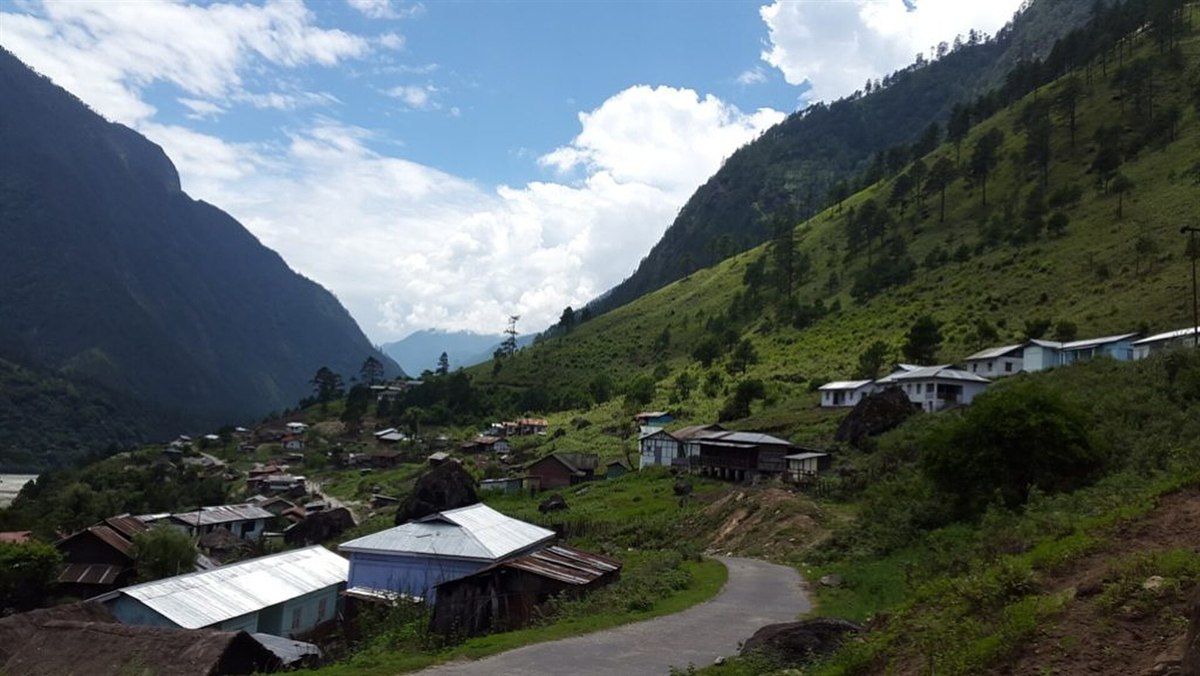
Analysis. VVP is real money, not yet a demonstrated transformation. The government’s reporting counts inputs: villages covered, roads built, funds released. This investigation found no published, independent, village-level audit of outcomes in jobs, health, schooling, connectivity, or population retention. That does not prove the programme failed. It means citizens cannot tell whether it works. On a border where the state’s legitimacy depends on delivery, that is not a footnote; it is an accountability gap.
China’s approach is different in scale and purpose. The CSIS ChinaPower project has documented more than 600 “xiaokang” border villages built between 2018 and 2022, many of them near the LAC. Some are dual-use: civilian settlements with military infrastructure, roads, and communications. CSIS has identified villages such as Zhuangnan, Majiduncun, Yarao, and Kuiqiongmen, some within 7 km of the line. The purpose is not only welfare. It is presence.
Alleged. A retired Indian Army commander, Lt Gen Abhay Krishna, writing in India Narrative on Oct. 24, 2026, cited figures relayed by researchers that 241,835 people were “involved” in the Tibetan Autonomous Region’s border-village programme, and reports of plans to move tens of thousands of border residents into 628 villages. He argued that the settlement pattern is meant to make the LAC look like an ordinary Chinese provincial frontier and, over decades, to shift the demographic balance opposite Arunachal Pradesh. The figures are the ones he cites. This article could not independently verify them, and the Indian government has not published a comparable count.
Analysis. The claim is easy to weaponise and hard to verify; that is exactly why it needs disciplined scrutiny. The documented villages show a method in which settlement is also administration and administration can reinforce a claim. A border is not only a line on a map; it is also the people who live beside it. The record described here points to different approaches: China has built hundreds of border villages, while India is trying to keep residents from leaving. They are not equivalent policies. The demographic question is slower than a patrol and harder to reverse, which makes evidence more important, not less.
India’s response has been to build roads, tunnels, and border infrastructure. The Sela tunnel keeps the Tawang approach open in winter. The Frontier Highway, sanctioned in Nov. 2024 at Rs 28,229 crore for 1,637 km across 12 districts, is meant to run within 20 km of the LAC and connect remote posts; its total estimated cost is near Rs 40,000 crore. In Oct. 2026, the state cabinet approved Rs 2,205 crore for 1,022 km of roads to 126 border villages under the VVP. The VVP is meant to keep people in the villages those roads serve. But the race is asymmetric. China can move people and capital into a village with a speed and scale that India cannot match. India’s advantage is democracy and local legitimacy, but only if the state actually delivers.
Documented. The contracts are moving, and the ledger is not clean. In Aug. 2026, the Ministry of Road Transport and Highways awarded a joint venture of Ceigall India and Sushee Infra Mining 4 packages on NH-913, the Frontier Highway, worth Rs 2,149.62 crore. The packages cover the Huri-Taliha and Sarli-Huri sections, with completion windows of 36 to 48 months and 5-year maintenance obligations. A week later, the ministry awarded the same venture the Lada-Sarli section for Rs 704.70 crore, with 48 months to build. In Nov. 2025, Chief Minister Pema Khandu said preliminary findings into land compensation on that same Lada-Sarli stretch pointed to “massive misuse” of funds, and that the irregularities had already set timelines back.
Analysis. Put the dates side by side. The Frontier Highway was sanctioned in November 2024. Its packages were awarded in August 2026, roughly 21 months later, with three to four years of construction still ahead. That is not an argument against building it; it is a measure of the delay between announcing a strategic answer and delivering one. A road scheduled to take years cannot answer a reported tent today. The only clock that matters to the people on the ground is the one their access, patrols, and supply routes are already running on.
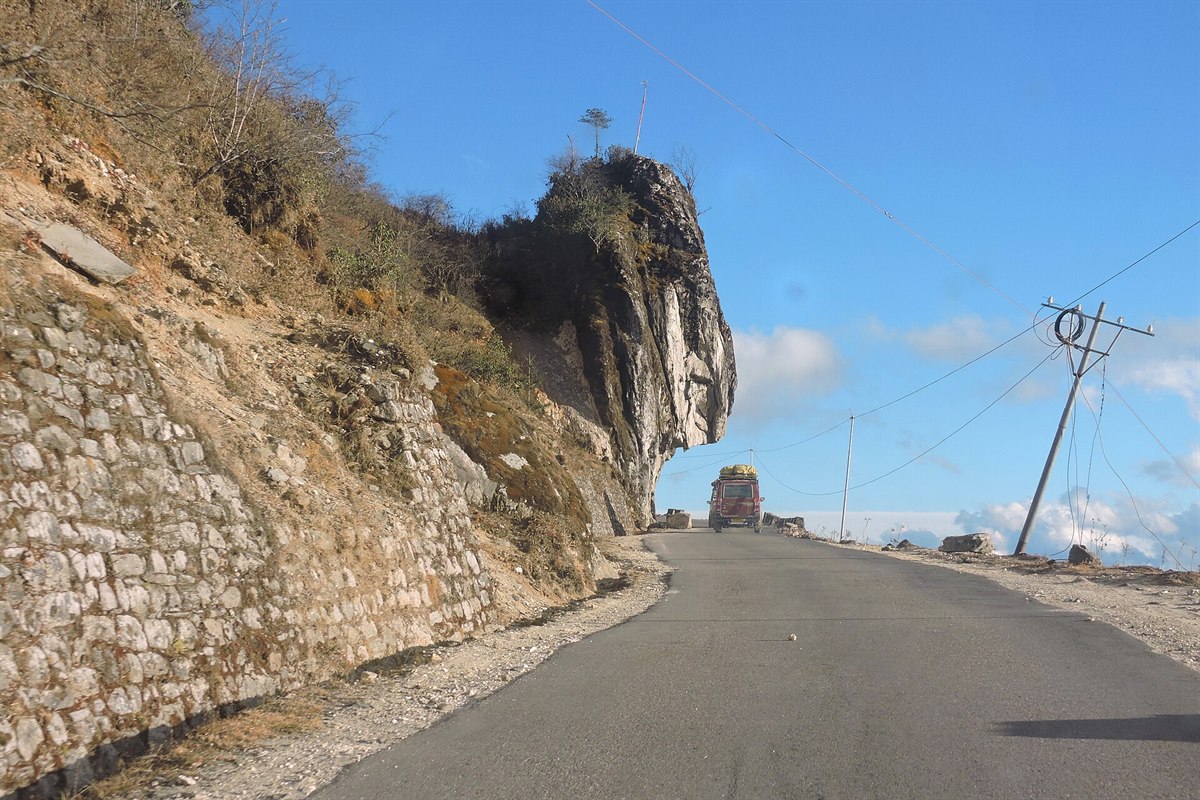
Documented. On Oct. 19, China announced export controls on tunnel-boring machines and related equipment, with licensing requirements taking effect on Nov. 18. Beijing cited national security and non-proliferation. China accounts for roughly 70 percent of the global TBM market. Indian imports of TBMs fell from $18 million in 2022-23 to about $800,000 in 2025-26. The Sela and Zojila tunnels were built mainly using the New Austrian Tunnelling Method and drill-and-blast, so they are not directly exposed. Other rail, metro, and hydropower projects may be.
Analysis. The timing of the TBM controls, three days before the ITBP chief’s statement and amid the Siang protests, is striking. It is not proof of a coordinated coercion campaign. The controls may reflect China’s export-control politics, its rivalry with the United States, or a desire to slow Indian infrastructure. What the record does establish is dependency: India is racing China on the border while relying on Chinese machines for tunnel construction. Whatever Beijing intended, that is a vulnerability Delhi should have planned around.
The republic that mislaid its own road
Documented. On July 2, 2026, Arunachal Pradesh Law Minister Kento Jini wrote to Union Road Transport and Highways Minister Nitin Gadkari. The letter, reported by The Hindu, asked the Centre to hand back the Akajan-Likabali-Bame road to the Border Roads Organisation, the same agency that had built and maintained it before the file was transferred to the National Highways and Infrastructure Development Corporation Limited in 2014-15. The corridor serves 7 districts, and a landslide at the Siji block point had stranded thousands. He did not polish the point:
“Considering the proven track record, expertise, efficiency, and strategic importance of the project, it is believed that BRO would be the better organisation to implement the project efficiently within the stipulated time frame.”
Arunachal Pradesh Law Minister Kento Jini, in his letter to the Union minister, as reported by The Hindu
Documented. The paradox is not that the state cannot build. The money for the frontier exists: Rs 28,229 crore for the 1,637 km Frontier Highway, and Rs 2,205 crore for 1,022 km of roads to 126 border villages under the Vibrant Villages Programme, both documented above. What does not exist is 1 owner for the road 7 districts already depend on.
Documented. The ownership question got more crowded. In June 2026, the Ministry of Defence declared the Akajan-Likabali-Bame road a strategic road, clearing the way for the Ministry of Road Transport and Highways to develop and maintain it, and NHIDCL was told to take over the remaining stretches from the Border Roads Organisation. On Aug. 18, the Lower Siang deputy commissioner convened officials and stakeholders in Likabali. NHIDCL’s deputy general manager for projects promised that maintenance and re-carpeting of the Likabali-Bame stretch would begin on Nov. 15, 2026. By Oct. 25, the Arunachal Times reported that the road was in “deplorable condition” and that a Likabali social activist, Nyakar Taipodia, said residents had been told the opposite of the June order: that the road would now go back to the BRO. The paper also reported a former Basar MLA’s claim that Rs 30 crore sanctioned for the Siji block point had not been properly spent. The corridor links Taksing, Mechukha, and Monigong, all near the Chinese border.
Analysis. This is the failure in miniature: not a shortage of money or engineers, but responsibility moving through files faster than the road changes surface. Four months after the Ministry of Defence called the road strategic, the latest public commitment is a start date for re-carpeting. The districts that depend on it are told to wait for November 15, then for the next monsoon, then for the next handover. A strategic label that cannot produce a dependable road is decoration on a delay.
Documented. The monsoon did not wait for a reply. In June, landslides and flash floods cut off 7 districts of Arunachal Pradesh and left 3 people dead, per ANI. By mid-July, the count had reached 7 dead and more than 97,000 affected, per India TV. In February 2026, the state’s Governor had already pressed the Centre on the same border-roads problem. In Aug. 2023, Hindustan Times had documented how the same border-village programme, Vibrant Villages Programme, had stalled in Himachal Pradesh for lack of funds. The Border Roads Organisation can build a tunnel through a mountain at 13,000 feet. It cannot get its own road back once the file has been assigned elsewhere.
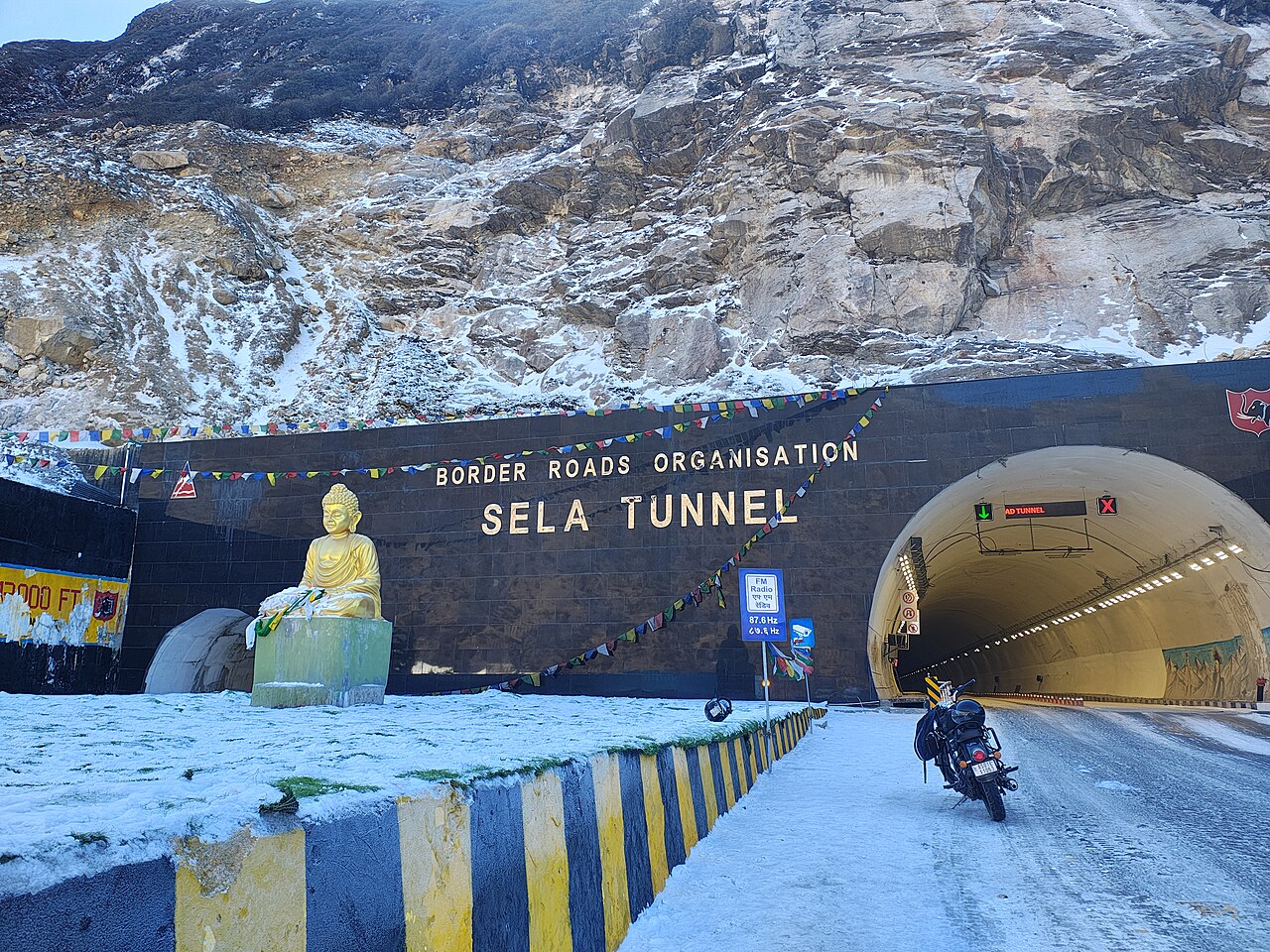
Analysis. The tunnel in the photograph is the same organisation’s work. The state praised the builder, transferred its road, and now receives a minister’s letter asking for the road back in the language officials use when the blunt version is harder to print. Between those letters, the monsoon cut off seven districts. The state can fund a highway toward the border and roads toward villages, yet the ownership of the road between them keeps changing. The file sets the schedule; the floodplain collects the cost.
Tawang and the succession
Documented. In July 2025, the 14th Dalai Lama vested exclusive authority over his succession in the Gaden Phodrang Trust. In Aug. 2026, the US-China Economic and Security Review Commission published a report arguing that the succession process was “already underway,” that Tawang in Arunachal Pradesh was a plausible birthplace for the 15th Dalai Lama, and that the United States and India should coordinate their approach. Tawang is the birthplace of the 6th Dalai Lama and the only Dalai Lama birthplace still freely accessible.
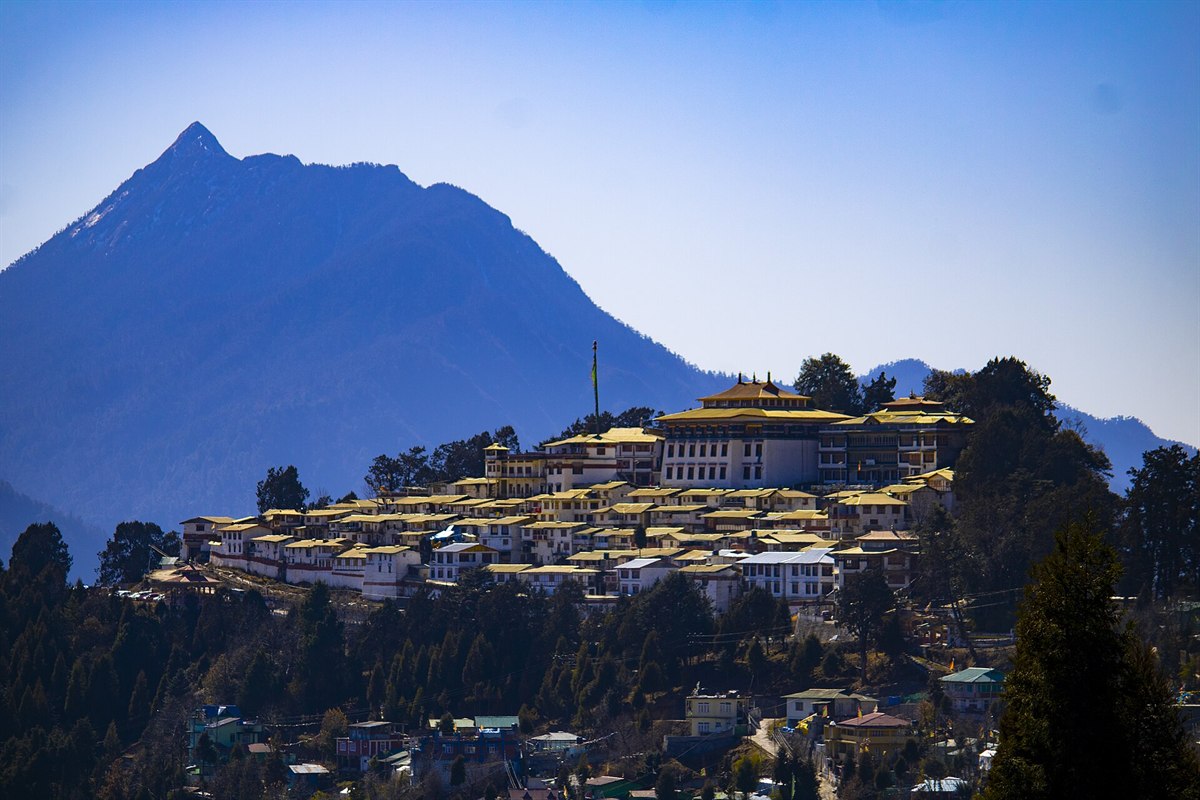
China’s reaction to the Dalai Lama’s connections to Arunachal has long been disproportionate: Beijing has previously denounced his visits to Tawang as intrusions into Chinese territory, an overreaction documented by Tibetan analysts.
Analysis. The USCC report is a recommendation to Congress, not US policy and not an American commitment to India’s claim over Arunachal Pradesh. Its stated logic is to internationalise the succession and complicate China’s control over Tibetan Buddhism. That may serve Tibetan and American interests; it also risks making India manage a succession fight on its own territory while Beijing insists it can approve the reincarnation. Tawang is a religious and political symbol, not a chess square. Any Indian government that tries to use it instrumentally risks harming the community it says it protects.
Documented. On Oct. 31 the symbol was used, and the ceremony had a crowd. At Gaden Namgyal Lhatse, the monastery better known as Tawang Monastery, Chief Minister Pema Khandu inaugurated a Sacred Exposition of the Holy Relics of Lord Shakyamuni Buddha: the Piprahwa relics, brought back to display in the state for the first time in 13 years, with the Union Tourism and Culture Minister Gajendra Singh Shekhawat attending. The relics will be shown in 3 districts, Tawang from Oct. 31 to Nov. 7, West Kameng from Nov. 8 to 14, and Namsai from Nov. 14 to 21. Khandu used the platform to announce an Arunachal Buddhist Confederation, a common platform for the state’s Mahayana communities in Tawang, West Kameng, Mechuka, Tuting, the Taksing area and Anjaw and its Theravada communities in Namsai and Changlang, seeking affiliation with the International Buddhist Confederation. Its first president is Venerable Agadhamma, chief monk of the Namsai Pariyatti Sasana Buddhist Vihara; its secretary general is Thupten Kalden, director of the state’s Department of Karmik and Adhyatmik Affairs. The 14th Dalai Lama sent greetings and blessings; his message was read out by Venerable Shartse Khensur Jangchup Choeden Rinpoche, secretary general of the International Buddhist Confederation. The Prime Minister’s message, read out by Khandu, named the return of the Piprahwa relics among India’s heritage work. The exposition was approved by the Centre, and the Union Tourism Ministry is framing a policy for Buddhist sites in the Northeast, Khandu said. He put it beside the International Tourism Mart, which had just run for 3 days in the same town, as evidence of the Centre’s support for the state’s culture and tourism. It was on the sidelines of that Mart, on its opening day, that he gave the border his “no matter of tension” verdict. An international conference on Buddhism runs alongside the exposition, according to the Prime Minister’s message, which names Tawang, Bomdila and Namsai.
Analysis. Hold the 2 scenes in one frame. On the ridge at Tawang, India’s Culture Minister and the officials of the International Buddhist Confederation were staging the return of the Buddha’s relics to the only Dalai Lama birthplace still freely accessible, and the state was founding a confederation to pull its Mahayana and Theravada communities onto one platform with an international body. In the same town, 2 days earlier, the Chief Minister had told reporters on the sidelines of the tourism fair that Chinese patrols crossing and recrossing an undefined line was “not a new thing.” Beijing insists that it must approve the reincarnation, and that Tawang is Chinese territory. India’s answer, on the record this weekend, was a relics schedule, a new confederation, and a message from the man whose successor Beijing claims the right to choose. That is a real claim of its own, and a cheaper one than a border settlement. Whether it is worth the risk of managing a succession fight on Indian soil is the question the USCC report asks and Itanagar did not answer.
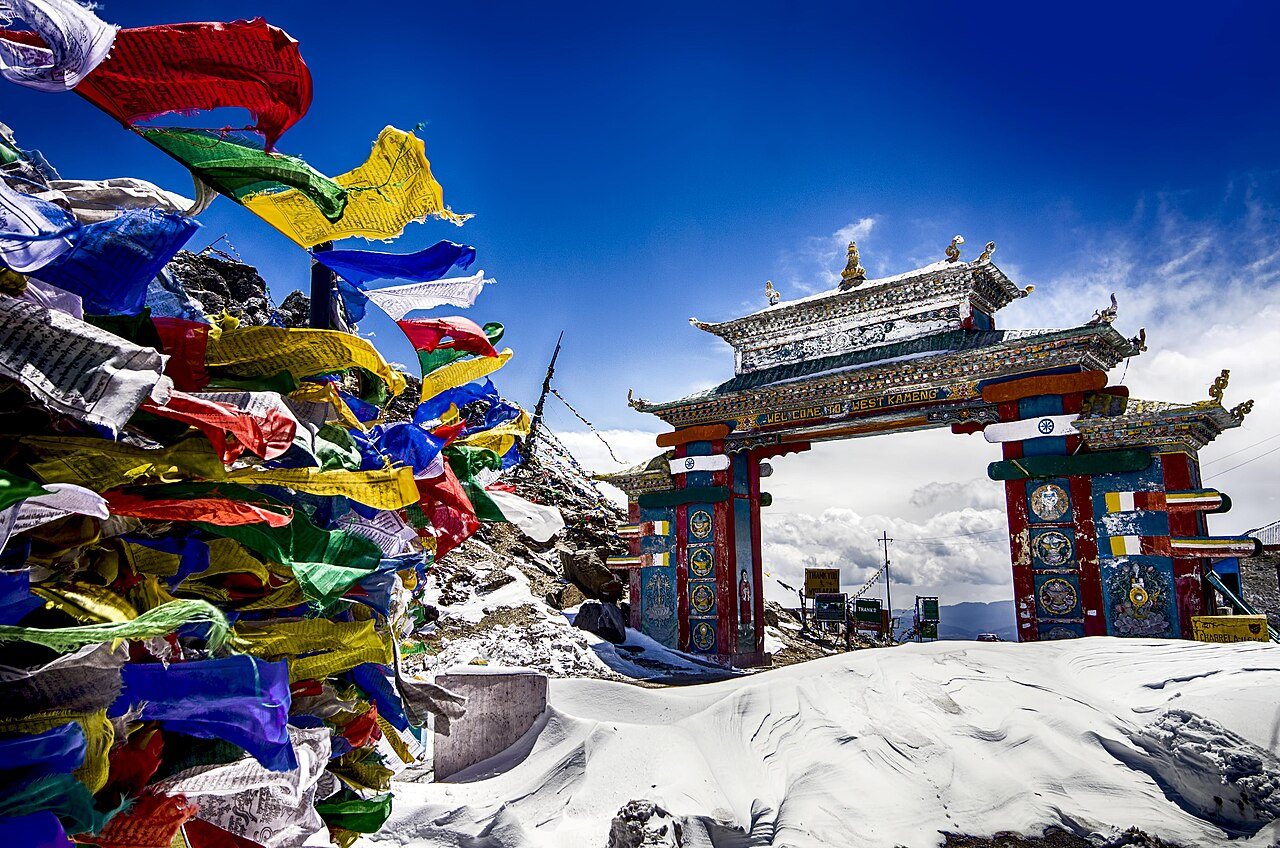
Tawang. The town is the only Dalai Lama birthplace still freely accessible.
The information war
Documented. The crisis has been accompanied by a flood of viral content. PIB Fact Check has debunked videos falsely linked to Arunachal, including footage from Manipur. Other fact-checkers have identified old footage from the Yangtse sector near Tawang, dating to around 2021, recirculated as new. Some images have been AI-generated or recycled. The result is that real incidents and fabricated ones circulate in the same channels, with the same urgency and the same certainty.
Documented. On Oct. 28, the Army debunked a video circulating as leaked remarks by Lt Gen Girish Kalia, in which he was made to say that China had taken control of Asaphila, Longju, and Taksing. The Army said the footage came from a press briefing in Kupwara, and that he made no such statement. It borrowed the authority of a serving general and 3 place names at the centre of the dispute.
Documented. The same trick was tried on the Defence Minister. A clip circulating this week appeared to show Rajnath Singh downplaying the reported border tensions, questioning concerns raised by Indian Army personnel, accusing some soldiers of rebelling against the government, and suggesting that India-China trade and Chinese investment mattered more than the frontier. Newschecker reported on Oct. 31 that no credible record of any such statement exists in the Ministry of Defence’s website or its official handles, and that a reverse image search traced the visuals to an ANI post of Oct. 26, in which the Defence Minister was answering Congress president Mallikarjun Kharge’s remarks about the Prime Minister’s late father in Patna. The agencies PTI and IANS reported that exchange on Oct. 26. Hive Moderation returned a high probability of AI-generated or deepfake content, Meta’s AI-detection signal indicated the video was created or edited with AI, and the Hiya and Undetectable AI voice detectors both flagged the audio as likely synthetic. PIB Fact Check published its own debunking of the clip on Oct. 31, calling it AI-manipulated. The fabrication put in the Defence Minister’s mouth a line the government did not need a deepfake to say. Two days earlier, from Tawang, the state’s Chief Minister had said in his own voice that there was “no matter of tension.”
Documented. On Nov. 2 the instrument changed. Mobile internet services were suspended in Upper Siang while a 36-hour bandh ran across 3 districts, reported by Northeast Live and India Today NE. No deepfake was involved, and no fact-check followed. A district lost its mobile network because a protest was scheduled in it. That is the first suspension in this record attached to the Siang dispute rather than to the frontier, and it sits alongside the Oct. 4 to Oct. 5 request from the state’s 2 press bodies for the legal basis of the restrictions on SUMP-related content, a request the government has still not answered.
Analysis. This is not a China-only problem. Indian political actors also amplify unverified claims. But official silence has a cost: when the government publishes no coordinates, imagery, or incident logs, it leaves an information vacuum that falsehoods rush to fill. Local journalists who know the ground are among the best antidotes; they are also facing restrictions on SUMP coverage. A state cannot complain about misinformation while making verified information harder to report. That is a wound it is inflicting on its own credibility. The suspension moves the goalposts: the vacuum is no longer only a failure to publish, it is an active withdrawal of the channel, and a state that switches off a district’s network during a protest is running the information war itself rather than losing it.
How China takes land without firing a shot
Documented. The Ministry of External Affairs said it plainly on Oct. 23: the situation is disturbed when Chinese forces “deviate from established patrolling patterns.” That is an official description of the method, dressed in bureaucratic language. A patrol goes further than it did last year. Tents appear where tents were not. The tents stay through a season. A road reaches them. A helipad is graded beside the road. A name is issued. Beijing has issued at least 112 names since 2017. CSIS has documented more than 600 construction-villages near the line, some dual-use, some within 7 km of it; Janes, working with Vantor imagery, has documented helipads, new roads, and expanded facilities at Zhari town in Lhunze County. Longju, overrun in 1959, has been on the Chinese side ever since.
Documented. Asked about specifics, the MEA spokesperson said, “I would refer you to the Ministry of Defence.” The ministry said both sides were using existing diplomatic and military mechanisms, and that “maintenance of peace and tranquillity in the border areas is essential for the overall development of bilateral relations.”
Analysis. This is salami slicing: no single step is large enough, by itself, to make war a plausible response. A patrol goes farther; a tent appears; a village is built a few kilometres from the line. Each move is small enough to deny and defend in isolation. The other side must choose between fighting over a few hundred metres and absorbing the change. If it absorbs the change, a tent can become a post, a post can acquire infrastructure, and the new position can become the baseline for the next dispute. Trucks, excavators, helipads, settlement machinery, and naming campaigns do the cumulative work. The pattern is analytically consistent with incremental pressure; the specific allegations at Taksing and Asaphila remain unverified.
Analysis. Seasonality compounds the risk. PPA fact-finding teams reported that Shera 5 has effectively been abandoned since 2023 and Indian patrols did not reach the Taksing approaches between April and October, the monsoon window in which the alleged camps were reported. If access is absent for half the year, the state is not continuously establishing what happens on the ground; it is returning after a gap and arguing over the record. The diplomatic thaw has not publicly resolved that gap. Delhi continues to talk, the Army continues to call encroachment reports baseless, and trade continues. What the public cannot see is whether any of those choices changed conditions at the frontier.
Documented. The thaw has a measurable half. The Defence Ministry’s annual report for 2025-26, released on Sept. 13, 2026, records “a significant reduction” in the deployment of Chinese People’s Liberation Army forces opposite India’s northern borders during 2025. It also counts at least 10 combined-arms brigades along the LAC and in traditional training areas. Hindustan Times, which reviewed the 323-page report, estimated 40,000 to 50,000 Chinese troops on the frontier and an equal number in training areas; before the Oct. 2024 understanding that disengaged troops from all friction points, the estimate was more than 60,000 in Ladakh alone. The report covers the year to March 31, 2026, and predates the Taksing reports. The drawdown is real. So is the brigade floor.
Analysis. Hold both ledgers open. A partial drawdown is not a settlement; it is fewer soldiers in one sector while the line remains undrawn and construction continues. That is why a force chief can confirm face-offs in Arunachal in the same year the ministry reports a significant reduction in Ladakh. The facts are not contradictory. They describe different sectors and different records. It is reasonable to ask whether de-escalation where agreements exist is coexisting with incremental pressure where they do not; the public evidence here does not establish a single coordinated plan.
Opinion. China is not taking Arunachal Pradesh through a conventional conquest. The risk described in this article is slower: infrastructure, patrol patterns, settlements, and silence accumulating into facts on the ground. The government’s reflexive denial of “encroachment” does not answer that risk. When the state refuses to publish the evidence that could confirm or rebut local reports, its silence becomes part of the conditions in which incremental pressure can take hold.
The equipment gap, the Shaurya Commandos, and the war of trucks
Documented. On Oct. 23, 2026, the ITBP dispatched its specialised Shaurya Commandos to reinforce the Arunachal frontier as the face-offs continued. On the other side of the line, the building has already happened: helipads and all-weather roads at Zhari town in Lhunze County per Janes/Vantor imagery; more than 600 dual-use border villages per CSIS; and, since Oct. 19, Beijing’s export controls, required licences from Nov. 18, on exactly the tunnel-boring machines that reduced Indian imports of them from $18 million in 2022-23 to about $800,000 in 2025-26.
Analysis. Much of this frontier’s competition is not about who fires first. Under the 1996 Agreement, face-off troops largely do not shoot. The competition that matters is also about earthmoving: who gets a grader onto a ridge, keeps a road open through winter, and holds a construction season. China has industrialised that capacity. Export-control paperwork now tightens access to machinery India relies on. Shaurya Commandos and vigilance matter, but they respond to a condition that infrastructure can create before a soldier arrives: the other side has already built.
Documented. At the Alwar event where he confirmed the face-offs, the Director General also read out a maintenance report in public. ITBP personnel over 50, he said, know the weapons they use are the same ones issued when they joined. He described underground shelters as a pilot project that “all companies have started building” at border posts, and said anyone standing in the open can now be targeted. He said 70 percent of his Rs 400 crore modernisation fund had gone to drones, with Rs 1,000 crore earmarked for drones inside a further Rs 3,500 to Rs 4,000 crore scheme. A Shaurya Commando team now sits in every battalion, 2 more have been constituted toward a full company each, and a full Shaurya battalion is being raised. He said drones are a way for even a small country to challenge a big one, citing what Ukraine extracted from Russia. He called China India’s “biggest adversary” and said traditional means of warfare were obsolete against a modernised force. Then he asked for one thing in his own voice: do not pull the force off its mandate.
Analysis. Hear what the ITBP chief said in context: his force’s personnel carry ageing rifles, shelters are improvised, and there is one drone platoon per battalion. Then he publicly asks the ministry that owns the force not to pull it away from its mandate. That is not a routine strategic communique; it is a public request for capacity, and an unusually direct one. The ministry’s public record offers no corresponding numbers or response. When the force responsible for the frontier has to plead in public to remain there, the silence from its overseers becomes part of the story.
Documented. The men who carry that buildout have their own arithmetic. The Alliance of All Ex-Paramilitary Forces Welfare Association said on Oct. 23 that the ITBP needs 20 new battalions a year and a border outpost every 10 km. Its general secretary, Ranbir Singh, put the force’s gap in plain numbers: a sanctioned strength of 1,03,622 personnel against a 2026-27 budget of Rs 11,324.08 crore, with about 1 lakh posts unfilled across the CAPFs. The association wants Rs 50,000 crore a year for the ITBP alone. It also named the diversion this article has documented: thousands of border personnel pulled into election and protest duty in the Delhi region over the previous 2 months, some still there. It asked for drones, modern weapons, and clothing rated for minus 30 to minus 40 degrees Celsius.
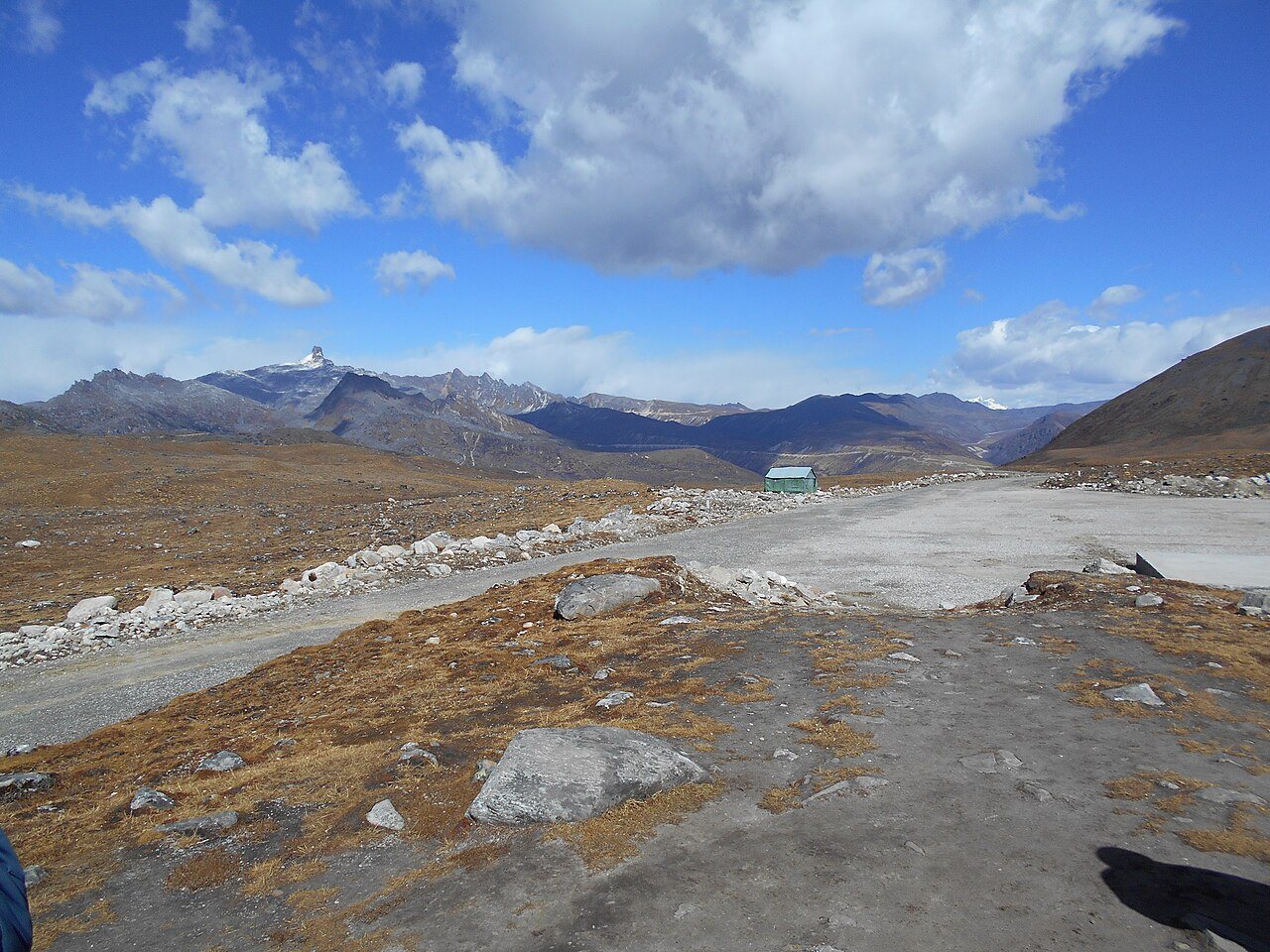
Bumla Pass in the Tawang sector. Altitude and winter set the terms of the deployment.
Analysis. Put the two ledgers side by side. The ITBP is asked to guard 3,488 km of frontier in extreme conditions; veterans say about 1 lakh posts are missing across sister forces and that the budget is less than a quarter of what the job requires. In the same week, the Home Ministry extended 39 ITBP companies in Delhi. Those numbers do not prove that moving those companies would have resolved the face-offs. They do show a force stretched across competing assignments, and a ministry that publishes the arithmetic without explaining how it expects the border mandate to be met. A border cannot be guarded by a force whose availability is treated as an afterthought.
How China treats India, and how India treats China, and its own citizens
Documented. Beijing’s posture toward India took 3 simultaneous forms in 2026. First, refusal: on Apr. 14, Beijing reiterated that it does not recognise “Arunachal Pradesh” at all, days after issuing its 6th batch of 23 replacement names while calling the state “Zangnan.” Second, pressure: on-the-ground construction continues across the frontier zone, a mega-dam is under way upstream, place-names are being redrawn 30 years in advance of anything India agrees to, and export controls were calibrated, by timing if not by intent, to a border crisis. Third, engagement: trade continues, flights and pilgrimage resumed, and the thaw is maintained. Analyst Brahma Chellaney summarised the combination: China is using border pressure and export curbs to constrain India’s rise.
Documented. The trade ledger kept its own border. China’s Foreign Minister Wang Yi said in Sept. 2026 that the 2 countries’ leaders had agreed India and China “should be partners, not rivals.” He spoke in the month Chinese tents were reported in pockets his ministry declines to name. The Financial Express reported in Oct. 2026 that India’s trade deficit with China had widened to $105.93 billion for Jan. to Sept., up 20.7 percent, even as exports to China jumped 40.7 percent to $19.26 billion. Bilateral trade rose 25.4 percent to $144.45 billion; Chinese exports to India reached $125.19 billion. BusinessLine had already marked the crossing above $100 billion. Congress’s Kharge joined the accounting: imports up 102 percent since FY 2020-21, a deficit that climbed 155 percent to $112.16 billion, 23 leaders’ meetings, 25 rounds of Special Representatives talks, and 36 meetings of the border consultation mechanism. Union minister Kiren Rijiju said in Sept. 2026 that the World Bank, under Chinese pressure, does not fund projects in Arunachal Pradesh.
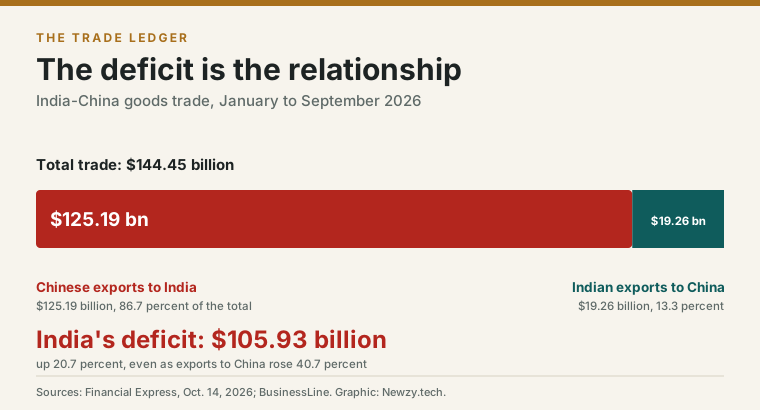
The trade ledger, January to September 2026. Newzy.tech graphic.
“Only Arunachal has a problem because the World Bank doesn’t fund projects due to Chinese pressure. Otherwise, all the states have received a lot of investment, and I am also trying to attract investment to Arunachal.”
Union minister Kiren Rijiju, as reported by NewsDrum
Analysis. The international ledger is brutally clear about its limits. Governments printed maps, statements, and a counter-map; trade partners printed trade numbers and kept trading. A resolution in New York does not change a ridge in Upper Subansiri, and no one should pretend it does. Beijing builds on the ridge; Delhi builds committees. The file labelled international support is not a deployment plan, and its blank spaces will not patrol the border for India.
Documented. India’s record has 2 halves. Toward China: a state visit by Xi Jinping at the BRICS summit on Sept. 12 to Sept. 13, an 8-point consensus that names no disengagement, an Army that calls encroachment reports “incorrect and without any basis,” and trade that never paused. Toward its own citizens in the affected state: paramilitaries moved into 27 villages to survey a dam, ten arrests including 4 under a preventive law before the crisis week, social-media restrictions condemned by the state’s own press bodies, and an elderly civil-society letter from June, asking both governments to intervene, still publicly unanswered by anyone.
Analysis. China’s record combines rivalry with trade; India’s combines courtship with unresolved border pressure. That asymmetry is on the record. But the harder indictment is domestic: India’s concessions in this period were also concessions against its own transparency obligations. Press restrictions, preventive arrests, and unanswered letters are not actions Beijing took. They are choices made by Indian institutions in New Delhi and Itanagar. A foreign adversary may explain the pressure. It cannot take responsibility for the response away from the state.
8 ways the line reaches the people
Diplomacy negotiates the line. The line also works at its own level: pastures, passport counters, school timetables, and village roads. The costs it loads on Arunachal Pradesh are specific, and they are on the record.
1. The pastures the line moved
Documented. The Taksing story in this article is a livelihood story. The Nah Welfare Society and the PPA fact finders describe villages whose grazing grounds and patrol trails sit exactly where Chinese postures and Indian silence intersect, where access lapsed through the monsoon, and where no agency answers. Elsewhere on the LAC, the federal record says the same thing in its own voice: in July 2026, villagers along Pangong in Ladakh told a parliamentary panel that they had not reached their traditional grazing grounds since the 2020 border clash, and had been asking for controlled access ever since. The Observer Research Foundation has documented the identical squeeze on the Changpa herders of Ladakh. The method moves the herd trail first and the treaty later.
2. Detentions nobody plans for
Documented. In Sept. 2020, 5 Tagin youths from Upper Subansiri district, porters and guides working with the Indian Army, went missing while out near the line; the PLA confirmed within days that they were on its side, and returned them weeks later in Anjaw district, more than 1,000 kilometres from where they were taken. Families in the border belts wait in panic every hunting season, because an undrawn border means that a child’s route to the forest can cross a state that refuses to mark its edges. No mechanism has been built on the Indian side to prevent the next one.
3. Stapled visas for real passports
Documented. China does not treat Arunachal Pradesh residents as the Indian passports they carry would suggest. In July 2023, it issued stapled paper visas, not stamped ones, to 3 wushu athletes from the state for the World University Games in Chengdu; India withdrew its entire contingent rather than accept the insult to their nationality. In Sept. of the same year, 3 Arunachal athletes were denied clearance for the Hangzhou Asian Games outright, and the Ministry of External Affairs called the practice discriminatory. The pattern runs back through at least 2 more denied events in 2011. A student, an athlete, or an official from this state meets the same wall Beijing draws: their India is, on Chinese paper, China.
4. The water threat and the dam nobody voted on
Documented. Medog upstream and the SUMP downstream, the 2 halves of the water story documented above, are not abstractions for the Adi and Galo villages of the Siang valley. The first can reorder their river’s seasons from a control room they will never see. The second puts survey teams, paramilitary posts, and arrest registers into their villages. The same people carry both projects. That is not a coincidence of geography; it is the mechanism by which a border dispute becomes a farm dispute.
5. Money stopped abroad
Documented. The costs reach into development finance. In 2009, China blocked India’s country plan at the Asian Development Bank because it contained a $60 million flood management project for Arunachal Pradesh; the Indian government confirmed the blockage on the record, and China publicly rebuked the bank for funding the state at all. The exclusion is current: in Sept. 2026, as Xi Jinping landed for the BRICS summit, Union minister Kiren Rijiju said the World Bank, under Chinese pressure, does not fund projects in Arunachal Pradesh. The precedent outlives the incident: international lenders calibrate around the dispute, and projects for roads, flood control, and water sanitation wait while the embassies argue. Beijing does not need to shell a village to hold it back. A protest note at a lender’s board does the same work.
6. Soldiers in the schoolyard
Documented. The militarisation documented above is not only about barracks. In May 2025, central armed police were deployed into Siang villages to enable dam surveys, and the Adi Students’ Union recorded the details that matter: forces positioned in schools and colleges, village movement circumscribed, daily routine organised around the survey calendar. By Oct. 2026, the protest cycle those deployments provoked had ended in FIRs, tear gas, at least 15 arrests or detentions, and 4 preventive arrests before the bandh began. The security posture is a government’s prerogative. Where it parks itself is a choice, and the people on whom it parks itself have names for that choice.
7. Names, and the heritage inside them
Documented. The renaming war documented above is a culture story as much as a cartographic one: the at least 112 Chinese-issued names since 2017 overwrite Monpa, Adi, Nyishi, and Mishmi names that have carried local meaning for centuries, and Beijing’s pressure on Tawang’s religious autonomy works the same seam. A place list is also a meaning list, and the first draft of that meaning has been lived in by people whose version appears on no government list.
8. The emptied villages
Documented. Fear, rough geography, and thin infrastructure have pushed forward villages toward emptying for decades. India’s answer, the Vibrant Villages Programme, now commits Rs 11,639 crore across 2 phases against China’s more than 600 dual-use border villages, and the audit gap in this article stands: input reporting without independent outcome verification. The race stays asymmetric, and the people stay on its sharp end, asked to be the border and to hope the services follow.
Opinion. Read the eight headings as one indictment: pressure reaches Arunachal Pradesh through pasture, passports, rivers, lenders, schoolyards, names, and village roads; Delhi’s public answer is too often a briefing or a video call. Nah, Tagin, Adi, and Monpa communities live where two bureaucracies meet and neither has yet made itself answerable to them. No round of Special Representatives talks can retire that grievance while the ground remains undocumented.
The Pulwama ledger: what the border was worth at the ballot box
Documented (historical). In 2019, a suicide bombing at Pulwama killed 40 CRPF personnel. Balakot followed within weeks, and the government ran the subsequent national election substantially on that record, rallies built around armed deterrence, military assertiveness, and the promise of a border protected at a price adversaries would pay. In June 2020, 20 soldiers died at Galwan. At the all-party meeting, the Prime Minister stated that no one had crossed the border nor captured any post, a formulation that opposition leaders chose to contest at the time.
Documented. In Oct. 2026, facing face-offs at “several locations” confirmed on the record by the ITBP chief, the Leader of the Opposition in Parliament publicly asked whether another Galwan was unfolding, and the government’s answers have been: no coordinates, no incident log, and a denial of “encroachment” that several sources say sits poorly beside its own border force’s admission.
Opinion. A leader who made border security part of his electoral case now governs through confirmed face-offs, missing coordinates, and official statements that refuse to say plainly what changed. Critics call the Prime Minister a puppet, too weak or too invested in friendship with Beijing to confront it. That label is not established by this record. The record supports a more precise charge: the government used the language of security to seek public trust, then withheld the facts that trust requires when a frontier crisis arrived. No one is asking for war over a tent. A nuclear neighbour and a million people on the line demand prudence. But prudence does not require silence about locations, incidents, or evidence. A government that is loud about security at election time and spare with verifiable information in a crisis is not entitled to call the gap strategy. Arunachal’s residents were told the deterrent was in safe hands; they are now being asked to accept face-offs described as a change in Chinese patrol habits.
The videos the state will not look at
Documented. Since late July, residents and local visitors in Upper Subansiri district have posted videos and photographs of what they say are Chinese tents and patrols, the earliest of them at Asaphila; their technical provenance has not been established by any neutral voice, including ours. Local organisations going to the ground on Aug. 11 to Aug. 13, the PPA and students’ unions, published what they found, including the abandonment of Shera 5. Meanwhile central and state fact-checking energy went, in part, to debunking recycled footage from other decades and other states, which is necessary work. On Oct. 25, the Army said a video circulating on Pakistan-based accounts, which claimed Chinese soldiers were searching Indian personnel inside Arunachal Pradesh, was actually footage of a counter-terrorism drill in Bengaluru in May 2026. What was not done is the other half: no agency of the Government of India or of the Arunachal Pradesh government has published an assessment of the specific Taksing and Asaphila videos, saying which are real and which are fake, or explained why the Army’s “incorrect and without any basis” can coexist with the ITBP chief’s confirmation of face-offs. That gap runs alongside the documented restrictions on reporting the Siang dam.
Analysis. The government has a decisive evidentiary advantage: satellite imagery, UAV streams, and patrol logs unavailable to ordinary citizens. If the circulating videos are false, a careful public assessment could say so. If they are authentic, the state could explain what they show, with security-sensitive details redacted. Neither outcome requires publishing operational secrets. What the public record instead contains is a vacuum around the specific Taksing and Asaphila footage. The people who filmed it remain under suspicion; the institution best placed to resolve the question has not published its answer.
Analysis. The Oct. 28 rebuttal sharpens that asymmetry instead of settling it. A fabricated general’s quote drew a same-week correction, with the original footage identified and named. Footage filmed by residents of Taksing and Asaphila has drawn no published assessment in 3 months. Speed is a choice, and so is which fabrications get answered. The choice repeated itself 3 days later: on Oct. 31, the Army’s correction was followed by PIB Fact Check debunking a manipulated clip of the Defence Minister, with the original ANI footage dated and named. Two fakes, two fast rebuttals, both about videos manufactured from other people’s speeches. The videos shot by residents of the 2 circles at the centre of the dispute are not manufactured from anything, and they are still waiting for an official to look at them.
The agencies that answer to no one in public
Documented. On June 26, 2026, the Nah Welfare Society wrote to the Government of Arunachal Pradesh and the Government of India seeking intervention on the alleged camps. As of the reporting cutoff, no agency, the state government, the Home Ministry, the Indian Army, or the intelligence apparatus, has acknowledged the letter in public, in a readout, or in any document released on the encroachment question. The only published “investigations” of the camps remain those conducted by civil organisations: the society’s letter, the fact-finding visits, the students’ unions’ accounts. For context on how fast the same machinery can act when it decides a matter is its business: the Dec. 2023 murder of a former MLA in Changlang district of Arunachal Pradesh was transferred to the National Investigation Agency within days of the government approving the move.
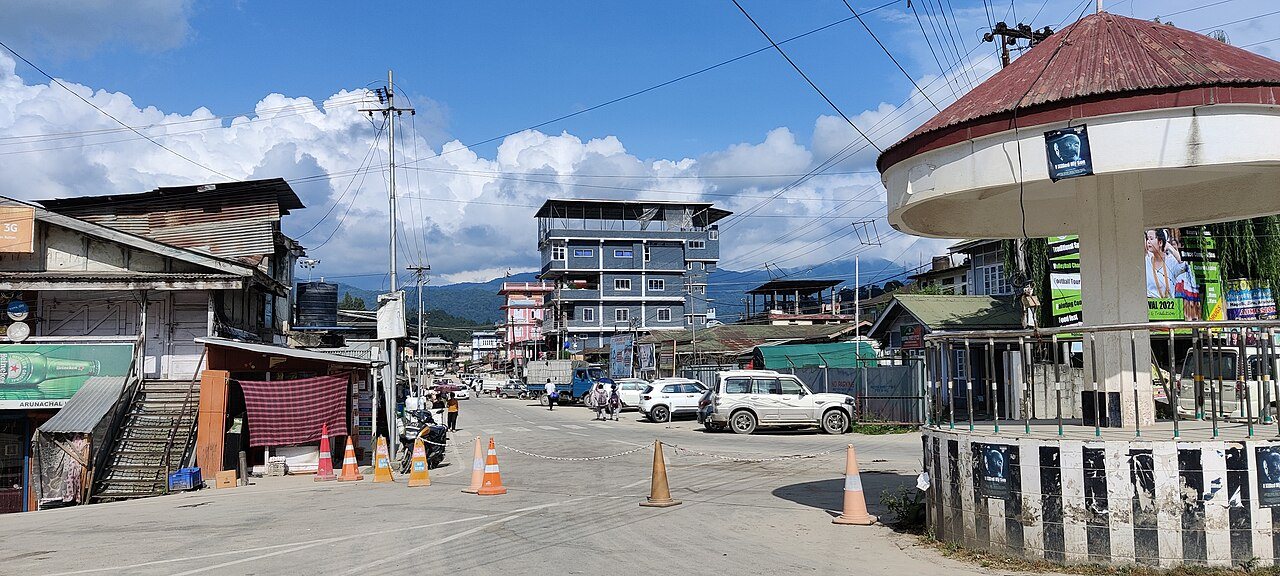
Itanagar, the state capital. The letter on the Taksing camps went to this government and to Delhi.
One caution, because accuracy matters more here than the point’s popularity: under the mandate it operates, the National Investigation Agency handles terrorism and related offences; a boundary encroachment is not its file, it belongs to the Army, the ITBP, the Home Ministry, and the intelligence services. That is precisely why the absence is itself the finding. There is no NIA to blame for not confirming the tents. There is only the state, entire, declining to confirm them.
Documented. The strongest contrast on the record now polices the other side of the mirror. On Aug. 20, police filed an FIR that became a CBI case in September. According to The Hindu, the FIR alleges that Rs 20.94 lakh (about Rs 2.1 million) was credited to the State Bank of India account of Bhanu Tatak, a lawyer and anti-dam activist, through foreign exchange transactions from 2022 to 2025, from donors the agency names as the Philippines-based Asia Indigenous People’s Network on Extractive Industries and Energy, Ireland-based Front Line, and the UK-based Human Rights Resource Centre. Scroll, which also saw the FIR, adds a 4th donor, the Philippines-based Indigenous Peoples Rights International, and reports the agency’s allegation that she has never filed income tax returns. The FIR says the funds were received “without obtaining mandatory certification of registration” under the foreign contribution law, and that they were used to “organise and sustain anti-dam protests” against the Siang project and the 2,880 MW Dibang project. Scroll’s reading puts the sum at “more than Rs 17.6 lakh,” a floor consistent with The Hindu’s Rs 20.94 lakh. The state had already stopped her from boarding a flight to Ireland at the Delhi airport in Sept. 2025, after issuing a Look Out Circular against her. She denies violating the law and says she is cooperating with the investigation. Days after the agency moved, Chief Minister Pema Khandu insisted there is “nothing forceful” about the 11,200 MW project she opposes, though many people across the 4 named districts, East Siang, Siang, Upper Siang, and West Siang, resist it.
Compare the speeds: an ex-MLA’s murder reaches the National Investigation Agency within days; a letter that alleges armed camps on Indian territory collects dust for 4 months; a lawyer who uses the courts for arrested villagers gets a CBI file in under a month. The machinery is not slow. It is aimed.
Analysis. Four months, and no public owner of the question. The state opened a case against a lawyer faster than it answered a village letter alleging camps on the frontier. Those are different matters, and the case against Bhanu Tatak is an allegation under investigation, not proof of wrongdoing or political targeting. But the contrast in public responsiveness is real: a lawyer faces a detailed file; a community asking what is happening near its land has no published answer. Every institution may have a role. None has publicly accepted the obligation to tell the people whose boundary this is.
What We Know, What We Suspect, and What We Still Cannot Prove
What we know
- On Oct. 22, 2026, the ITBP Director General confirmed ongoing face-offs at “several locations” in Arunachal Pradesh. He did not name China in the quoted remarks, give locations, or confirm casualties.
- On Oct. 23, the MEA spokesperson said the situation is disturbed when Chinese forces “deviate from established patrolling patterns.”
- The Indian Army has denied reports of Chinese “encroachment” as “incorrect and without any basis.”
- On Oct. 23, the Home Ministry extended the deployment of 273 CAPF companies in Delhi until Oct. 31, including 39 ITBP companies. On Oct. 30 it extended 270 companies to Nov. 16.
- From Oct. 8 to Oct. 12, 221 CAPF companies, including 25 ITBP companies, were cleared for Delhi and retained for 30 days while the CJP mobilisation was underway.
- The Akajan-Likabali-Bame road was transferred from the Border Roads Organisation to the NHIDCL in 2014-15; the Ministry of Defence declared it strategic in June 2026, and NHIDCL promised re-carpeting from Nov. 15.
- India’s trade deficit with China was $105.93 billion for Jan. to Sept. 2026.
- A Corps Commander-level meeting was held at Wacha-Damai on Sept. 6, 2026 and did not end the face-offs.
- The Aug. 25 SR talks produced an 8-point consensus on process, not a public disengagement plan.
- Local organisations have alleged PLA camps at 5 locations in Taksing circle since at least June 2026. The allegations have not been independently verified.
- Satellite imagery shows Chinese infrastructure expansion in Lhunze County, Tibet, including helipads and new roads, but does not resolve the Asaphila tents.
- The Siang Upper Multipurpose Project is at the pre-feasibility stage and has not been approved for construction.
- The Oct. 23 violence in Pasighat led to 3 FIRs, at least 15 arrests or detentions, and damage to government and party property.
- By Oct. 26, East Siang Police counted 26 arrests, 5 of them juveniles, 6 people detained for questioning, and 8 cases registered over the Pasighat violence. Frontline put the arrest count at 35 to 40 on Oct. 27. Inspector General Hibu Tamang told Scroll the statewide count was 69 arrests and 4 detentions under the Arunachal anti-terror law.
- On Oct. 26, Arunachal Pradesh Congress president Bosiram Siram alleged PLA troops had advanced 40 to 50 km into Upper Subansiri and held the high ground. Chief Minister Pema Khandu denied it. No coordinates, imagery, or incident record has been published either way.
- On Oct. 27, the Home Ministry gave Sanjay Singhal, chief of the Sashastra Seema Bal, additional charge of the ITBP from Oct. 31, when DG Shatrujeet Kapur retires. The order took effect on Oct. 31.
- On Oct. 29, at the sidelines of the 14th International Tourism Mart, Chief Minister Pema Khandu called the face-offs “transgression, not intrusion,” said the border situation was normal, and said there was “no matter of tension” because the line “is not defined.” On Oct. 30 the Congress accused the BJP of treating transgressions as normal.
- On Oct. 30, former civil servant Ashish Joshi asked the Delhi High Court to scrutinise the “large-scale deployment and repeated extensions” of CAPF companies in the capital.
- On Oct. 30, Arunachal24 reported a police application dated Oct. 27 before the Chief Judicial Magistrate, East Siang, seeking Section 96
BNSSsearch warrants against the journalist Tongam Rina, the advocate Sunny Tayeng and the activists Otul Jerang and Tajong Talom, including their phones and devices. The state press bodies condemned it. No confirmation of an order or a search was available, and the state has not said whether either happened. - On Oct. 31, several hundred demonstrators gheraoed Arunachal Bhawan in New Delhi against the SUMP; Delhi Police detained several of them, among them the environmental engineer and activist Katon Moyong.
- On Oct. 31, Khandu answered the case against the dam with storage arithmetic: Medog at about 5.5 BCM against the Siang’s 9.2 BCM, “more MW does not mean more stored water,” public hearings promised after the report, and construction conditional on “the explicit consent of the local population.”
- On Oct. 28, the Army debunked a deepfake video attributed to Lt Gen Girish Kalia claiming China had taken Asaphila, Longju, and Taksing; the footage came from a Kupwara press briefing. On Oct. 31, Newschecker and PIB Fact Check found a clip of Defence Minister Rajnath Singh dismissing border tensions was AI-manipulated; the original visuals are his Oct. 26 answer to Mallikarjun Kharge in Patna.
- On Oct. 31, the sacred relics of Lord Shakyamuni Buddha returned to Arunachal Pradesh after 13 years, with an exposition at Tawang Monastery running to Nov. 21 across 3 districts; Khandu announced an Arunachal Buddhist Confederation, led by Venerable Agadhamma with Thupten Kalden as secretary general, seeking affiliation with the International Buddhist Confederation.
- On Nov. 1, from an Itanagar dateline, The Arunachal Times reported that around 40 people were detained after the Arunachal Bhawan gherao, with 25 to 30 held at the Baba Haridas Nagar police station, and carried allegations from those released that they were assaulted in custody. Delhi Police published no count and has not denied the allegations.
- On Nov. 1, former Chief Minister Gegong Apang turned his Oct. 28 demand into what the paper reported as a “final ultimatum”: stop the pre-feasibility survey and cancel the project permanently, or the Chief Minister resigns. He also asked for a judicial inquiry, headed by a retired Supreme Court judge, into the unproven payment allegations made by Katon Moyong.
- On Nov. 2, a 36-hour bandh called by the Siang Indigenous Farmers’ Forum and the SUMP Affected Area Youth Association shut Upper Siang, Siang and East Siang from 5 a.m., and mobile internet services were suspended in Upper Siang. Deputy Commissioner Ashok Tajo called the shutdown “mostly effective” in Yingkiong and Geku; Superintendent of Police Kamdam Sikhom said his district was “functioning normally”.
- On Nov. 2, the Arunachal Pradesh Congress Committee called for the project to be scrapped, for those arrested to be released, for the cases under the Arunachal anti-terror law to be withdrawn, for the suspension orders against government employees to be revoked, for the cases against
gaon burasto be dropped, and for additional forces to leave the project-affected areas. The suspensions of government employees and village headmen had not been explained by the state. - On Nov. 2, the BJP member of the Assembly for Tuting-Yingkiong, Alo Libang, a seat inside the affected belt, said he backs the dam, that the government “has not explained it to villages well”, that delegations from Delhi arrive “without telling us”, and that the livelihood assistance promised to project-affected households has not been paid. TheWire reported senior BJP figures in Pasighat against the project, among them Oyem Dai of Yabgo village.
- The anti-dam crackdown ledger also includes: a Sept. 2026 CBI case against protest lawyer Bhanu Tatak; a May 2025 disappearance episode involving human rights lawyer Ebo Mili; and Mili’s Oct. 24 surrender and next-day arrest.
- China has issued at least 112 names for Arunachal Pradesh since 2017; India has standardised 27.
What we suspect
- That the face-offs are part of a deliberate Chinese campaign to test the post-Galwan understanding and the 2026 thaw.
- That the Indian government is downplaying the scale of the border problem to protect the diplomatic and trade relationship.
- That the SUMP is driven more by strategic signalling than by a transparent cost-benefit analysis.
- That the TBM export controls are intended to slow Indian border infrastructure, even if the timing is not proof.
- That the naming exchanges are performative for domestic audiences and make compromise harder.
- That the violence in Pasighat was exploited by actors who wanted to discredit the protest, though no evidence has been published.
- That the government’s silence on the Taksing videos is a decision, not an oversight, and that no institution has explained which of the circulating videos it has checked.
- That the energy going into restricting speech about the Siang dam is one measure of how much the authorities would prefer the public not to discuss the Arunachal question at all.
What we still cannot prove
- The exact location, scale, and permanence of the reported PLA tents.
- Whether the 40 to 50 km advance alleged by the state Congress president is accurate, exaggerated, or a description of the same tents read from a different distance.
- Whether China has permanently seized new territory in Taksing circle.
- Whether the Sept. 6 Corps Commander talks produced a secret understanding.
- The number of injuries and arrests beyond the official figures.
- Whether the Indian government has a secret territorial trade in mind.
- Whether China will weaponise water, and what the Medog operating rules actually are.
- The environmental, seismic, and resettlement impact of the SUMP.
- Whether the viral videos are part of a coordinated campaign.
- Whether any specific video said to show the Taksing or Asaphila camps is authentic, and, critically, why no instrument of state has evaluated one.
- Whether the USCC report reflects official US policy.
- Whether a magistrate granted the Oct. 27 search-warrant application in East Siang, and whether any phone or device was actually seized.
- Whether the Chief Minister’s invitations to the Adi Bane Kebang youth wing and the Adi Students’ Union produced a meeting before the pre-feasibility report is filed.
- Whether the allegations of assault in Delhi custody after the Arunachal Bhawan gherao are true. The register that would settle them has not been published, and the count reported by 3 outlets does not reconcile.
- Whether the Nov. 2 suspension of mobile internet in Upper Siang was ordered under a stated provision, by whom, and for how long.
- Whether the livelihood assistance announced for households in the project-affected areas was ever authorised, and how much of it has been paid.
The claims and what would settle them
| Claim | Best available evidence | Status | What would settle it |
|---|---|---|---|
| PLA tents 6 to 7 km inside India’s perception of the LAC near the Maja base in the Asaphila area | Government sources cited in The Hindu; the Nah Welfare Society letter; the fact-finding teams | Alleged | Published coordinates and imagery; a joint incident log |
| PLA troops 40 to 50 km inside Upper Subansiri, holding the high ground | State Congress president Bosiram Siram, Oct. 26, citing a Congress delegation visit of Aug. 26 to Aug. 29; denied by Chief Minister Pema Khandu | Alleged | Published coordinates and imagery; a joint incident log |
| Face-offs continuing in October 2026 | On-record statement by the ITBP Director General, Oct. 22; the MEA spokesperson, Oct. 23 | Documented | Nothing further required |
| The border situation is normal and there is “no matter of tension” | Chief Minister Pema Khandu, Oct. 29, at the International Tourism Mart; stands against his own border force chief’s Oct. 22 statement | Official assertion, unreconciled | A published incident log for the sector, month by month |
| The Sept. 6 Corps Commander meeting failed to end the face-offs | The ITBP Director General statement on Oct. 22, 46 days after the meeting | Reasonable inference | An official readout of what was and was not agreed |
| 39 ITBP companies were held in Delhi while face-offs continued | PTI, Oct. 23; The Hindu, Oct. 22 | Documented | Nothing further required |
| The ALB road is in “deplorable condition” four months after the Ministry of Defence called it strategic | Arunachal Times, Oct. 25; the Law Minister’s letter, July 2 | Documented | A published maintenance audit and completion date |
| The SUMP is at the pre-feasibility stage, not approved for construction | Government statements; Down To Earth reporting | Documented | Nothing further required |
| The SUMP is a strategic response to Medog | Khandu’s Jan. 2025 statement; government advisories | Documented as intent; unproven as design | Published hydrological model and cost-benefit analysis |
| China’s TBM controls will affect Indian infrastructure | India Today import data; the Reuters notice | Documented | None required |
| The Oct. 23 violence was orchestrated by political rivals | None published | Unproven | Independent inquiry findings |
| Search warrants were granted against Tongam Rina and 3 others, and their devices seized | Police application dated Oct. 27, reported Oct. 30; no order or search confirmed | Unconfirmed | The order itself, or a police confirmation of any search |
| Around 40 people detained after the Arunachal Bhawan gherao, and assaulted in custody | The Arunachal Times, Sabrang India and Maktoob Media, Oct. 31 to Nov. 2; the counts do not reconcile and Delhi Police has published none | Unconfirmed | Delhi Police’s custody register for the night and a reply to the allegations |
| Nobody local was told before the survey teams and outside delegations arrived | The farmers’ forum statement and the BJP MLA for Tuting-Yingkiong, both Nov. 2, from opposite positions on the dam | Stated by both sides; no consultation record published | The survey’s own consultation record |
| Mobile internet was suspended in Upper Siang during the Nov. 2 bandh | Northeast Live, India Today NE, Nov. 2 | Documented | The suspension order, the provision cited, and its duration |
Ten Questions the Authorities Must Answer
- To the Government of India: What are the coordinates of the face-off sites, and what is the current status of the tents reported near Asaphila, occupied, withdrawn, or replaced?
- To the Ministry of Defence and the Army: Why did the Army call reports of Chinese encroachment “incorrect and without any basis” while the ITBP Director General confirmed ongoing face-offs? Which specific claims were false?
- To the Ministry of External Affairs: Did the Sept. 6 Wacha-Damai Corps Commander meeting produce a written understanding on disengagement or patrolling? If so, why are face-offs continuing? If not, what was discussed for 2 days?
- To the Ministry of External Affairs: In the Aug. 25 8-point consensus, what does “early and substantial harvest” mean in territory, and which sectors are excluded? Will the 2005 Agreement’s protections for settled populations apply to any exchange?
- To the Government of India: Will it publish the satellite imagery and intelligence assessments behind its public statements, with appropriate security redactions, so the public can judge the scale of the problem?
- To the Arunachal Pradesh government and NHPC: What is the full cost, tariff, resettlement, and seismic-risk case for the 11,200-MW SUMP? Will the pre-feasibility report be published before further surveys? Where is the ledger of the escrow account the Cabinet decided in June 2025 to open for free-power revenue, and has any rupee been credited to it? What have the 1,115 MW already built delivered to the villages that host them? Has a single rupee of the livelihood assistance for project-affected households been paid, and if not, why was it announced? Who signed the order bringing delegations from Delhi into the valley without telling the elected representative of the seat, and what was he told in advance?
- To the Arunachal Pradesh government, the police, and Delhi Police: Who authorised the use of tear gas on Oct. 23, under what legal provision, and what is the status of the independent inquiry? How many people were injured, and how many were arrested? On whose order was mobile internet suspended in Upper Siang on Nov. 2, for what stated duration, and under which provision? How many people were detained outside Arunachal Bhawan on Oct. 31, at which stations were they held, and will the custody register for that night be published so the assault allegations can be confirmed or ended?
- To the Arunachal Pradesh government and the police: What is the legal basis for restricting SUMP-related content on social media, did a magistrate grant the Oct. 27 application for Section 96 search warrants against a serving journalist, and will the government stop treating local reporters as a security threat?
- To the Chinese government: Will China publish the operating rules, hydrological data, and environmental assessments for Medog, and will it accept a binding notification regime for downstream flows?
- To both governments: Will you accept an independent, third-party monitoring mechanism on the LAC and a joint, verifiable record of patrols and incidents, so that the next face-off is documented rather than disputed?
What Happens Next
| Scenario | Likelihood | What it would look like | Indicator to watch |
|---|---|---|---|
| Managed standoff | Most likely | Face-offs continue at low intensity; talks proceed; no casualties; winter reduces friction; both sides claim stability. | No new tents; local commander meetings; calm MEA statements. |
| Tactical escalation | Possible | A clash with injuries; domestic pressure; reinforcements; de-escalation after Corps Commander talks. | Troop build-up, medevac, sharp MEA statement, satellite imagery. |
| Procedural breakthrough | Possible but narrow | Expert Group terms of reference agreed; new hotlines tested; a sector-specific understanding; no Arunachal settlement. | WMCC meeting, joint statement, dates for SR 26. |
| Water crisis | Less likely, high impact | Medog impoundment or dam failure; Siang flows drop; India accelerates SUMP; mass protests. | Chinese construction milestones, hydrological data, emergency meetings. |
| Political rupture in Arunachal | Possible, and now voiced from inside the ruling party | SUMP protests escalate; BJP MLAs criticise the handling in public; a court challenge; the Centre pauses the project. | The Tuting-Yingkiong MLA’s Nov. 2 interview; further MLAs breaking ranks; ABK strikes; the Delhi gherao, which has already happened once; a renewed internet suspension. |
What would change our assessment: a published disengagement agreement; satellite evidence of tent withdrawal; a confirmed casualty report; a court order halting the SUMP surveys; the survey’s own consultation record, published; a Chinese decision to publish Medog operating rules; or a credible, independent investigation of the Oct. 23 violence.
What the correct job actually requires
Opinion. None of this is mysterious. It is a sequence of choices and omissions recorded in public, and several can be reversed tomorrow morning.
- Give the 39 companies back to the line, and stop renting the border to the capital’s calendar.
- Give a single office ownership of the frontier’s incident log, written to the day, published when asked.
- Answer the villagers. Their letter on 5 alleged PLA camps went out on June 26; 4 months, 2 governments, and 1 investigation later, it has neither confirmation nor correction.
- Replace every rifle that a 50-year-old jawan was issued in his youth. Modernisation is not a speech at a felicitation.
- Hand the ALB road back to the Border Roads Organisation. The 7 districts that depend on it cannot afford a 2nd monsoon under the current tenant.
- Lift the digital gag on the Siang, and state the legal basis or drop the mechanism. A reporting ban is not an argument; it is an alibi.
- Say what happened to the Oct. 27 warrant application. A magistrate either granted a police request to seize a working journalist’s devices or did not, and the state has not told the public which. Answer the 2 press bodies that have now asked twice.
- Stop auditing lawyers. A case against a defender of villagers is not the law applying itself evenly; it is the law applying to 1 side of a road.
- Publish the dam’s costs, consultations, and consent record before publishing the dam’s name. “Nothing forceful” is a sentence that repairs with hearings and nothing else.
The tunnel at Sela is proof the state can build when the file has 1 owner and 1 budget. The queue stands because the queue is cheaper than the line.
Said plainly: Everyone is guarding the wrong door
China’s record is the clearest: it builds in territory India contests, renames places it claims, and rejects India’s account of the boundary. These are not abstract gestures. They are choices that steadily make a disputed frontier harder to resolve. Beijing is trying to change facts on the ground faster than diplomacy can produce a remedy. That is a choice made in Beijing.
India’s failure is different, and it is documented. On Oct. 22, the ITBP chief confirmed face-offs at several locations and said they were continuing. The Army called reports of encroachment “incorrect and without any basis”; the MEA referred to Chinese patrol deviations. The government has published no coordinates, imagery, or incident log that reconciles those statements. That gap does not prove the reported tents are real, that territory has been seized, or that officials are concealing either. It proves the public has been handed competing official formulations and no public evidence with which to test them. A denial is not an incident report. A briefing is not verification.
Then the Chief Minister supplied the sentence that should end the argument. On Oct. 29, Pema Khandu called the face-offs “transgression, not intrusion” and said both armies sometimes cross the line. The Army’s formula was “incorrect and without any basis.” Those 2 statements cannot both be the government’s position. One of them is a euphemism, and the state has not told the public which. “Transgression, not intrusion” is a lawyer’s phrase for a border that is crossed. If that is the honest account, it is the first official admission that the reports were not all fiction.
He went further, and he said where. Asked on the sidelines of the 14th International Tourism Mart whether border tension would hurt tourism, Khandu said the situation was normal, the Army was guarding the frontiers effectively, and there was “no matter of tension”; then he gave the reason: “Because there is no line demarcation at the border, it is not defined.” On Oct. 30 the Congress general secretary Jairam Ramesh named what that does: “The issue is no longer just Chinese transgressions. It is the BJP’s growing tendency to treat them as normal.” The charge is not that the Chief Minister was wrong about the geography. It is that a line described as undefined cannot be defended, cannot be measured, and cannot be accounted for, and that the sentence arrives as an answer to a question about tourist arrivals. A frontier that is “not defined” is also a frontier no official has to describe, and on Oct. 29 the state’s own border force chief was still on record saying the face-offs continued.
The same failure of accountability runs through the Siang dispute, and here this page states a position rather than a finding. Newzy.tech says no to building the dam on the Siang. Not no to studying the river, and not no to hydropower in Arunachal Pradesh: no to this project. An 11,200-MW proposal with about 9.2 billion cubic metres of live storage, sold to the public as a counterweight to a Chinese dam, sited in a Zone V valley at the bend that produced the magnitude 8.6 earthquake of 1950, and left to the developer whose last river-valley project in this same basin took 21 years and came in 344.66 percent above its sanctioned cost. The strategic case collapses on figures the state has itself published. Medog is scheduled for commercial operation in 2033. This project starts from pre-feasibility in 2026, and on its own builder’s documented pace it delivers power in the 2040s. That is not a defence mechanism. It is a construction schedule with a security slogan attached.
The order of events is the argument. In May 2025 central armed police went into Siang district to make the survey possible, and residents of more than 27 villages who objected were met with a law-and-order answer. On Oct. 23, 2026 a bandh called after 4 Adi community leaders were detained under the Arunachal Pradesh Unlawful Activities (Prevention) Act, 2014 ended with the NHPC office in Pasighat in flames. That violence was wrong, and the reply to it was a ledger: by Oct. 27 the statewide count stood at 69 arrests and 4 detentions under the same law, with the charges running from rioting to a terror statute. On Oct. 4 to Oct. 5 the state’s 2 press bodies asked the government for the legal basis of the restrictions on SUMP-related content and never got one. An application dated Oct. 27 asked a magistrate in East Siang for the phone of a journalist whose only recorded act was reporting the protest. Then, on Oct. 31, Khandu answered the objection with numbers: Medog holds roughly 5.5 billion cubic metres against the Siang’s planned 9.2, so megawatts are the wrong comparison, and after the pre-feasibility report there will be “adequate public hearings” and construction will need “the explicit consent of the local population.”
The Chief Minister’s storage arithmetic on Oct. 31 is correct and it argues against him. Megawatts come from a drop; cubic metres come from a drowned valley, and his own 2 examples are the price list: Etalin at 3,097 MW with roughly 7.5 million cubic metres of storage, the Dibang project at 2,880 MW with about 4 billion cubic metres. The bigger the number, the larger the price the Siang belt pays, and the 9.2 billion cubic metres that answer China are precisely the 9.2 billion the valley would hand over. Consent promised after the report, in an interview, by a government that has already sent the forces, filed the cases and restricted the coverage is a timetable rather than a permission, and no statute in this state requires it: the 2013 land Act demands consent only from private and public-private acquisitions, the Sixth Schedule and PESA do not reach Arunachal Pradesh, Article 371H carries a law-and-order clause and a floor on Assembly size but no land clause, and the state has told the Ministry of Tribal Affairs that the Forest Rights Act is not applicable where it governs.
On Nov. 2 the consent answer arrived, and it did not come from the opposition. Alo Libang, the BJP member of the Assembly for Tuting-Yingkiong, a seat inside the belt that would be flooded, backs the project and says the government “has not explained it to villages well”, that delegations from Delhi come to discuss the pre-feasibility report “without telling us”, and that the livelihood assistance promised to project-affected households has still not been paid. The Siang Indigenous Farmers’ Forum says the same thing about the survey from the other end: nobody was informed. A governing-party legislator who supports the dam and a movement that opposes it describing the same omission is the only consent finding on this record that does not depend on anyone’s opinion of the dam. The state’s answer to that weekend was a 36-hour shutdown across 3 districts, a mobile internet suspension in the district where the survey runs, and a final ultimatum from a former Chief Minister. Public hearings promised after a report the government’s own MLA cannot explain are a timetable, not a permission.
Two reservoirs on one active fault system, the nearer one in another country, converts a worst-case fear into a worst-case piece of engineering. Katarki put a 25 to 30 percent release from Medog as catastrophic for the Siang project itself; Chellaney holds that a downstream mega-dam cannot neutralise the failure of a much larger upstream one. The breach warning does not stop at Itanagar. It runs down the Brahmaputra to about 27 million people on a floodplain that a reservoir this size also starves of sediment. And the demand arithmetic is smaller than the slogan: Arunachal Pradesh’s highest recorded peak demand is 223 MW, solar paired with batteries now delivers at INR 5.06 per kWh below what state utilities pay, and the grid firming that India actually needs can be bought in the plains in three years instead of in this gorge in twenty.
The money argument is the strongest thing the state has, and the state’s own record answers it. Arunachal Pradesh is entitled to 12 percent free power, 1 percent of revenue for a local development fund, and up to 26 percent equity on the dams the Union Cabinet cleared for it in Apr. 2026, and its own Cabinet projects Rs 4,525 crore a year from free power after 2035. Set that against what the machinery has already produced: 1,115 MW built of 50,064 MW identified, 2.23 percent; 90 of 239 components in the comprehensive power scheme commissioned, and the finished milestones are 33 kV lines; a state newspaper writing in July 2026 that electricity is unreliable even in urban areas; a Tawang administration told to publish its winter load-shedding schedules in Oct. 2026; and the free electricity that a MoU dated Jan. 27, 2010 promised the families displaced at Dollungmuk still undelivered in 2026. Duflo and Pande found, testing India’s dams district by district, that agricultural production did not rise where a dam was built and poverty rose there, while the districts downstream got the irrigation and the gains. A royalty is a contract to enforce on the stations that already stand. It is not a reason to close another gorge, and contract records reported by The Arunachal Times show Rs 10.91 crore of NHPC money going to a public-relations firm on this river, not to a distribution line.
So the position, in one line: no to the dam. Build the notification regime, the gauging stations, the flood-forecast network, and the storage where the grid needs it and the river does not drown. Do not pour 9.2 billion cubic metres of reservoir into an earthquake zone above a town that has already received an outburst flood from Tibet, and do not answer Beijing’s unilateralism with India’s own. This verdict is on the record, and so is what would overturn it: a published feasibility study with a costed rehabilitation plan that names the submerged villages one by one, a reservoir operating rule tabled in public, a notification regime China and Bangladesh can both inspect, and a consent process whose count an outsider can audit. If those arrive, this page changes its answer. India’s water security will be negotiated on the Yarlung Tsangpo, not poured in concrete 1,000 km downstream of the dam it is meant to deter.
The arithmetic is an indictment, not proof of a missing patrol. On Oct. 30 the Home Ministry extended 270 CAPF companies in Delhi to Nov. 16, 8 days after the border force’s chief said face-offs were continuing. The 39 ITBP companies did not go back. The Election Commission can find 700 companies for one election; veterans ask for 20 new ITBP battalions a year. Those figures do not establish that a particular post was left empty or that a deployment caused a face-off. They do leave a question the government has not answered: why can the state count and move so much force for the capital, but not publish a basic account of what is happening at the frontier? A retired bureaucrat had to file a writ in the Delhi High Court before anyone with power asked whether 270 companies should be parked in 1 city for 5 weeks. The court has not ruled. The frontier cannot file a petition.
The CBI case against Bhanu Tatak remains an allegation, not proof of wrongdoing or political targeting. The village letter alleging camps is also unverified, not proof that camps exist. But the contrast in public response is plain: the lawyer faces a detailed investigation; the community that asked about the frontier has no published answer. Those facts do not prove motive. They expose the result: the machinery has a file for the activist and no public owner for the villagers’ question.
The protesters carry responsibility too. Their demands were specific; burning the NHPC office and a police station was indefensible and weakened their case. It does not erase the grievance, settle the legality of the state’s response, or make an independent account of the violence optional. Arson is not a substitute for answers. Neither is an arrest count.
The opposition asked whether another Galwan was unfolding and demanded answers about the missing Wacha-Damai readout. Those are necessary questions, not a border policy. The record still contains no public account that resolves the contradiction or tells residents what changed.
What works is small and concrete: the Border Roads Organisation’s tunnel at 13,000 feet; the officials who published 27 real names in Aug. 2026; the press bodies in Itanagar asking, twice now, for the legal basis of what was done to their reporting and to one of their own; the reporters who counted the companies; and the talks that continued despite face-offs and arson. The 2 new hotlines and meeting points are real mechanisms on a border where the last breakdown cost 20 soldiers. They matter. They cannot substitute for the incident record the public still has not seen.
The state’s own answer, offered between tourism pitches at Tawang, is that the line is undefined and so nothing needs explaining. An undefined line cannot be patrolled, measured, or defended in public, and it releases every official from having to say what happened beside it. That is not a border policy. It is an alibi that runs in perpetuity, and it was handed out on the same weekend the frontier force it describes changed chiefs without taking a single one of the 39 companies back to the mountains.
The queue is the failure. A border guard can do every job except the one he is not assigned. And no amount of praise for his valour can turn a missing public record into border control.
What has happened since 1914
- 1914: The Simla Convention draws the McMahon Line. The Chinese representative does not sign. China has rejected the line ever since.
- Aug. 15, 1950: The Assam-Tibet earthquake, magnitude 8.6, breaks at the bend upstream of the Siang. 1,526 people die in India and about 3,300 in Tibet; landslides obstruct the Dihang and a lake on the Subansiri bursts 8 days later.
- 1959: Chinese forces clash with Indian posts at Longju. Beijing holds the site to this day.
- 1962: War. Chinese forces overrun Tawang, then withdraw.
- 1993 to 1996: Border agreements keep the line quiet but undefined.
- June 2000: A rockslide-dammed lake in Tibet bursts and the flood runs through Pasighat, unannounced and from upstream.
- 2009: China blocks India’s country plan at the Asian Development Bank over a $60 million Arunachal Pradesh flood management project, and confirms the motive.
- 2014-15: The Akajan-Likabali-Bame road, built and maintained by the Border Roads Organisation, is transferred to the NHIDCL.
- 2017: Doklam standoff. China issues its 1st batch of replacement names for Arunachal: 6 of them.
- June 2020: Galwan. 20 Indian soldiers and 4 Chinese soldiers die.
- Sept. to Oct. 2020: The PLA takes 5 Tagin youths from Upper Subansiri and returns them weeks later in Anjaw, more than 1,000 kilometres from where they were taken.
- Feb. 2023: India approves the
Vibrant Villages Programme: Rs 4,800 crore for 662 border villages. - July 2023: China issues stapled visas to 3 Arunachal wushu athletes. India withdraws its contingent from the Chengdu University Games.
- Oct. 2024: India and China reach an understanding to disengage troops from all friction points in eastern Ladakh, ending a standoff of more than 4 years.
- Nov. 2024: The Centre sanctions Rs 28,229 crore for the 1,637 km Arunachal Frontier Highway, meant to run within 20 km of the LAC across 12 districts.
- Dec. 2024: China’s State Council approves the 60,000-MW Medog dam.
- Apr. 2025: VVP-II is approved, with Rs 6,839 crore for 1,954 villages.
- May 2025: Paramilitary forces enter Siang villages for the dam survey. Days after the Siang Deputy Commissioner files a police complaint against him, human rights lawyer Ebo Mili goes missing for days.
- June 9, 2025: 114 scientists, researchers and practitioners call for all construction, surveys and pre-clearance work on the Siang to stop, citing Zone V, earthquake-triggered landslides and glacial outburst floods.
- July 2025: Medog construction begins. The 14th Dalai Lama vests his succession in the Gaden Phodrang Trust.
- Aug. 2025: The Bogum Bokang Kebang, the Adi community’s traditional council, gathers against the Siang dam and the survey.
- Nov. 2025: Chief Minister Pema Khandu says preliminary findings into land compensation on the Lada-Sarli stretch of the Frontier Highway point to “massive misuse” of funds, and that the irregularities have already set timelines back.
- Feb. 2026: The Arunachal Pradesh Governor presses the Centre to strengthen border roads.
- Mar. 3, 2026: The Gazette of India withdraws IS 1893 (Part 1):2025, including the new Zone VI written for the Himalayan arc and the Northeast, after objections over construction cost. The Siang belt stays in Zone V.
- Apr. 10, 2026: China issues its 6th batch of 23 names. The 2017 total reaches at least 112.
- Apr. 14, 2026: China repeats that it does not recognise “Arunachal Pradesh.”
- June 2026: Flash floods and landslides cut off 7 districts of Arunachal Pradesh; 3 people die. The Ministry of Defence declares the Akajan-Likabali-Bame road a strategic road and tasks the NHIDCL with taking over the remaining stretches from the BRO.
- June 26, 2026: The Nah Welfare Society alleges PLA camps at 5 Taksing locations. The letter goes publicly unanswered.
- July 1, 2026: The UN’s new world map appears during the “Correct the map” debate. It draws Arunachal Pradesh’s northern border as the “Indian line,” its Assam border as the “Chinese line,” erases the Nagaland border, and drops the “claim lines” label.
- July 2, 2026: Arunachal Pradesh Law Minister Kento Jini asks the Centre to hand the ALB road back to the Border Roads Organisation. No reply is reported.
- July 2026: The monsoon death toll reaches 7, with more than 97,000 people affected.
- July 23, 2026: China’s 15th Five-Year Plan for renewable energy names the Yarlung Zangbo Lower Reaches Hydropower Project, the Medog dam, among the major projects to advance.
- July 25, 2026: Face-off videos from Asaphila begin circulating. None is verified.
- Aug. 7, 2026: India standardises 27 place names.
- Aug. 9, 2026: The Parliamentary Standing Committee on Power records that NHPC’s 2,000-MW Subansiri Lower, sanctioned in 2003 at Rs 6,285.33 crore, ended at a completion cost of Rs 27,948.52 crore: a 344.66 percent overrun across 21 years. The panel asks for quarterly monitoring of any project with more than 20 percent variance.
- Aug. 11 to Aug. 13, 2026: Fact-finder teams visit Taksing and Gelemo and publish what they find.
- Aug. 12, 2026: Beijing calls the border “generally stable at the moment.”
- Aug. 17 to Aug. 18, 2026: The Ministry of Road Transport and Highways awards the Ceigall-Sushee joint venture 4 Frontier Highway packages worth Rs 2,149.62 crore, with 36 to 48 months of construction ahead. On Aug. 18, the Lower Siang deputy commissioner convenes officials in Likabali; NHIDCL promises re-carpeting of the Likabali-Bame stretch from Nov. 15.
- Aug. 20, 2026: The FIR that becomes the CBI’s FCRA case is registered against Bhanu Tatak, alleging Rs 20.94 lakh in foreign funds from 2022 to 2025.
- Aug. 24, 2026: The ministry awards the same venture the Lada-Sarli section for Rs 704.70 crore, with 48 months to build.
- Aug. 25, 2026: The 25th round of Special Representatives talks produces an 8-point consensus on process.
- Aug. 26, 2026: A glacial collapse and flash flood on the Nepal-China border renews questions about dam safety in the same seismic belt upstream of India.
- Sept. 4, 2026: The UN General Assembly adopts “Correct the Map,” 164 to 1. The text concerns map projections, not borders. India votes yes.
- Sept. 6, 2026: Corps commanders meet at Wacha-Damai for 2 days. The face-offs continue.
- Sept. 12 to Sept. 13, 2026: Xi visits India for BRICS. No boundary deliverable is announced. Union minister Rijiju says Chinese pressure keeps World Bank funding from Arunachal Pradesh.
- Sept. 13, 2026: The Defence Ministry’s annual report records a significant reduction in PLA deployment along the northern borders in 2025, while at least 10 combined-arms brigades remain along the LAC and in training areas.
- Sept. 2026: The CBI opens a case against Bhanu Tatak, legal counsellor for arrested anti-dam protesters, over research payments it says lacked permission.
- Oct. 8 to Oct. 12, 2026: For the Jantar Mantar mobilisation, 221 CAPF companies stand in Delhi, including 25 ITBP companies in 2 tranches, while CRPF companies are pulled from Jammu, West Bengal, and anti-Naxal Chhattisgarh.
- Oct. 16 to Oct. 17, 2026: Delhi Police detain more than 150 CJP workers during a “Lehra Do Tiranga” march. Dipke is placed under preventive arrest; Bora is released.
- Oct. 19, 2026: China announces export controls on tunnel-boring machines, licensing from Nov. 18.
- Oct. 22, 2026: The ITBP chief confirms face-offs at several locations, still ongoing.
- Oct. 23, 2026: MEA blames patrol deviations. The video of the ITBP chief’s speech is deleted from the force’s YouTube channel. The Home Ministry extends 273 CAPF companies in Delhi until Oct. 31, including 39 ITBP companies. The Siang bandh ends in arson; by Oct. 24, 3 FIRs are registered and at least 15 people are arrested or detained.
- Oct. 24, 2026: On ITBP Raising Day, the Prime Minister praises the Himveers’ “exceptional valour.” Kapur is set to retire on Oct. 31.
- Oct. 24 to Oct. 25, 2026: The Centre orders 2 Rapid Action Force companies, about 250 personnel, airlifted from Navi Mumbai to Pasighat overnight, as Section 163 prohibitory orders remain in force in parts of East Siang. No fresh violence is reported.
- Oct. 25, 2026: The Chief Minister meets MLAs, the Arunachal Indigenous Tribes Forum, and community organisations, and blames “misleading information and misconceptions.” The opposition demands an independent inquiry. Ebo Mili, who surrendered at Pasighat police station on Oct. 24 and called for peace, is arrested among 3 prominent faces of the movement. No inquiry is announced. The Arunachal Times reports the ALB road in “deplorable condition,” with residents told the handover has swung back from the NHIDCL to the BRO.
- Oct. 26, 2026: The Chinese Foreign Ministry states China is “strictly abiding by relevant agreements with India” (Indian Express). The MEA had said on Oct. 23 that friction points occur when PLA forces “deviate from established patrolling patterns.” The Chinese statement does not address the Taksing/Asaphila face-offs, reported tents, or the Sept. 6 Corps Commander meeting’s missing readout.
- Oct. 26, 2026, 8:38 p.m. IST: East Siang Police report 26 arrests, 5 of them juveniles, 6 detained for questioning, and 8 cases registered over the Pasighat violence.
- Oct. 26, 2026: State Congress president and former education minister Bosiram Siram alleges PLA troops have advanced 40 to 50 km into Upper Subansiri and hold the hilltops. Chief Minister Pema Khandu denies the claim.
- Oct. 27, 2026: Reuters reports India has deployed hundreds of additional central security personnel to the Siang Valley. Frontline puts the arrest count over the preceding days at 35 to 40.
- Oct. 27, 2026: The Home Ministry assigns Sanjay Singhal, chief of the Sashastra Seema Bal, additional charge of the ITBP from Oct. 31, the day DG Shatrujeet Kapur retires.
- Oct. 28, 2026: The Army debunks a deepfake video attributed to Lt Gen Girish Kalia in which he appears to say China has taken Asaphila, Longju, and Taksing. The footage came from a Kupwara press briefing.
- Oct. 28, 2026: Former Chief Minister Gegong Apang demands the immediate cancellation of the SUMP, an end to the militarisation of the Siang region, and the release of arrested leaders.
- Oct. 29, 2026: Chief Minister Pema Khandu calls the face-offs “transgression, not intrusion” and says both armies sometimes cross the line. The Army’s Oct. 23 denial of “encroachment” is left standing beside it. On the sidelines of the 14th International Tourism Mart, which the Union Tourism Ministry ran in Tawang from Oct. 29 to Oct. 31, asked whether border tension would hurt tourism, he says the situation is normal, the Army is guarding the frontiers effectively, and there is “no matter of tension,” because “there is no line demarcation at the border, it is not defined.”
- Oct. 29, 2026: Inspector General Hibu Tamang tells Scroll the statewide count in the Siang crackdown is 69 arrests and 4 detentions under the Arunachal anti-terror law.
- Oct. 29, 2026: Frontline publishes a people’s fact-finding tally of the Siang project: 20 villages in Upper Siang and 7 in Siang district fully submerged, 52 more affected indirectly, and about 1.5 lakh people displaced. The magazine places the valley in Seismic Zone V. No official rehabilitation and resettlement figure has been published.
- Oct. 30, 2026: The Home Ministry extends 270 CAPF companies in Delhi to Nov. 16, the 3rd extension in 5 weeks. The 39 ITBP companies stay in the capital.
- Oct. 30, 2026: Former civil servant Ashish Joshi asks the Delhi High Court to scrutinise the “large-scale deployment and repeated extensions” of central police companies during protests. The court has not ruled.
- Oct. 30, 2026: Congress general secretary Jairam Ramesh says the issue “is no longer just Chinese transgressions” but “the BJP’s growing tendency to treat them as normal,” citing Kapur’s Oct. 22 remarks, reported PLA camps and lost patrolling points, China’s renaming, the 60,000-MW Great Bend dam, and a record USD 112.6 billion trade deficit. The Congress figure is not reconciled with the $105.93 billion Jan.-Sept. ledger reported by the Financial Express.
- Oct. 30, 2026: Arunachal24 reports a police application dated Oct. 27 before the Chief Judicial Magistrate, East Siang, seeking Section 96
BNSSsearch warrants against the journalist Tongam Rina, advocate Sunny Tayeng and activists Otul Jerang and Tajong Talom, covering residences, clothing, phones and devices. The APUWJ and the Arunachal Press Club condemn it in a joint statement. No confirmation of an order or a search is available. - Oct. 31, 2026: Sanjay Singhal, chief of the Sashastra Seema Bal, takes additional charge of the ITBP as DG Shatrujeet Kapur retires.
- Oct. 31, 2026: Several hundred demonstrators under the banners of Himkhand and Youth for Change gherao Arunachal Bhawan in New Delhi, demanding the SUMP be withdrawn, detainees released and CAPF forces pulled out of the Siang region. Delhi Police detain several of them, among them the environmental engineer and activist Katon Moyong, while he was speaking to reporters. No Delhi Police or Home Ministry account is published.
- Oct. 31, 2026: In the Boleng area, Khandu again says the state is asking only for cooperation to finish the PFR, answers the megawatt objection with storage: Medog at about 5.5 BCM against the Siang’s planned 9.2 BCM, Etalin at 3,097 MW with roughly 7.5 MCM, Dibang at 2,880 MW with around 4 BCM, and “more MW does not mean more stored water.” He promises public hearings after the feasibility study and says construction needs “the explicit consent of the local population.” He invites the ABK youth wing and the Adi Students’ Union to talks.
- Oct. 31, 2026: The sacred relics of Lord Shakyamuni Buddha are put on show at Tawang Monastery for the first time in 13 years, in an exposition running to Nov. 21 across Tawang, West Kameng and Namsai, with Union Tourism and Culture Minister Gajendra Singh Shekhawat present. Khandu announces an Arunachal Buddhist Confederation seeking affiliation with the International Buddhist Confederation, with Venerable Agadhamma as its first president and Thupten Kalden as secretary general. The 14th Dalai Lama’s message is read out by the IBC’s secretary general, Venerable Shartse Khensur Jangchup Choeden Rinpoche.
- Oct. 31, 2026: Newschecker finds that a clip appearing to show Defence Minister Rajnath Singh dismissing border tensions and soldiers’ concerns is AI-manipulated; the visuals are his Oct. 26 ANI answer to Mallikarjun Kharge in Patna, Hive Moderation returns a high deepfake probability, and PIB Fact Check debunks the same clip the same day.
- Nov. 1, 2026: The Arunachal Times, from a Pasighat dateline of Oct. 31, reports that around 40 people were detained after the Arunachal Bhawan gherao, with 25 to 30 held at the Baba Haridas Nagar police station, and carries allegations from those released that they were assaulted in custody. Delhi Police publishes no count, no custody register and no answer. Former Chief Minister Gegong Apang serves what the paper reports as a “final ultimatum” on an Itanagar dateline of Nov. 1: stop the pre-feasibility survey, cancel the project permanently, or the Chief Minister resigns. He also demands a judicial inquiry into Katon Moyong’s unproven allegation that dam builders paid the Chief Minister and his ministers. The Asom Jatiya Parishad in Assam extends support to the anti-dam movement.
- Nov. 2, 2026: A 36-hour bandh called by the Siang Indigenous Farmers’ Forum and the SUMP Affected Area Youth Association begins at 5 a.m. across Upper Siang, Siang and East Siang, and mobile internet is suspended in Upper Siang. Upper Siang Deputy Commissioner Ashok Tajo says offices and schools are shut and the shutdown is “mostly effective” in Yingkiong and Geku; Siang Superintendent of Police Kamdam Sikhom says his district is unaffected. The Arunachal Pradesh Congress Committee demands the project be scrapped, the
APUAPAcases withdrawn, suspended government employees reinstated and cases againstgaon burasdropped. Tuting-Yingkiong BJP MLA Alo Libang, who backs the dam, tells ThePrint the government “has not explained it to villages well”, that outside delegations arrived “without telling us”, and that livelihood assistance for project-affected households has not been paid. TheWire reports senior BJP leaders in Pasighat against the project.
Bottom line: This record still does not prove that the reported tents are real or that India has lost territory. It proves something worse about how the state talks. The ITBP chief confirmed continuing face-offs on Oct. 22. The Army called encroachment reports “incorrect and without any basis.” The Ministry of External Affairs blamed a deviation from established patrolling patterns. The Chief Minister called the same border “transgression, not intrusion” on Oct. 29, and then told a tourism event that there was “no matter of tension,” because the line “is not defined.” Four official accounts, no coordinates, no incident log, no public reconciliation. Meanwhile the Home Ministry extended 270 companies in Delhi to Nov. 16, including the border force’s 39, and the force changed chiefs the same weekend. A Congress leader puts the incursion at 40 to 50 km; the Chief Minister denies intrusion; neither has published a single coordinate. On the dam, the same office that answers with storage arithmetic and a promise of consent has not published the report, has not explained the arrests, has not dated the hearings, and has asked a magistrate for a journalist’s phone while the objection travelled to Delhi. That is not evidence the line has fallen. It is evidence the public is being asked to trust incompatible versions of the same frontier, and to accept an undefined line as an explanation. Until someone publishes the record, “trust us” is not reassurance. It is the entire policy, and it is failing in 4 voices at once.
Sources
Tap to open the 223 sourcesTap to close
- MEA, Aug. 26, 2026 - the 8-point consensus from the 25th round of Special Representatives talks.
- MEA, Apr. 11, 2005 - the 2005 Agreement and its settled-population protections.
- PIB, Sept. 6, 2026 -
Vibrant Villages Programmeoutlays and village counts. - VVP portal, 2026 - official programme data.
- USCC, Aug. 2026 - the Dalai Lama succession report and its Tawang passages.
- The Hindu, Oct. 22, 2026 - the ITBP DG confirms the face-offs continue; the 6 to 7 km tent location near the Maja company operating base in Taksing circle.
- Indian Express, Oct. 24, 2026 - the ITBP chief’s remarks and Kharge’s 47-day question.
- Al Jazeera, Aug. 17, 2026 - explainer on the encroachment reports and the Taksing fact-finding.
- The Independent, Sept. 12, 2026 - Janes/Vantor imagery of the Lhunze County build-up.
- Arunachal Observer, June 29, 2026 - the Nah Welfare Society letter on alleged PLA camps.
- Arunachal Observer, Oct. 25, 2026 - the Chief Minister says he is open to talks on the SUMP.
- Arunachal Observer, Oct. 25, 2026 - the Pasighat violence, FIRs, and arrests.
- Arunachal Observer, Oct. 25, 2026 - the APCC and HRA demand an inquiry into the use of tear gas.
- Down To Earth, Oct. 25, 2026 - the bandh, the violence, the police account, and the protester quote.
- Down To Earth, Oct. 8, 2026 - SUMP explainer: 11,200 MW, 9.2 bcm, pre-feasibility stage.
- Down To Earth, May 22, 2025 - paramilitary deployment for the Siang survey, and the opposition of residents of more than 27 villages along the river to both the survey and the dam.
- Hindustan Times, Oct. 5, 2026 - press bodies condemn restrictions on SUMP coverage.
- Indian Express, Aug. 27, 2026 - the 25th SR round: 2 new hotlines, 2 more meeting points.
- The Wire, Aug. 26, 2026 - the dropped “early harvest” phrase between readouts.
- Global Times, Aug. 9, 2026 - China’s response to India’s naming exercise.
- Tibetan Review, Aug. 8, 2026 - India’s 27 place names.
- India Today, Oct. 21, 2026 - TBM export controls and the import collapse.
- The Hindu, Oct. 19, 2026 - the TBM export controls announced.
- Reuters, Sept. 12, 2026 - Xi lands in Delhi for the BRICS summit.
- Al Jazeera, Sept. 12, 2026 - Xi’s 1st India visit in 7 years.
- CSIS ChinaPower, May 2024 - dual-use “xiaokang” border villages near the LAC.
- India Narrative, Oct. 24, 2026 - Lt Gen Abhay Krishna’s claim that 241,835 people were involved in the TAR border-village programme and that 628 villages are planned; his argument about demographic pressure opposite Arunachal Pradesh.
- Lowy Institute, Feb. 6, 2025 - the Medog stakes for India and Bangladesh.
- The Diplomat, Feb. 7, 2026 - what is driving the Medog project.
- The Hindu, Sept. 5, 2026 - the July 23, 2026 15th Five-Year Plan for renewable energy naming the Yarlung Zangbo Lower Reaches project; the Aug. 26 Nepal-China glacial collapse and flash flood; Beijing’s intention to proceed.
- IDSA, July 3, 2014 - the McMahon Line at 100.
- Open Magazine, 2026 - India’s role in the succession fight.
- Tibet.net - China’s reaction to the Dalai Lama’s Arunachal visits.
- South Asian Voices, May 8, 2026 - succession uncertainty.
- New Indian Express, Oct. 23, 2026 - the “Is another Galwan unfolding?” attack.
- New Indian Express, Oct. 25, 2026 - the Section 163 prohibitory orders in East Siang, no fresh violence, and the demands to scrap SUMP, withdraw the armed forces, release 10 arrested activists, and reinstate the suspended village chiefs.
- New Indian Express, Oct. 25, 2026 - the Centre’s order of 2 Rapid Action Force companies, about 250 personnel, airlifted from Navi Mumbai to Pasighat.
- The Hindu, Oct. 23, 2026 - the Congress hits out at PM Modi over the face-offs.
- The Hindu, 2026 - the UN map places Arunachal and Aksai Chin between the 2 lines.
- WION, 2026 - the UN “Correct the Map” campaign.
- Cambridge Repository, 1914 - the Simla Convention treaty text.
- Reuters, Oct. 19, 2026 - China announces TBM export controls.
- India Today, Aug. 12, 2026 - the rounds of Chinese name standardisation in “southern Tibet” from 2017 to 2025, and India’s “cartographic aggression” framing of them.
- PIB Fact Check, Oct. 2026 - social-media debunks, used as leads only.
- Dynamite News, Oct. 25, 2026 - the Army’s fact-check of a Pakistan-linked video that claimed Chinese soldiers were searching Indian personnel in Arunachal; the footage was a counter-terrorism drill in Bengaluru in May 2026.
- The Hindu, Oct. 23, 2026 - the MEA’s “deviate from established patrolling patterns” briefing; the ITBP video deleted from YouTube after the report; Pawan Khera’s suppression charge; Kapur’s Oct. 31 retirement.
- Republic World, Oct. 23, 2026 - the MEA’s referral of specifics to the Ministry of Defence, its statement on existing diplomatic and military mechanisms, and its line that peace and tranquillity in the border areas are essential for the overall development of bilateral relations.
- The Hindu, Sept. 13, 2026 - the Defence Ministry annual report’s “significant reduction” in PLA deployment in 2025 and the 10 combined-arms brigade-sized formations along the LAC and in training areas.
- Hindustan Times, Sept. 13, 2026 - the 323-page report, the 10 brigades along the LAC and 10 in training areas, the 40,000 to 50,000 troop estimate, and the Oct. 2024 disengagement understanding.
- Republic World/ANI, Oct. 24, 2026 - the Prime Minister praises the Himveers’ “exceptional valour” and “selfless service” on ITBP Raising Day.
- ETV Bharat, Oct. 23, 2026 - the Alliance of All Ex-Paramilitary Forces Welfare Association’s demand for 20 new battalions a year, a border post every 10 km, and Rs 50,000 crore; the ITBP’s 1,03,622 sanctioned strength, Rs 11,324.08 crore budget, and about 1 lakh CAPF vacancies.
- Siasat Daily/PTI, Oct. 23, 2026 - the extension of 273 CAPF companies in Delhi until Oct. 31, including 39 ITBP companies, at the Delhi Police’s request.
- Lokmat, Oct. 25, 2026 - Khandu’s separate meetings with MLAs, the AITF, and community organisations, and his “national interests” and “misconceptions” quotes.
- Lokmat/ANI, Oct. 24, 2026 - Khandu’s invitation to the Adi Bane Kebang youth wing, his PFR commitment, and his statement that the government is “not discussing the construction of a dam” at this stage.
- India TV, Nov. 28, 2024 - the 1,637 km Frontier Highway, Rs 28,229 crore sanctioned, 12 districts, within 20 km of the LAC, and a total cost near Rs 40,000 crore.
- BusinessLine, Aug. 18, 2026 - the Ceigall-Sushee joint venture’s 4 Frontier Highway packages worth Rs 2,149.62 crore on NH-913.
- Financial Express, Aug. 24, 2026 - the Rs 704.70 crore Lada-Sarli package, 48 months, and 5-year maintenance.
- Hindustan Times, Nov. 21, 2025 - Khandu’s “massive misuse” warning on land compensation along the Lada-Sarli stretch and the timeline slippage.
- Construction World, Oct. 14, 2026 - the state cabinet’s Rs 2,205 crore road plan for 126 border villages and 1,022 km under the
Vibrant Villages Programme. - India TV, June 29, 2026 - the Army’s identical “incorrect and without any basis” denial when the Nah community’s reports first surfaced.
- ANI, Sept. 5, 2026 - the “Correct the Map” resolution adopted 164 to 1; equal-area projections; India’s statement by diplomat Raghoo Puri.
- Times of India, Apr. 12, 2026 - China’s 6th renaming exercise, 23 names, and India’s rejection.
- Livemint, Aug. 8, 2026 - the full 27-name list and the 6, 15, 11, and 30 name batches, including March 2024.
- ThePrint, Oct. 7, 2026 - the 221-company Delhi deployment of Oct. 8 to Oct. 12, its composition including 25 ITBP companies, and the CRPF pullouts from Jammu, West Bengal, and Chhattisgarh.
- Outlook, Oct. 16, 2026 - more than 150 CJP workers detained during the “Lehra Do Tiranga” march, including Dipke and Bora.
- News18, Oct. 17, 2026 - Dipke placed under preventive arrest after the march; Bora released.
- ANI, Apr. 29, 2026 - the Election Commission keeps 700 CAPF companies in West Bengal after polling.
- Hindustan Times, Sept. 10, 2026 - 15,000 Delhi Police personnel for the BRICS summit’s security.
- Indian Express, Oct. 25, 2026 - the explainer on tents 6 to 7 km inside India’s perception of the line, the April 2026 renaming release, and defence sources saying no violent clashes have been reported.
- The Hindu, Aug. 12, 2026 - Beijing calls the border “generally stable”; reports of crossings at Pukar La and Ollo; the MEA does not deny them.
- India TV, Aug. 11, 2026 - the “attention-seeking ploys” quote, the 1959 Longju capture, and the 69,000 sq km claim of the 1960 talks.
- The Hindu, Aug. 8, 2026 - India formally names 27 places, including Longju.
- NDTV, Sept. 8, 2026 - India flags anomalies in the new UN map’s treatment of Arunachal Pradesh and Aksai Chin.
- The Hindu, Sept. 17, 2026 - the Chief Minister’s “there is nothing forceful”; the CBI’s FCRA case against Bhanu Tatak, the Aug. 20 FIR, the Rs 20.94 lakh allegation, the named foreign donors, and the Look Out Circular.
- Scroll, Sept. 15, 2026 - the FIR’s 4th donor, Indigenous Peoples Rights International; the “more than Rs 17.6 lakh” reading; the allegation that Tatak never filed income tax returns.
- Arunachal Times, Oct. 25, 2026 - the ALB road’s “deplorable condition”; the June 2026 strategic-road declaration; the Aug. 18 meeting; the Nov. 15 re-carpeting promise; the renewed BRO handover confusion; the Rs 30 crore Siji claim.
- Arunachal Times, Oct. 25, 2026 - the Bhumi Odhikar statement that the bandh was triggered by the detention of 4 Adi leaders under the state’s 2014 preventive law.
- The Hindu, Oct. 23, 2026 - 4 women injured in the clash with police at the protest against the Upper Siang power project.
- Free Press Journal, Oct. 24, 2026 - the 12-hour bandh, the 4 organisations that called it, the 4 women injured at Dite-Dime near Geku, and the demands including the reinstatement of suspended gaon buras.
- The Telegraph, Oct. 25, 2026 - arson rocks the dam protest and injures security personnel; curbs follow.
- The Hindu, July 3, 2026 - the state minister’s letter to Gadkari to hand the ALB road back to the Border Roads Organisation; the 2014-15 transfer; the 7 districts and the landslide cutoffs.
- ANI, June 28, 2026 - flash floods; 3 victims; 7 districts cut off by landslides.
- India TV, July 13, 2026 - 7 killed and over 97,000 affected as rains trigger landslides and flash floods.
- Hindustan Times, Feb. 7, 2026 - the Governor states the need to strengthen border roads.
- Hindustan Times, Aug. 20, 2023 - fund delays hamper development in the border villages of Himachal Pradesh under the same programme.
- Financial Express, Oct. 14, 2026 - exports to China jump 40 percent and the deficit widens to $105.93 billion for Jan. to Sept.
- BusinessLine, Oct. 14, 2026 - the deficit with China crosses $100 billion in 2026; two-way trade up 25.4 percent to $144.45 billion for Jan. to Sept.
- New Indian Express, Sept. 14, 2026 - Wang Yi says the 2 countries agreed to be partners, not rivals.
- Outlook, Oct. 25, 2026 - the 27 villages the project could submerge; the Bogum Bokang Kebang mobilisation of Aug. 2025; the strategic framing against the Medog dam.
- Wikipedia, Medog Hydropower Station - background on capacity and construction.
- Wikipedia, Simla Convention - background on the 1914 negotiations.
- Wikipedia, 2019 Pulwama attack - historical context.
- Wikipedia, 2019 Balakot airstrike - historical context.
- Wikipedia, 2020-2021 China-India skirmishes - includes the June 19, 2020 all-party-meeting record.
- The Hindu, Oct. 22, 2026 - ITBP DG confirms continuing face-offs; Shaurya Commando teams’ role in Arunachal.
- Indian Express, Oct. 24, 2026 - ITBP DG’s Alwar remarks on face-offs and Shaurya Commandos; Kharge’s 47-day question.
- The Hindu, Oct. 23, 2026 - MEA’s “deviate from established patrolling patterns” briefing; ITBP video deleted from YouTube; Pawan Khera’s suppression charge; Kapur’s Oct. 31 retirement.
- The Hindu, Sept. 17, 2026 - CBI FCRA case vs Bhanu Tatak (Aug. 20 FIR, Rs 20.94 lakh, named foreign donors, Look Out Circular).
- NDTV, Dec. 22, 2023 - ex-MLA murder case moved to NIA within days; agency precedent context only.
- Times of India, Oct. 26, 2026 - Bosiram Siram’s allegation that PLA troops advanced 40 to 50 km into Upper Subansiri and hold the mountains; Chief Minister Pema Khandu’s denial.
- Economic Times, Oct. 27, 2026 - the Congress delegation’s Aug. 26 to Aug. 29 district visit behind the claim.
- Arunachal Observer, Oct. 28, 2026 - Siram’s “they’re on hilltops, we’re in valleys” account of the Upper Subansiri position.
- NE Now, Oct. 26, 2026 - East Siang Police’s 26 arrests, 5 of them juveniles, 6 detained for questioning, and 8 cases.
- Reuters, Oct. 27, 2026 - hundreds of additional security personnel deployed to the Siang Valley after the violence.
- Frontline, Oct. 29, 2026 - the 35 to 40 arrest count, APUAPA prosecutions, and the displacement estimate.
- The Hindu, Oct. 27, 2026 - Sanjay Singhal given additional charge of the ITBP from Oct. 31.
- Arunachal Observer, Oct. 28, 2026 - the Army’s rebuttal of the deepfake attributed to Lt Gen Girish Kalia; the Kupwara briefing footage it used.
- Arunachal Observer, Oct. 28, 2026 - Gegong Apang’s demand that the SUMP be cancelled, the militarisation ended, and arrested leaders released.
- India Today, Oct. 30, 2026 - the 270-company extension to Nov. 16, covering the INDIA bloc rally.
- Deccan Herald, Oct. 30, 2026 - the MHA order extending deployment from Oct. 31 to Nov. 16 at the Delhi Police’s request.
- New Indian Express, Oct. 29, 2026 - Khandu calls the face-offs “transgression, not intrusion.”
- Scroll, Oct. 27, 2026 - IGP Hibu Tamang’s statewide count of 69 arrests and 4 detentions under the Arunachal anti-terror law.
- The Hindu, Oct. 30, 2026 - Ashish Joshi’s PIL against the “large-scale” CAPF deployment and its repeated extensions.
- LiveLaw, Oct. 30, 2026 - the plea’s request over the 273 companies reduced to 270 and their extensions.
- Cover photo: Landscape as seen Sela Pass, Tawang Dist, Arunachal Pradesh by Kingshuk Mondal (CC BY 4.0) via Wikimedia Commons.
- Inline photo: Road approaching Sela Pass in Tawang Dist Arunachal Pradesh 1 by Kingshuk Mondal (CC BY 4.0) via Wikimedia Commons.
- Map: Asaphila-map by Contributors to OpenStreetMap (CC BY-SA 2.0) via Wikimedia Commons.
- Map: McMahon Line at Migyitun, LSIB versus Chinese claims by the United States Office of the Geographer, Stanford University, and OpenStreetMap (public domain) via Wikimedia Commons.
- Photo: Yarlung Zangpo Grand Canyon, Tibet by NASA/GSFC/METI/ERSDAC/JAROS and the U.S./Japan ASTER Science Team (public domain) via Wikimedia Commons.
- Photo: Siang River Pasighat by Rashid Jorvee (CC BY-SA 4.0) via Wikimedia Commons.
- Photo: Kibithu1 by the Government of Arunachal Pradesh (CC BY-SA 4.0) via Wikimedia Commons.
- Photo: Tawang Monastery from a distance by Chandrasen31 (CC BY-SA 4.0) via Wikimedia Commons.
- Photo: Evening at Jantar Mantar Protest 21st July 2026 by Alnitak-Alnilam-Mintaka (CC BY-SA 4.0) via Wikimedia Commons.
- Photo: Indo-Tibetan Border Police. Sarahan by John Hill (CC BY-SA 4.0) via Wikimedia Commons.
- Photo: Sela Tunnel by Nskjnv (CC BY 4.0) via Wikimedia Commons.
- Photo: North Block, Secretariat Building, New Delhi, India, 2018 by Kuldeep Maruvada (CC BY-SA 4.0) via Wikimedia Commons.
- Photo: Pasighat Bridge by ঈশান জ্যোতি বৰা (CC BY-SA 4.0) via Wikimedia Commons.
- Photo: Bum La Pass by Itrajib (CC BY-SA 4.0) via Wikimedia Commons.
- Photo: Itanagar town 01 by Ganesh Mohan T (CC BY-SA 4.0) via Wikimedia Commons.
- Photo: Tawang Gate by Dhrubazaanphotography (CC BY-SA 4.0) via Wikimedia Commons.
- The Hindu, July 2026 - Ladakh border villagers tell a parliamentary panel they lost access to grazing grounds after 2020.
- ORF, 2026 - the post-2020 squeeze on the Changpa herders’ access and migration.
- The Hindu, Sept. 2020 - 5 Upper Subansiri villagers reported taken by the PLA.
- ThePrint, Oct. 2020 - the group’s release in Anjaw district, around 1,000 kilometres away.
- Hindustan Times, July 28, 2023 - stapled visas for 3 Arunachal wushu athletes; India withdraws from the Chengdu games.
- Business Standard, Sept. 22, 2023 - 3 Arunachal athletes denied clearance for the Hangzhou Asian Games; the MEA calls the practice discriminatory.
- Indian Express, May 2009 - Beijing blocks India’s ADB plan over a $60 million Arunachal project.
- BBC, June 2009 - China rebukes the ADB for funding Arunachal projects.
- Arunachal Times, Oct. 25, 2026 - 3 prominent anti-SUMP activists arrested, including Ebo Mili.
- North East Now, Oct. 25, 2026 - Mili and youth leader Otul Jerang surrender on Oct. 24 and call for peace.
- LiCAS, Oct. 19, 2026 - IPMSDL documentation: the Geku clash, the Uggeng lathi charge, the reporting block from Oct. 5, 4 named preventive detentions, the 150,000 displacement estimate, and coercion claims over MoUs.
- Arunachal Times archive, May 30, 2025 - the disappearance of Ebo Mili after the Siang Deputy Commissioner’s complaint.
- Counterview, Aug. 2024 - the 10 hour detention of Ebo Mili and Dunge Apang.
- Business Standard, Oct. 22, 2026 - drone platoons, underground bunkers, the strike course, and the Rs 4,000 crore modernisation approval.
- NewsDrum, Sept. 12, 2026 - Rijiju says Chinese pressure keeps World Bank funds away from Arunachal Pradesh.
- Economic Times, Sept. 2026 - the Sept. 6 and 7 flag meetings on either side of the line, per the MEA.
- Times of India, Oct. 2026 - 40 police injured and MLAs houses looted in the Pasighat violence.
- Indian Express, Oct. 27, 2026 - Chinese Foreign Ministry states China is “strictly abiding by relevant agreements with India”; MEA had said friction points occur when PLA forces “deviate from established patrolling patterns.”
- India TodayNE, Oct. 29, 2026 - Chief Minister Pema Khandu on the sidelines of the 14th International Tourism Mart: “This is transgression, not intrusion, and this is not a new thing”; the Army is guarding the frontiers effectively.
- India TodayNE, Oct. 30, 2026 - Khandu’s “no matter of tension” and “there is no line demarcation at the border, it is not defined”; Jairam Ramesh’s reply and the USD 112.6 billion deficit figure.
- Deccan Herald, Oct. 30, 2026, PTI - the Congress charge that BJP leaders are rationalising Chinese actions, a day after the Chief Minister called the border situation normal.
- Arunachal24, Oct. 30, 2026 - the police application dated Oct. 27 before the Chief Judicial Magistrate, East Siang, seeking Section 96
BNSSsearch warrants against Tongam Rina, Sunny Tayeng, Otul Jerang and Tajong Talom; the APUWJ and Arunachal Press Club joint statement; no confirmation of an order or a search. - Organiser, Oct. 31, 2026 - the Boleng interview: “All we need right now is the PFR,” Medog at about 5.5 BCM against the Siang’s 9.2 BCM, Etalin at 3,097 MW with roughly 7.5 MCM, Dibang at 2,880 MW with around 4 BCM, “more MW does not mean more stored water,” and the promise of hearings and “explicit consent of the local population.”
- Arunachal24, Oct. 31, 2026 - the Piprahwa relics returned after 13 years; Tawang Oct. 31 to Nov. 7, West Kameng Nov. 8 to 14, Namsai Nov. 14 to 21; Union Culture Minister Gajendra Singh Shekhawat, the Ministry of Culture and the National Museum; the recently concluded International Tourism Mart.
- India TodayNE, Oct. 31, 2026 - the Arunachal Buddhist Confederation announced at Tawang Monastery, seeking International Buddhist Confederation affiliation, with Venerable Agadhamma as first president and Thupten Kalden as secretary general; the 14th Dalai Lama’s message read out by Venerable Shartse Khensur Jangchup Choeden Rinpoche.
- Newschecker, Oct. 31, 2026 - the clip of Defence Minister Rajnath Singh dismissing border tensions and soldiers’ concerns is AI-manipulated; the original is his Oct. 26 ANI answer to Mallikarjun Kharge in Patna; Hive Moderation, Meta’s AI detection, Hiya and Undetectable AI all flag it, and PIB Fact Check debunks it the same day.
- Arunachal24, Nov. 1, 2026 - hundreds gherao Arunachal Bhawan on Oct. 31 under Himkhand and Youth for Change; Delhi Police detentions including the environmental engineer and activist Katon Moyong; the SIFF spokesperson Tagori Mize on meaningful dialogue.
- PIB, Oct. 28, 2026 - the 14th International Tourism Mart runs Oct. 29 to 31 at Tawang, the town’s first hosting since the 2nd edition in 2013; the inaugural programme lists Union Tourism and Culture Minister Gajendra Singh Shekhawat, Minister of State Suresh Gopi and Chief Minister Pema Khandu.
- ANI and NewKerala, Aug. 9, 2026 - the Parliamentary Standing Committee on Power on NHPC’s 2,000-MW Subansiri Lower: sanctioned in 2003 at Rs 6,285.33 crore, completion cost Rs 27,948.52 crore, a 344.66 percent overrun over 21 years, and the panel’s call for quarterly monitoring of projects above 20 percent variance.
- SANDRP, June 17, 2025 - damage at Subansiri Lower in every year from 2019 to 2025, the June 2025 spillway wall collapse, and commissioning pushed to May 2026.
- Times of India, Oct. 25, 2025 and PIB, Mar. 16, 2026 - first power after 13 years, and 2 of the 8 units on the grid by March 2026.
- PRS India, 2021 - the CAG finding: 12 delayed hydro projects, a cumulative time overrun of more than 100 years, and a cost overrun of Rs 31,530 crore.
- The Hindu, Aug. 13, 2023 and Akashvani News, Aug. 12, 2023 - 12 stalled Arunachal projects totalling 11,523 MW and Rs 1.42 lakh crore handed to NHPC, SJVN and NEEPCO after private developers walked away, and experts calling them unviable.
- Times of India, Apr. 4, 2025 - the CEA’s list of 16 Northeast hydro projects and 14,069 MW still awaiting construction.
- USGS and Wikipedia, 1950 Assam-Tibet earthquake - magnitude 8.6 on Aug. 15, 1950 with its epicentre at 28.363N, 96.445E; 1,526 deaths in India and about 3,300 in Tibet; landslide dams on the rivers of the bend, the Dihang obstructed, and a Subansiri landslide lake that burst 8 days later.
- Geolog, Aug. 15, 2025 - the 75th-anniversary analysis by seismologist C. P. Rajendran: the 1950 rupture mobilised millions of tonnes of landslide debris at the bend, and modern dams near it face the same hazard.
- IS 1893 (Part 1) text - the Northeast in Zone V, the highest hazard category, with the standard covering liquid-retaining structures including dams.
- The Hindu, Mar. 7, 2026 and ETV Bharat, Mar. 11, 2026 - IS 1893 (Part 1):2025 added a Zone VI for the Himalayan arc and the Northeast, and the Gazette of India dated Mar. 3, 2026 withdrew it after objections from ministries and infrastructure agencies over construction cost.
- Scroll.in, June 9, 2025 and Arunachal24, June 10, 2025 - 114 scientists, researchers and practitioners calling for the suspension of all construction, surveys and pre-clearance work on the Siang, citing Zone V, earthquake-triggered landslides and glacial outburst floods.
- Arunachal Observer, Aug. 7, 2026 - the magnitude 2.8 to 3.6 swarm in Upper Siang on Aug. 5, 2026. The National Centre for Seismology catalogue records a magnitude 4.0 event at 28.972N, 95.210E, 8 km deep and 92 km north of Pangin on Oct. 30, 2026.
- The Hindu, July 12, 2026 and South China Morning Post, July 9, 2026 - China Geological Survey work finding the Paizhen Fault active beneath the Medog site, and Chinese geologists warning of landslides and collapse there.
- Eos Landslide Blog, July 1, 2026 - the landslide that blocked the Siji river in Lower Siang on June 29, 2026 and affected 3,100 people in 14 communities.
- Frontline, Oct. 29, 2026 - retired IAS officer Mohan Katarki’s judgement that a 25 to 30 percent release from Medog would be catastrophic for the Siang project itself; the people’s fact-finding tally of 20 villages in Upper Siang and 7 in Siang district fully submerged, 52 more affected indirectly, and about 1.5 lakh people displaced; the Siang valley in Seismic Zone V.
- Brahma Chellaney, Sept. 15, 2026 - a downstream mega-dam cannot reliably neutralise the catastrophic failure of a much larger upstream structure; seismic coupling, the conflict between holding water as buffer and generating power, and the military vulnerability of both.
- Lowy Institute, Feb. 6, 2025 and Lowy Institute, Nov. 21, 2023 - the India-China hydrological MoUs date from 2002, were renewed in 2013 and June 2018, and cover data rather than release schedules; the assessment that the answer to Medog is a treaty and data, not a Lower Siang dam.
- ORF, Dec. 4, 2019 - China withheld monsoon-season hydrological data after the 2017 Doklam standoff, sharing resumed in 2018, and no binding advance-notification duty for releases exists.
- Frontiers in Water, Aug. 15, 2022 - about 27 million people depend on the Brahmaputra floodplain.
- Frontiers in Earth Science, 2023 and Shang et al., Geomorphology - the June 2000 Yigong rockslide-dam outburst sent a flood through Pasighat; the two studies’ peak-discharge and volume figures disagree, so only the Pasighat fact is used here.
- OmniCore Plus, June 2026 and CEIC - Arunachal Pradesh’s peak demand of 202 MW in June 2026 and its all-time high of 223 MW in July 2025.
- Times of India, Oct. 13, 2025 and Water Power Magazine, Oct. 14, 2025 - the CEA transmission master plan: Rs 6.4 lakh crore, 21,475 circuit kilometres including 15,000 km of HVDC, to develop 76 GW of Brahmaputra-basin hydro by 2047, 52.2 GW of it in Arunachal Pradesh.
- Ember, Apr. 7, 2026 and Reuters, Sept. 4, 2026 - solar with battery storage at INR 5.06 per kWh, below state purchase tariffs and below new coal; the CEA proposal to require two hours of storage on new renewable projects from July 2027.
- PRS India and the LARR Act text - the consent thresholds in the 2013 land law: 80 percent for private acquisition, 70 percent for public-private projects, and none for acquisition by a government project.
- ConstitutionofIndia.net on Article 371H, the Fifty-fifth Amendment text, Article 244 and the PESA dashboard - Article 371H, inserted by the Constitution (Fifty-fifth) Amendment Act, 1986, covers the Governor’s special responsibility for law and order and a floor of 30 Assembly members, with no land or forest clause; the customary-ownership protections sit in Article 371A for Nagaland and Article 371G for Meghalaya; the Sixth Schedule and PESA do not extend to Arunachal Pradesh.
- Frontline, July 29, 2026 and PIB, Mar. 27, 2017 - the state’s position that the Forest Rights Act, 2006 is “not so relevant” where customary community ownership prevails, and the government’s answer that no Forest Rights Committee has been constituted in Arunachal Pradesh; the Jhum Land Regulation, 1947 permits the government to acquire customary jhum land.
- EIA Notification, 2006, PRS on the Forest Conservation Amendment Act, 2023, Global Conservation on Mouling National Park and MyGov on Arunachal’s protected areas - Category A clearance with a mandatory public hearing for river-valley projects above 100 MW or submerging habitation; the 2023 forest exemption for strategic linear projects near the borders, which does not cover dams; Mouling National Park on the Siang’s right bank and the Dihang-Dibang Biosphere Reserve in Upper Siang.
- IUCN Cetacean Specialist Group, Oct. 25, 2010 - five planned dams on the Brahmaputra and its tributaries risked the “complete disappearance” of the Gangetic dolphin from the system.
- Journal of Threatened Taxa, Nov. 26, 2025 and Ichthyofaunal diversity of Arunachal Pradesh - 54 fish species recorded in an East Siang tributary with the mahseer Tor putitora listed as endangered, and 259 fish species in the state, about 27 percent of India’s freshwater diversity.
- ICSF and SANDRP, Nov. 2025 - Farakka’s cut in hilsa runs of roughly 92 percent on the lower Ganges, and the mahseer collapse on the Narmada.
- Nature Communications, May 25, 2023 and Wikipedia, Brahmaputra River - the Brahmaputra carries one of the world’s highest sediment loads, and the combined Ganges-Brahmaputra suspended load is the largest of any river system; the delta and the chars are built by what passes through.
- World Commission on Dams, 2000 - Indian large dams displaced an estimated 21 to 33 million people, and rehabilitation was largely unrecorded and largely failed.
- Kishor Uprety, International Water Law Project, July 14, 2014 - neither China, which voted against it, nor India, which abstained, is a party to the 1997 UN Watercourses Convention.
- CSDR, Feb. 21, 2025, ScienceDirect and the Permanent Court of Arbitration - India’s own upstream record: Farakka run from 1975 without an agreement, the Teesta share undelivered since 2011, the Ganges treaty due to expire in Dec. 2026, and Pakistan’s Kishanganga reference against India.
- Asia Financial, Aug. 26, 2025, carrying Reuters - NHPC’s planning assumption that China could divert up to 40 billion cubic metres in a dry season, and that Indian storage should keep about 30 percent of its capacity empty as a buffer.
- The Daily Star, Aug. 8, 2025 - no Bangladeshi protest against the Siang project on record, and Dhaka’s assessment that Indian storage would add little for Bangladesh, whose objection is aimed at China.
- Assam Tribune, July 24, 2026 - Chief Minister Himanta Biswa Sarma crediting the Subansiri Lower reservoir with protecting Dhemaji and Lakhimpur from worse flooding.
- Wikipedia, Medog Hydropower Station and The Diplomat, Feb. 7, 2026 - Medog’s commercial operation planned for 2033.
- The Arunachal Times, Dec. 2024, and Times of India, Apr. 4, 2025 - Arunachal Pradesh’s 50,064 MW of identified hydro potential against 1,115 MW built, or 2.23 percent: Ranganadi 405 MW in 2001, Pare 110 MW in 2019 and Kameng 600 MW in 2020, all three NEEPCO stations, with 4,880 MW under development and 88 percent unexploited as of Oct. 2024. Union Minister of State for Power Shripad Naik gave the same 1,115 MW figure in Parliament.
- The Arunachal Times, Apr. 9, 2026, and Asian Power, Apr. 13, 2026 - the Union Cabinet’s Apr. 8, 2026 clearance of about Rs 40,000 crore of new Arunachal dams: Kamala at 1,720 MW and Rs 26,069.50 crore across Kamle, Kra Daadi and Kurung Kumey as an NHPC and state joint venture with 96 months to build, and Kalai-II at 1,200 MW and Rs 14,105.83 crore on the Lohit in Anjaw as a THDC and state joint venture with 78 months. The state receives 12 percent free power and 1 percent of revenue for a Local Area Development Fund on both.
- Team MyGov, June 2, 2026 - the Union Government’s own statement of the benefit terms: 12 percent free power, 1 percent Local Area Development Funds, up to 26 percent equity in joint ventures, and the claim that the revenue supports healthcare, education, roads and tourism; a state target of 19,165 MW across 33 projects from more than 50,000 MW of potential.
- India Today NE, June 13, 2025, and ANI, June 14, 2025 - the Arunachal Cabinet’s declaration of 2025 to 2035 as the Decade of Hydropower. The escrow account for free-power revenue, the commitment to fair compensation for families affected by SUMP, and the projection of Rs 4,525 crore a year from nearly 19 GW after 2035 are carried by the India Today NE report of that meeting.
- The Arunachal Times, Feb. 6, 2026 - Deputy Chief Minister Chowna Mein on Feb. 5, 2026 describing a 19 GW build-out drawing Rs 1.9 lakh crore, more than 30,000 direct jobs and about 16,000 indirect jobs.
- Assam Tribune, June 21, 2025 - Brahmaputra Board chairman Dr Ranbir Singh describing the Siang project as 11,000 MW of generation and a flood-control measure for the Brahmaputra basin that would also blunt the effect of China’s Great Bend dam.
- The Arunachal Times, Oct. 16, 2026 - the Oct. 15, 2026 Itanagar press conference of Rajya Sabha MP Tai Tagak and industries minister Nyato Dokum on SUMP as economic growth, infrastructure, employment and local development, and Tagak’s account that the project began with a 1983 Brahmaputra Board study and was given national project status in 2008.
- The Arunachal Times, July 23, 2026 - of 239 components under the comprehensive power scheme, 90 commissioned; the completed milestones are 33 kV lines; “even in urban areas, electricity remains highly unreliable,” with monsoon landslides damaging lines and remote areas beyond the grid.
- The Arunachal Times, Oct. 15, 2026, and Arunachal24, Oct. 14, 2026 - the Tawang deputy commissioner attributing recurring outages to grid constraints and right-of-way delays and directing that winter load-shedding schedules be notified in advance.
- The Arunachal Times, July 15, 2026 - 2 transmission towers and an 11 kV line built under the Non-Lapsable Central Pool of Resources at a reported cost above Rs 3 crore, the only supply to Dambuk and Paglam until 2022, reported missing with no case registered.
- The Arunachal Times, July 29, 2026 - the Citizens Right Protection Forum’s representation of July 28, 2026 to the Chief Minister that families at Dollungmuk remain without the free electricity promised under the MoU dated Jan. 27, 2010, and its reading of NHPC’s disclosure that Arunachal Pradesh holds 10.75 percent free power, about 215 MW, at the 2,000 MW Subansiri Lower project, with Assam at 1.25 percent, about 25 MW.
- NBER Working Paper 11711, 2005, published as Duflo and Pande, “Dams”, Quarterly Journal of Economics 122(2): 601-646, 2007, with the author’s publication list - “In a district where a dam is built, agricultural production does not increase but poverty does. In contrast, districts located downstream from the dam benefit from increased irrigation and see agricultural production increase and poverty fall.”
- PIB, Apr. 26, 2026, and the government’s Renewable Energy Statistics 2024-25 - Arunachal Pradesh’s small hydro potential of 2,064.92 MW, the largest share in the Northeast.
- The Arunachal Times, Apr. 10, 2026, and The Arunachal Times, Apr. 11, 2026 - the Kitpi micro-hydro plant commissioned in 1977 and re-rated at Rs 1,526.78 lakh to serve about 1,250 households and 4,700 people, and the 2 units of 1.5 MW at Shyaro still on trial run.
- The Arunachal Times, Oct. 19, 2026 - contract records showing NHPC’s engagement of the Mumbai firm Concept Public Relations India Limited for Rs 8.73 crore from Aug. 7, 2025 to Aug. 6, 2026, extended to Nov. 6, 2026, Rs 10 crore 91 lakh 25 thousand in total, with a scope including “mapping and engaging influential local individuals,” community leaders and NGOs, community events, sponsored digital content and sentiment monitoring.
- India Today NE, Nov. 2, 2026 - mobile internet services suspended across Upper Siang as the 36-hour bandh called by the Siang Indigenous Farmers Forum and the SUMP Affected Area Youth Association, with student unions and community organisations, began at 5 a.m. across Upper Siang, Siang and East Siang; the demands for release of detained activists and an immediate halt to pre-feasibility report survey work; the opposition to the deployment of central police forces in project-affected areas; SAAYA’s letter to the Bogum Bokang Welfare Society recording an emergency executive meeting on Oct. 29 that decided the shutdown; the government’s line that the exercise is a preliminary feasibility assessment and not a decision to build, and the Centre’s Aug. 2024 statement to Parliament that the project was at the preliminary investigation stage and would require environmental clearances.
- The Assam Tribune, Nov. 2, 2026 - the bandh’s effect on government offices, schools, shops and transport; tyres burnt at several locations; Upper Siang Deputy Commissioner Ashok Tajo on the shutdown being “mostly effective” in Yingkiong town and Geku; Siang Superintendent of Police Kamdam Sikhom saying there was no impact in his district and that offices, shops and schools were “functioning normally”; the 3 demands of release, withdrawal of security forces and suspension of survey work.
- Northeast Live, Nov. 2, 2026 - the internet suspension in Upper Siang amid the escalating anti-dam protest.
- Morung Express, Nov. 2, 2026 - the 36-hour shutdown across the 3 districts and the Congress demand for scrapping the project.
- The Hindu, Nov. 2, 2026 - the Arunachal Pradesh Congress Committee statement from Itanagar: scrapping the 11,200-MW project, release of all arrested protesters, withdrawal of the Arunachal Pradesh Unlawful Activities (Prevention) Act cases, revocation of the suspension orders against government employees, withdrawal of cases against gaon buras, removal of additional security personnel from project-affected areas, compensation, medical assistance and rehabilitation for injured protesters; “no development at the cost of indigenous communities’ ancestral land, identity, culture and livelihood”; “Different groups but one voice; different organisations but one collective resolve - Stop SUMP, Save Siang”; the note that 27 villages could be submerged.
- ThePrint, Nov. 2, 2026 - Tuting-Yingkiong MLA Alo Libang, who backs the dam: the government “has not explained it to villages well”; he campaigned for the project after the 2024 elections and “even till 2025 nothing happened”; delegations from Delhi and outside arriving “without telling us”, so “obviously people will panic”; the delay in disbursing livelihood assistance to project-affected households; police protection for pro-dam residents withdrawn in May after homes and fields were damaged, leaving people “psychologically scared”; the force is there “to secure them only”; SIFF’s demand to withdraw the forces called unnecessary; “we can’t forcefully suppress them” and “All they have in their mind is that this is their ancestral land and without this, they are nothing.”
- TheWire, Nov. 2, 2026 - the ground report from Pasighat recording opposition to the project among senior BJP leaders in the town, including Oyem Dai of Yabgo village, who warned the party could lose power.
- Indian Express, Nov. 2, 2026 - the Siang Indigenous Farmers Forum statement from New Delhi: “The government never went to either the private landowners or the community landowners. Nobody was informed about the pre-feasibility survey.”
- The Arunachal Times, dateline Pasighat, Oct. 31, 2026, published Nov. 1-2, 2026 - around 40 people detained after the Arunachal Bhawan protest, 25 to 30 held at the Baba Haridas Nagar police station, and allegations from those released of assault in custody including being stripped and groped; no Delhi Police confirmation or denial.
- Sabrang India and Maktoob Media, Oct. 31 to Nov. 2, 2026 - the same allegations of sexual assault in custody, detainees separated to distant locations, and a journalist taken away alone; the protest called by Himkhand and other Himalayan organisations; Maktoob publishes no total of its own, and Delhi Police published no count.
- The Arunachal Times, dateline Itanagar, Nov. 1, 2026 - former Chief Minister Gegong Apang’s “final ultimatum” to stop the pre-feasibility survey and cancel the project permanently or see the Chief Minister resign; his demand for a judicial inquiry headed by a retired Supreme Court judge into the corruption allegations made by Katon Moyong against the Chief Minister, his Cabinet and the state’s MPs, allegations that remain unproven and uninvestigated; the condemnation of police action at Arunachal Bhawan; the list of districts the project touches, Upper Siang, Siang, West Siang, East Siang, Lower Siang, Dibang Valley and Lohit.
- The Arunachal Times, dateline Jonai, Nov. 1, 2026 - the Asom Jatiya Parishad extending support to the anti-dam movement across the state border.


