China's 2025 Victory Day Parade: An Indian Perspective on a Geopolitical Earthquake
China's September 3, 2025 Victory Day parade showed 76 weapon systems while world leaders watched. India stayed away, measured a real military gap, and has been buying, testing, and building ever since.
Updated October 3, 2026 - troop figure corrected to 12,000+ per Wikipedia’s parade page; DF-26D range revised to ~5,000 km per US DoD; post-parade developments through Aug. 29, 2026 added.
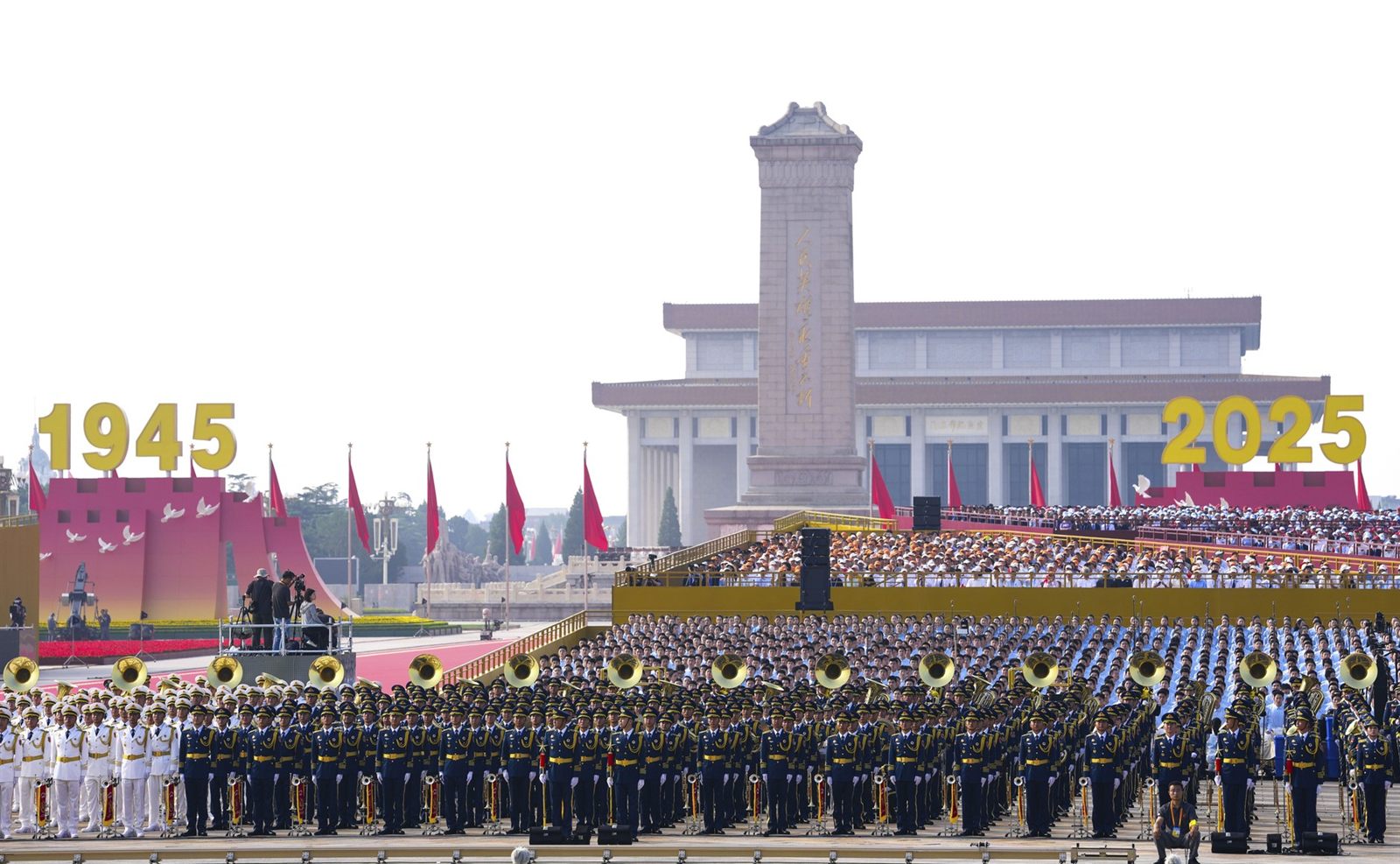
Beijing loves a parade. But this one felt different. Over 12,000 troops moved as one body. Chinese reports listed 76 weapon systems. They said 47 had never been seen in public before. And every big missile seemed to carry a silent address: Washington, Guam, Taiwan, and quietly, New Delhi.
The story in 30 seconds
- On September 3, 2025, China held a large military parade in Tiananmen Square marking 80 years since the end of World War II
- Over 12,000 troops marched; Chinese reports listed 76 weapon systems, 47 of them new
- Missiles, drones, lasers, and stealth fighters on display; leaders from Russia, North Korea, Iran, and Pakistan attended
- The United States reacted with concern; India stayed away and measured the gaps in its own defenses
- Since then, India has tested missiles, cleared large arms deals, and pushed private firms into missile production
What China showed on September 3
Reports listed over 12,000 troops in the event. Reports also listed 76 weapon systems on the ground, as reported by Chinese state media. Of those, 47 were shown in public for the 1st time. The message was plain. China wanted to show that it had moved from weakness after World War II to strength 80 years later.
Missiles drew the most attention
The DF-17 hypersonic glide vehicle was on display. It flies at Mach 5 and above. Analysts at CSIS Missile Threat put its range at 1,600 km to 2,500 km. Most current missile defenses struggle to stop such a fast and agile weapon.
The DF-26D was also shown. It is often called the Guam Killer. Its range is about 5,000 km, as assessed by the US Department of Defense. It can carry nuclear or conventional warheads. Analysts see it as a weapon aimed at US bases and ships in the western Pacific.
The DF-61 intercontinental ballistic missile appeared for the 1st time in 2025. Analysts estimate its range at about 12,100 km, similar to the DF-41, with some reports cited by Janes putting it up to 18,000 km. It can carry multiple warheads. That range puts the entire US mainland within reach. The Federation of American Scientists called its debut a surprise. Its launcher looks nearly identical to the DF-41 launcher from 2019.
China also showed the JL-3 submarine-launched missile and the YJ-21 hypersonic missile. The US Department of Defense puts JL-3 range at about 10,000 km, as noted by the Federation of American Scientists. The YJ-21 has a claimed range near 1,500 km and a claimed speed of Mach 6 to Mach 10. Both are built to threaten large warships, including aircraft carriers. The signal was that China can strike ships far from its coast.
Drones showed where war is heading
The AJX002 extra-large underwater drone was part of the show. It is built for quiet, long-range work. Its roles include recon and strike from under the sea.
Loyal wingman drone types labeled Type D and Type E were also shown. Watchers linked them to the FH-97 concept. They are meant to fly with crewed fighters. They can collect data and carry out precision strikes.
Robot dogs with AI tools for urban combat were also displayed. They can run, climb, scan, and support troops in built-up areas. This is no longer lab work. It is field hardware.
Lasers and jammers were the quiet part
China displayed high-energy laser guns to shoot down drones. It also showed microwave weapons to damage enemy electronics.
Full-spectrum jamming vehicles were on display as well. They are built to block radios, radars, and links in real time. The goal is control of the electromagnetic space in battle.
The HQ-29 missile-defense interceptor was also noted by watchers. Chinese sources describe midcourse interception from 100 km to 2,000 km altitude. Analysts note a possible counterspace role. That role remains unconfirmed in official sources.
Air and ground power looked upgraded
The J-20 and J-35 stealth fighters were in the air segment. These include J-20A and J-20S and J-35A variants, as listed for the parade. These are China’s top jets for air control. India expects to see more Chinese air activity near the Line of Actual Control and around Taiwan.
H-6 bombers able to carry hypersonic payloads were shown. These included H-6N nuclear bombers with JL-1 air-launched missiles, plus H-6J and H-6K types. That extends strike range well beyond defense of the coast.
On the ground, Type 99B tanks with active protection were shown. Type 100 tanks were shown beside them. They are harder to kill than older tanks. PHL-16 rocket systems were also shown. They can strike targets 130 km to 500 km away depending on the rocket. The Fire Dragon 480 round reaches about 500 km, as noted by Janes and the US Naval War College. That range matters on the India border.
Why Beijing held the parade
The stated reason was history. Beijing linked the 80th anniversary of the end of World War II to its return as a strong power. It spoke of moving past the Century of Humiliation.
The deeper reasons were strategic. China displayed a full nuclear triad on land, at sea, and in the air. That sent a deterrence signal. It also sought to put pressure on Taiwan and to warn US carrier groups in the Indo-Pacific.
At home, the parade fed national pride. It told the public that the country is strong and secure. Peace words were used on stage. Hard power was shown on the road.
Who attended and why it mattered
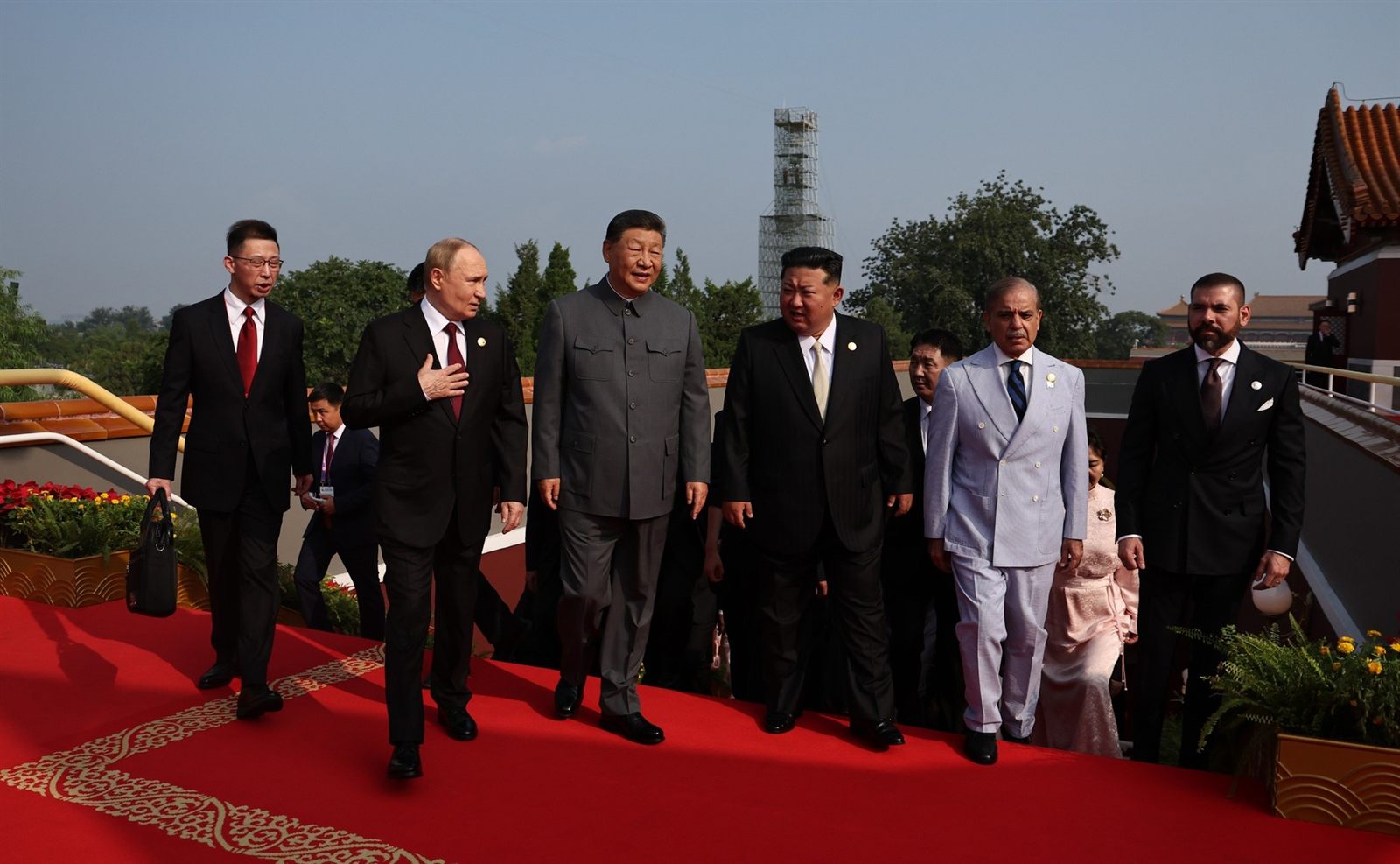
Xi Jinping stood with Vladimir Putin, Kim Jong Un, and Masoud Pezeshkian. Chinese officials said 26 world leaders attended. Many read the photo as a bloc of states opposed to the West. Each guest carried a signal.
“We are the new world order.” The message, as read by analysts, from Xi standing with Putin, Kim Jong Un and Pezeshkian
| Country and Leader | Significance | Strategic Message |
|---|---|---|
| Russia - Vladimir Putin | Strategic alliance, Ukraine war support | Anti-Western bloc formation |
| North Korea - Kim Jong Un | Military cooperation, weapons supply to Russia | Authoritarian solidarity |
| Iran - Masoud Pezeshkian | Middle East partnership | Regional power projection |
| Pakistan - Shehbaz Sharif | All-weather friendship, CPEC | South Asia influence |
| Belarus - Alexander Lukashenko | Regional ally | Eastern Europe ties |
| Myanmar - Min Aung Hlaing | Military junta relations | Military regime support |
| Uzbekistan - Shavkat Mirziyoyev | Central Asia cooperation | Silk Road partnership |
| Serbia - Aleksandar Vučić | European foothold | European division |
| Cuba - Representative | Communist alliance | Ideological alignment |
| Laos - Representative | Southeast Asia influence | Regional integration |
| Vietnam - Representative | Regional power | Economic partnership |
| Indonesia - Prabowo Subianto | ASEAN outreach | Maritime cooperation |
How the world reacted
The US was rattled. President Trump called the event a conspiracy by adversaries. Behind that remark, Pentagon planners voiced worry about hypersonics and nuclear growth. Talk of an arms race grew. China was no longer seen as only a regional concern.
“Please give my warmest regards to Vladimir Putin and Kim Jong Un, as you conspire against the United States of America.” US President Donald Trump, in a social media post during the parade
India chose to stay away. Prime Minister Modi did not attend. That absence was read as a quiet and firm signal. Indian planners saw systems in the parade that could be moved to the Line of Actual Control, including missiles, drones, and electronic warfare trucks. India leaned more on the QUAD with the US, Japan, and Australia.
Russia and North Korea welcomed the show. Their presence fit the idea of an anti-West alignment. Japan, Australia, and ASEAN states were uneasy. They watch the South China Sea buildup with care. They see ships, missiles, and runways on reefs. They fear more pressure ahead.
Europe was also nervous. Talk of a multipolar world sounds fair until power shifts in hard ways. The presence of Serbia’s Aleksandar Vučić was read as a Chinese bid to gain space inside Europe and to test NATO unity.
The net result was a harder mood. US-China talks risked a freeze. India moved closer to Washington. The board shifted. India found itself near the center.
The gap between China and India
The numbers point to a wide gap. They are not the full story, but they shape choices.
| Category | China | India | Technology Gap and Implication |
|---|---|---|---|
| Nuclear Warheads | ~620 total stockpile, SIPRI puts it near 600 | ~190 total stockpile, SIPRI puts it near 180 | China has full triad and advanced delivery. Ours is still coming up. |
| Defense Budget | ~$336 billion, SIPRI 2025 | ~$92.1 billion, SIPRI 2025 | They outspend us almost 4 to 1. That cash buys fast upgrades. |
| Hypersonics | Operational, multiple platforms | Limited development programs | They can hit fast and dodge defenses. We can’t yet. |
| Autonomous Systems | Advanced AI integration, loyal wingman drones, UUVs | Early-stage drone development | We are generations behind in drone and AI warfare. |
| Naval Power | A much larger, modern navy | Smaller, still modernizing | Their navy reaches far, including into the Indian Ocean. Ours doesn’t match that. |
| Manufacturing | Indigenous production across all major systems | Heavy reliance on foreign tech | We still import too much. That hurts us in a real fight. |
Why India fell behind
Money is 1 reason. China funds defense research at scale. Its military-civil fusion links private tech to the army. India’s budget has grown, but not at that pace.
Factories are a 2nd reason. China builds ships, missiles, and drones in large runs. India’s defense industry is slower. Rules are heavy. Imports fill many needs.
The 3rd reason is weak links between labs, firms, and schools. China ties the state, firms, and universities in 1 push. India’s setup is split. DRDO works in 1 lane. Private firms work in another. The rhythm is weak.
The fourth reason is planning. China plans for decades with clear targets. India often reacts after a shock, such as Galwan. Reaction buying cannot build lasting power.
What India can do next
India needs steady and hard work. Panic will not help.
1st, spend more on research and build at home. Aim toward 2.5 percent of GDP for defense research and development. Push BrahMos-II, Agni-VI, and home-grown combat drones. Cut the need to ask others for core tech.
2nd, fix buying rules. Files move too slowly. Clear the backlog. Let Tata, L&T, and startups build at scale.
3rd, work with friends in smart ways. Go deeper with the US through QUAD and iCET for tech sharing. Work with Israel on AI, robotics, and counter-drone tools. Work with France on jets and engines. Seek joint development, not just shopping.
Fourth, build asymmetric tools. India cannot match China tank for tank in every sector. It can invest in cyber, space, and electronic warfare. Satellites, hacking tools, and jammers can blunt a larger force at lower cost.
Fifth, make the nuclear deterrent more survivable. Speed up nuclear subs. Improve delivery systems. If China holds about 600 warheads with a full triad, no rival should doubt India’s reply.
The ground truth without hype
The parade was more than a show. It was Beijing saying it wants to write new rules, not just play by old ones. The tech gap with India is real. Even the US finds the pace hard to match.
The linkup of China, Russia, North Korea, and Iran felt like a real bloc. Some call it the Axis of Upheaval. Those states are ready to push back on the West together.
At the same time, China is not 10 feet tall. Its economy has weak spots. Property stress, youth joblessness, and local debt weigh on growth. Big parades can hide big problems at home.
Still, the signal was clear. China’s army looks strong, modern, and confident. September 3, 2025, was a warning shot. It shook the region. For India, the stakes are high. The time to build is now.
Said plainly: respect the arithmetic, not the theatre
Start with what is real. Over 12,000 troops, 76 systems as listed by Chinese reports, 47 debuts, and named missiles with published ranges are facts, not rumors. Anyone telling you the parade was pure bluff is selling comfort. The DF-61, the hypersonics, and the drone wing are hardware India must assume works until proven otherwise. Underestimating an adversary is how nations get surprised.
Now cut the other way. Parades are advertising, and the PLA’s last full war was in 1979. Not 1 of these shining systems has been tested in real combat. Steel on a boulevard is not victory in a war. A nation that confuses a march with invincibility will misread both its enemy and itself.
India’s gap is money and factories, not courage. 92 billion dollars does not outbuild 336 billion through speeches. The honest record since the parade - Agni-5 MIRV tests, S-400 missile buys, 25 billion dollars in cleared proposals, billions for home-built drones - shows Delhi understood the bill. Credit belongs where it is due, no matter which party signs the file.
1 more hard truth about friends. QUAD is useful, and summits in New Delhi and port partnerships have value. But no sailor from Tokyo or Washington will hold the LAC for India. Alliances are discounts, not guarantees. Self-reliance is the only doctrine that survives contact with a real crisis.
So fear honestly, build furiously, and worship nothing. Not their parade, and not our press releases.
What has happened since September 2025
Much moved in less than a year. India tested weapons, cleared deals, and changed rules for industry - but the border is still not settled.
- Sept. 22, 2025 -
J-35stealth fighter certified for catapult launch on the Fujian carrier; J-35AE export variant rolled out May 1, 2026 - Oct. 2025 - India hosts QUAD Ports of the Future conference; leaders’ summit skipped as US-India ties strain
- Feb. 13, 2026 - 288 added S-400 missiles approved from Russia (~Rs 10,000 crore); 2-3 more regiments sought above $1.1 billion
- Mar. 27, 2026 - Reuters: India clears $25 billion in military purchase proposals (transport aircraft, air defense, drones)
- May 8, 2026 - Agni-5 flight test with MIRV tech from Odisha; one missile, multiple warheads
- May 26, 2026 - QUAD foreign ministers meet in New Delhi; Quad at Sea observer mission backed
- June 2026 - $2 billion+ pledged for domestic military drones; 600+ Indian firms in the field
- July 2026 - $5.46 billion in military buys approved (missiles, electronic-warfare kits, kamikaze drones)
- Aug. 17, 2026 - Al Jazeera: China-blocked-patrol claims near Taksing, Arunachal; Army denies; Foreign Ministry calls border peace vital
- Aug. 26, 2026 - Al Jazeera: Defence Minister Rajnath Singh approves DRDO tech transfer to Indian firms for home missile production
- Aug. 29, 2026 - Air Power Asia: BrahMos toward 800-900 km; Project Kusha air defense for 2028-29 (range above 350 km); Mission Sudarshan Chakra AI shield
Bottom line: Money and factories are moving fast. The LAC is still not settled. The next test is whether orders, funds, and factories turn plans into deployed strength.
Sources
Tap to open the 5 sourcesTap to close
- Wikipedia - 2025 China Victory Day Parade; DF-17; DF-26; DF-61; J-20; J-35; List of states with nuclear weapons; List of countries with highest military expenditures.
- Federation of American Scientists - Nuclear Weapons at China’s 2025 Victory Day Parade, Sept. 4, 2025.
- CSIS Missile Threat - DF-17 range data, Apr. 23, 2024.
- Janes / US Naval War College - PHL-16 range data.
- Reuters / Defence News / Al Jazeera - post-parade India-China developments, Feb.-Aug. 2026.