The Moran Quest for Recognition: Escalating Demands for Scheduled Tribe Status in Assam
The Moran community's 11-year wait for Scheduled Tribe status exploded into a September 2025 blockade of Assam's oil and coal roads. The file still moves mostly on paper.
Updated July 29, 2026 - Assam polls (Apr. 9, 2026), cabinet ordinances, Oram’s June 30 review, and Pegu’s July 29 no-timeline statement added.
100 days. That was the promise in 2014. 11 years later, thousands of Morans walked into Tinsukia town with a new message: no more waiting. And their target was not just the government. It was the oil and coal that keep Assam running.
The story in 30 seconds
- The Moran community in Upper Assam seeks Scheduled Tribe status and Sixth Schedule protection
- Around 10,000 to 20,000 people joined a protest in Tinsukia on Sept. 10, 2025
- The All Moran Students Union set a 72-hour deadline to Sept. 15 and warned of an oil-and-coal blockade
- The blockade began Sept. 15 at 5 a.m.; suspended Sept. 28 after talks
- Assam polls Apr. 9, 2026; BJP won 82 seats; Sarma took oath May 12, 2026
- As of July 29, 2026: no ST Bill listed; no timeline given by the Centre
A long wait comes to the street
For many Moran families, this demand is old. Leaders say promises were made before many elections but no result followed.
The protest in Tinsukia took place just before Prime Minister Narendra Modi visited Assam on Sept. 13. The Assam Tribune reported on Sept. 11 that nearly 20,000 people joined the rally on the evening of Sept. 10 in Tinsukia town. Field reports placed the crowd between 10,000 and 20,000. The Indian Express described the Sept. 10 action as a massive torch rally attended by thousands. The All Moran Students Union led the march after smaller rallies in Talap, Kakopathar and Margherita.
Slogans were raised against the ruling party. Community leaders said the rally would continue in phases if no clear plan was shared.
The union asked for a clear roadmap by Sept. 15. It warned of an indefinite economic blockade after that date. The plan was to stop oil tankers and coal trucks and to block key roads in the district.
Who the Morans are
Morans describe themselves as 1 of the early peoples of the Brahmaputra valley in Upper Assam. They live mainly in Tinsukia, Dibrugarh, Charaideo and nearby areas. Small groups also live in Arunachal Pradesh.
History records show they had their own chiefs in the south-eastern part of the valley between the Disang and Dihing rivers. They followed their own customs in that period. Accounts of the 13th century link Moran chief Bodousa to Ahom king Sukaphaa through the marriage of princess Gondheswari, after which Morans became part of the new Ahom polity, as recorded in community histories and regional chronicles.
In the 17th century many Morans accepted Vaishnavism under the Mayamara sect. The change was linked to Aniruddhadeva, a preceptor in the Sankardeva tradition through Gopal Ata. Today most Morans speak Assamese. Their older Moran speech, linked to Dimasa, has largely faded. Bihu remains their main festival.
What the community seeks
The demand has 2 parts.
1st, Scheduled Tribe status. This would bring job quotas, college seats, land safeguards, political reservation and special funds.
2nd, Sixth Schedule cover or stronger council powers. The Moran Autonomous Council was created in 2020. Community leaders say it lacks the law-making, court and fund powers that Sixth Schedule councils hold. They seek an upgrade so land rules and local funds stay under community control.
Leaders also point to location. Tinsukia sits near Digboi refinery, Duliajan oil fields and coal routes. A road block there can affect fuel and goods flow. That is why the blockade warning drew wide notice.
What the Morans asked vs where things stand
| Demand | What they asked for | Status as of July 2026 |
|---|---|---|
| Scheduled Tribe status | ST listing for Moran + 5 other Assam communities | No Bill listed; process pending at Centre |
| Sixth Schedule / council powers | Moran Autonomous Council upgrade to Sixth Schedule | Council exists (2020); no Sixth Schedule rank |
| Dated roadmap | Government plan by Sept. 15, 2025 | Talks promised; blockade paused Sept. 28 |
| ST Bill in Parliament | Introduced Jan. 2019 | Lapsed; GoM report Nov. 2025; no passage |
How the past shaped the demand
Under Ahom rule from the 13th century, Moran chiefs lost independent power. They became subjects of the larger Ahom state. Records describe them as suppliers of elephants for the army. They kept many social customs but lost ruling rights.
Under British rule from 1826 to 1947, large tracts in Upper Assam were taken for tea gardens. Historians note that Moran farming and forest land shrank in this period. Many Morans became wage workers on gardens built on former village and forest land. With loss of land, old rites weakened and the old speech declined.
After Independence, community accounts cite official notes that listed the gap but gave no fix. Moran histories cite a 1955 survey note that called Morans most backward and a 1965 study note that said they met marks then used for tribal listing, such as distinct culture, isolation, shyness of contact and backwardness. These specific survey claims could not be traced to a public official text in the sources checked for this update, so they are stated here as community-cited accounts, not as verified state records. Yet no ST tag followed.
In 1972 Morans were placed in the Other Backward Classes list, as reported by local press and community records. OBC status gave limited job quota but no land shield and no political reservation like ST status. Leaders call this a state of limbo.
The BJP promise and the delay
In the run-up to the 2014 general polls, Narendra Modi promised ST status for 6 Assam groups. The 6 named were Moran, Tai Ahom, Mottock or Matak, Koch Rajbongshi, Sootea or Chutia, and Tea Tribes. The BJP vision paper for the 2016 Assam polls repeated the pledge in time-bound terms.
Moran leaders cite the pledge as a 100-days promise. The exact 100-days wording comes from Moran leader statements quoted in local press, including All Moran Students Union president Palindra Bora, also spelled Polindra Bora in some reports, who told the Assam Tribune in Sept. 2025 that the Prime Minister had assured ST status within 100 days of forming the government.
In November 2015, Union minister Kiren Rijiju said the file was with the Prime Minister and could clear before the 2016 state polls, as reported by local press. In January 2019 the Home Ministry said a Bill would be placed in Parliament and cabinet approval was waived. A Bill was introduced in the Rajya Sabha in Jan. 2019 but it passed without delay (lapsed without passage, as noted by the Indian Express in Nov. 2025). No such law was passed.
In January 2021 BJP chief J P Nadda said at a Silchar rally that the Centre had granted the status, as reported by local press. State leader Himanta Biswa Sarma later said the remark meant a renewed pledge. The groups stayed in the OBC list.
Moran leaders say this history explains the anger in 2025. They put the wait at 11 years since the 2014 pledge and at decades since the 1st official notes cited in community accounts.
The Sept. 2025 protest and the blockade threat
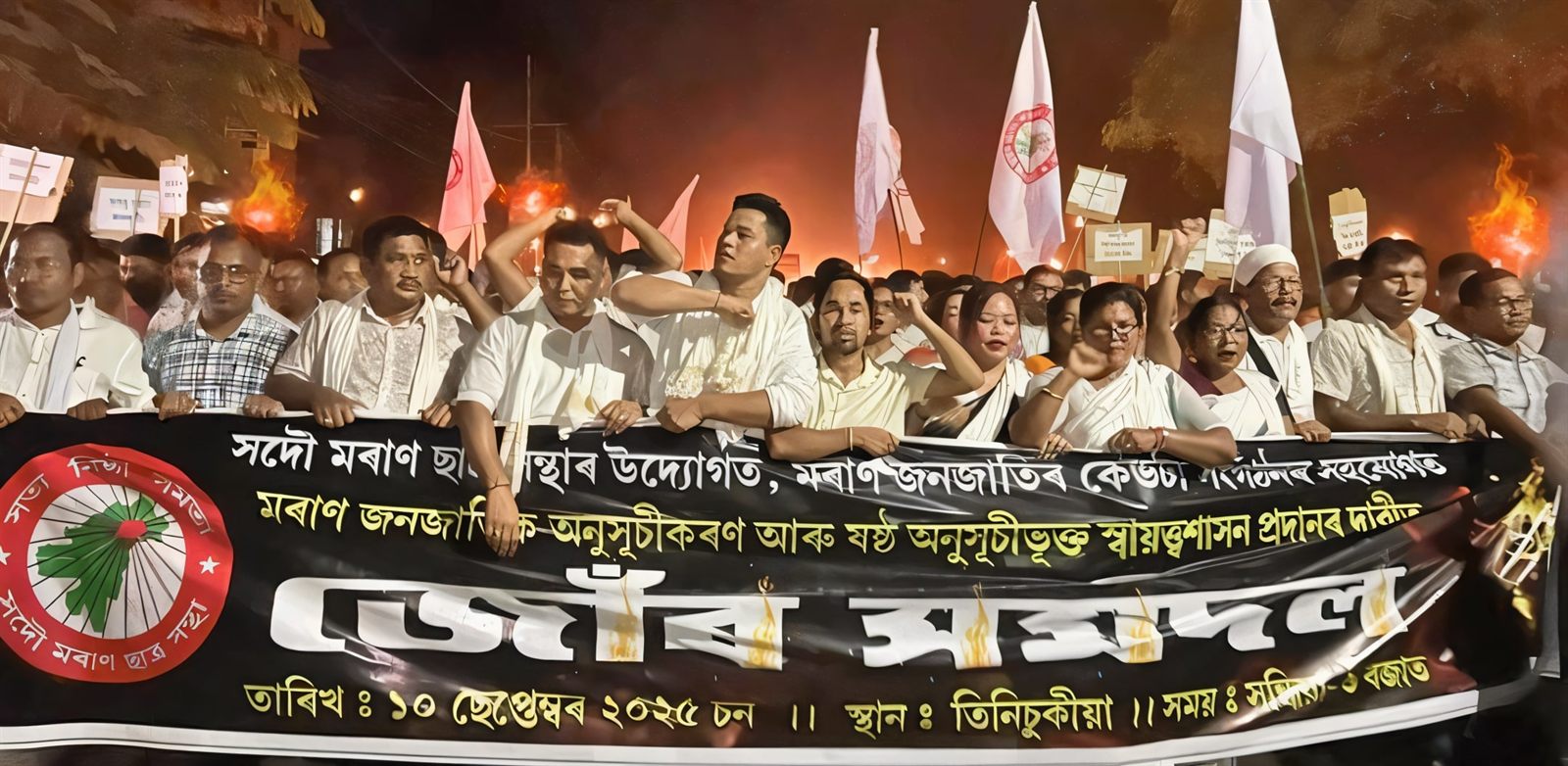
The Sept. 10, 2025 rally drew 10,000 to 20,000 people, as per field reports cited by the Assam Tribune and the Indian Express. Men, women, elders and students joined. The timing was linked to the Prime Minister visit and strong media presence.
The union gave the government 72 hours to share a dated plan by Sept. 15. It said oil tankers linked to the Digboi and Duliajan belt and coal trucks from Upper Assam mines would be stopped if the date passed. The Telegraph quoted All Moran Students Union general secretary Jaikanta Moran, also spelled Joykanta Moran in some reports, on Sept. 12 as saying coal and oil taken out from Tinsukia would be targeted from Sept. 15 unless the government replied by Sept. 14.
“Give us a roadmap by September 15, or we shut down the oil and coal economy.” The 72-hour ultimatum issued by Moran protest leaders at Tinsukia, as reported by local press.
Media teams were already in the state for the Prime Minister visit. Observers called the timing sharp.
The response from the state
In mid-Sept. 2025 Chief Minister Himanta Biswa Sarma said the process was moving with positive efforts. He asked groups to pause protests. The Assam Tribune reported his Sept. 15 remarks from Kokrajhar that people should not think protests are the only solution and that frequent stir could delay the file further.
After the blockade began, he said on Sept. 16 that protest is no solution and only talks can settle the matter, as reported by local press. He said the report on ST status for the 6 groups would be placed in the coming Assembly session. He added that the state held a positive view but groups should wait for the report. He warned that street action could slow the file.
On the ground, hundreds of loaded trucks were held on the Makum Bypass of NH-15 and the Makum-Forland Road on Sept. 15 morning from 5 a.m. Trade in oil, coal, tea and timber from Tinsukia was hit for the day. Tinsukia Deputy Commissioner Swapneel Paul confirmed to the Indian Express that goods vehicles were stopped in the Makum area. Superintendent of Police Gaurav Abhijit Dilip said 20 to 30 vehicles, mostly linked to Oil India Limited and Coal India Limited, were stranded on the 1st afternoon and talks were on.
Why ST and Sixth Schedule matter here
For supporters, the tag is about daily life. Reserved seats can help youth enter colleges and state jobs. Land cover can slow sale and transfer of rural plots. Political reservation can give the group a clear voice in the Assembly. Special funds can support hostels, roads and water works.
The council question is about local rule. With Sixth Schedule type powers, a council can frame local laws, run traditional courts, keep funds and check land deals. Without such powers, leaders say funds pass through state offices and local writ is weak.
Critics of delay point to backlog in ST posts cited in published reports and community claims. The exact backlog figure could not be verified to a single official source in the records checked for this update, so no single number is stated here. In Aug. 2026 the Centre directed ministries to form reservation panels and run special drives to fill SC and ST backlog posts, as reported by the Economic Times. Supporters of existing ST groups reply that backlog and new entry are separate matters.
Why the state finds it hard
If the state says yes, existing ST bodies may protest. The All Bodo Students Union, the All Assam Tribal Students Union and the Coordination Committee of Tribal Organisations of Assam, which says it represents 14 tribes, have opposed the move. Committee president Aditya Khakhlary said the 6 groups are fairly advanced and do not meet tribal marks under the Lokur Committee norms of 1965, as reported by The Federal in July 2026 and The Hindu in Jan. 2026. Their fear is quota dilution and loss of seats and funds.
The Federal noted in July 2026 that Assam has 7 percent reservation for Scheduled Castes, 10 percent for ST Plains, 5 percent for ST Hills, 27 percent for OBC and MOBC combined and 10 percent for Economically Weaker Sections, for a total of 59 percent. Tribal bodies argue that adding 80 to 90 lakh new claimants to a fixed pool could push totals past the 50 percent ceiling set in the 1992 Indra Sawhney ruling and cut existing shares in seats, hostels and jobs. Existing ST population was 38,84,371 or 12.44 percent in the 2011 Census.
If the state says no, Upper Assam faces blocks on fuel and coal. Losses can run into crores per day. Prices can rise and daily workers suffer first. Votes in Tinsukia, Dibrugarh and Charaideo belt can shift.
If all 6 groups enter the ST list, Assam ST share could rise from about 12 to 13 percent to about 35 to 50 percent, as per varied estimates cited in public debate. That shift would change reservation totals, seat reservation and fund flows. It could also raise calls for Article 371 type shields. Parties fear the chain effect.
Reactions across parties
Raijor Dal chief Akhil Gogoi called the Tinsukia rally an unprecedented uprising. He said it could be the largest gathering in Assam since the anti-CAA protests. He backed the ST Bill demand and linked it to land and political rights for indigenous groups. He also called for Article 371 type protection for Assam on the lines of Nagaland, as reported by Northeast Now on Sept. 11, 2025.
“An unprecedented uprising.” Akhil Gogoi, Raijor Dal, on the Moran mobilisation
Assam Jatiya Parishad chief Lurinjyoti Gogoi faulted the state for neglect of tribal hopes, as reported by local press. Congress largely stayed quiet in the 1st week. Observers noted that Congress had also kept the file pending during its own years in power. In its manifesto for the Apr. 9, 2026 polls, released on Apr. 2, 2026, Congress promised ST status for the 6 groups, as reported by The Hindu.
The BJP faced direct heat because the pledge was its own. Party leaders could not call the demand wrong. At the same time they pointed to legal steps and need for agreement among all sides. Moran votes are seen as key in Upper Assam seats including Tinsukia belt, so the cost of anger is high.
4 ways this could move
Scenario 1 - The Centre moves fast
Delhi clears a dated roadmap or a Bill. Morans pause the street action. Existing ST groups then start their own rallies. Other states watch the method and the result. The quota debate turns national. As of July 29, 2026, this had not happened. No Bill was listed for the Monsoon Session.
Scenario 2 - The blockade grows
After Sept. 15, roads to Digboi and Duliajan face halts. Coal piles up. Fuel flow tightens. Security planners worry because energy links matter for the region. Daily life costs rise. Talks become urgent within days. This played out in part from Sept. 15 to Sept. 28, 2025, before a pause for talks.
Scenario 3 - A middle deal
The state offers more funds and powers for the Moran Autonomous Council. It promises ST entry in steps with a shield for current ST quota through sub-quotas. Leaders sign a paper with dates. Trust is the test here after years of past pledges. The Nov. 2025 Group of Ministers report proposed such a shield through a new ST Valley category, but tribal bodies rejected it.
Scenario 4 - Police action
Police detain union leaders and clear roads near oil sites. Roads open for a time. But anger hardens among youth. A rights claim turns into a long-term rift between people and state offices. Past Assam cases show such rifts heal slowly.
Why this matters beyond 1 group
The case tests whether poll pledges carry weight. It tests how tribal listing works under the Constitution. It tests whether a poor group must stop trucks to be heard.
It is also a federal test. ST listing needs state advice, central study, tribal-panel review and Parliament law. Delay at any step stalls the whole chain.
If Morans gain entry, Tai Ahom, Mottock, Koch Rajbongshi, Sootea and Tea Tribes will press harder. Assam politics, seat maps and job shares would shift. Other parts of India would cite the case.
Said plainly: a promise is a debt
Put the 2 dates side by side and the case is closed. 100 days was the pledge cited from 2014. Still studying was the answer in 2025. 11 years of documented delay is not process. It is deceit with letterhead. No community should have to blockade oil to be heard, and the fact that the Morans must is the government’s shame, not theirs.
Honesty cuts the other way too. Backlog in ST posts and the quota fears of Bodo and other tribal bodies are real arithmetic, not bigotry. Adding millions of new claimants to a fixed pie without expanding it is a promise written on someone else’s share. The Morans deserve entry on merit, and existing tribes deserve an honest answer about the math in the same breath. Anyone promising entry without the math is campaigning, not solving.
The blockade threat itself deserves a fair reading. Stopping tankers is non-violent economic pressure, the classic weapon of people with no other lever. It worked in the narrow sense: the chief minister was talking within days. A baton charge or a harsh crackdown would have turned a pending file into a burning district, and everyone who urges force should own that outcome in advance.
So here is the bill, presented to all sides at once. Delhi and Dispur owe a dated answer, not another committee. The Morans are owed dignity after a decade of being used for votes. The existing tribes are owed candor about numbers. Deliver all 3 together, in public, or admit the promise was never meant.
What has happened since Sept. 2025
This part uses dated reports checked till July 29, 2026. No ST law for the 6 groups was found. One line up front: the blockade paused, the polls passed, the file did not close.
- Sept. 15, 2025 - Blockade begins at 5 a.m. in Tinsukia; over 1,000 tankers held on Makum Bypass and Makum-Forland Road; ~90% of fuel depots dry (Assam Tribune)
- Sept. 15-16, 2025 - Chief Minister Sarma urges calm; says report on ST status will go to the coming Assembly session (Assam Tribune)
- Sept. 26, 2025 - Over 10,000 rally in Sadiya demanding ST status for Tai Ahom; slogan: No ST, no rest (Assam Tribune)
- Sept. 28, 2025 - Blockade suspended, not withdrawn; state promises detailed report to Assembly on Nov. 25 and to Centre on Nov. 26 (India Today NE)
- Nov. 27, 2025 - Assam Cabinet approves GoM report on ST status; 3-member panel headed by Ranoj Pegu proposes 3-tier split (ST Plains, ST Hills, ST Valley) (The Hindu)
- Dec. 5, 2025 - Tribal bodies rally in Silchar against the plan; GoM report rejected as illegal and unconstitutional (Barak Bulletin, The Hindu)
- Apr. 9, 2026 - Assembly polls held; May 4 - BJP wins 82 of 126 seats (alliance 102); May 12 - Sarma sworn in for a 2nd term (The Hindu, EC)
- June 5, 2026 - Moran and Motok groups enforce a 48-hour bandh in Tinsukia and Dibrugarh; tyres burnt; anger over cabinet exclusion (Times of India, Assam Tribune)
- June 30, 2026 - Union Tribal Affairs Minister Jual Oram reviews tribal work in Guwahati; says the 6 groups must wait; process via RGI, NCST (Assam Tribune)
- July 7-29, 2026 - No Bill listed for Monsoon Session; Pegu tells the Assembly no timeline can be given (The Federal, India Today NE, TOI)
Bottom line: Council files moved on paper. The ST file did not close. As of July 29, 2026, the demand stands where it stood in Sept. 2025 - process cited as the reason for the wait.
Sources
Tap to open the 8 sourcesTap to close
- Assam Tribune (Sept. 11) & Assam Tribune (Sept. 15), 2025 - protest crowd; blockade at Makum-Forland Road; Sarma’s Kokrajhar remarks.
- Indian Express, Sept. 16, 2025 - Sarma on talks; Supreme Court / High Court context.
- India Today NE, Sept. 28, 2025 - blockade suspended after talks.
- The Hindu (Nov. 27) & The Hindu (Dec. 5), 2025 - GoM report; tribal backlash; Silchar rally.
- The Hindu, Jan. 2, 2026 - CCTOA rejection of report.
- Election Commission / The Hindu, May 4-5, 2026 - Assam poll results; BJP 82 seats.
- Assam Tribune (June 5) & Assam Tribune (June 30), 2026 - 48-hour bandh; Oram’s tribal review.
- The Federal / India Today NE / TOI, July 7-29, 2026 - no Bill listed; no timeline from Pegu/Oram.