France's Breaking Point: From a Hung Parliament to Burned Town Halls
France's 2024 snap election gamble left a hung parliament no one could govern. Two years of forced budgets ended in a burned town hall in Limoges, 2,397 arrests and 997 officers hurt.
Updated October 19, 2026 - Expanded with the full month-long chronology of the school revolt, Interior Minister Laurent Nuñez’s admission that police “lost control” in some cities, Justice Minister Gérald Darmanin’s “we failed” statement, the first day of the government’s crisis response, and the latest budget, damage and polling figures.
28 months without a majority. 3 prime ministers in 12 months. 1 night of fire. On Oct. 17, 2026, France burned. A 143-year-old town hall in Limoges. A tourist office in Lyon. Shops from Paris to Marseille. Police made 2,397 arrests. They counted 997 of their own hurt. The revolt behind it all began at 1 high school east of Paris. The fuse was lit on June 9, 2024, when a president gambled on a snap election. He lost the bet. The country is still paying for it.
The story in 30 seconds
- June 9, 2024: After the far right tops the European vote, President Emmanuel Macron dissolves parliament and calls a snap election.
- July 2024: Voters return a hung parliament. No bloc comes close to the 289 seats needed to govern.
- Dec. 4, 2024: Michel Barnier’s government falls on 331 votes, the first censured prime minister since 1962. Sept. 8, 2025: François Bayrou falls, 364-194.
- Feb. 2, 2026: After 3 uses of the
49.3power, the Assembly rejects the last censure motions and the 2026 budget finally passes. - Sept. 17-18, 2026: Teachers at a Créteil high school strike over unfilled posts; pupils blockade the building the next day, and a national movement is born.
- Oct. 17, 2026: 550,000 people march over fuel and living costs. By night, public buildings and shops are burning; 2,397 are arrested, and 997 police and gendarmes are hurt.
- Oct. 18-19, 2026: Macron refuses Interior Minister Laurent Nuñez’s resignation. Nuñez admits police “lost control” in some cities; Darmanin says the state “incontestably failed”. The 2027 budget vote opens Oct. 20; unions and yellow-vest groups call Nov. 5.
- April 18, 2027: The presidential election. Marine Le Pen, appeal and ankle tag pending, leads the polls.
The night a town hall burned
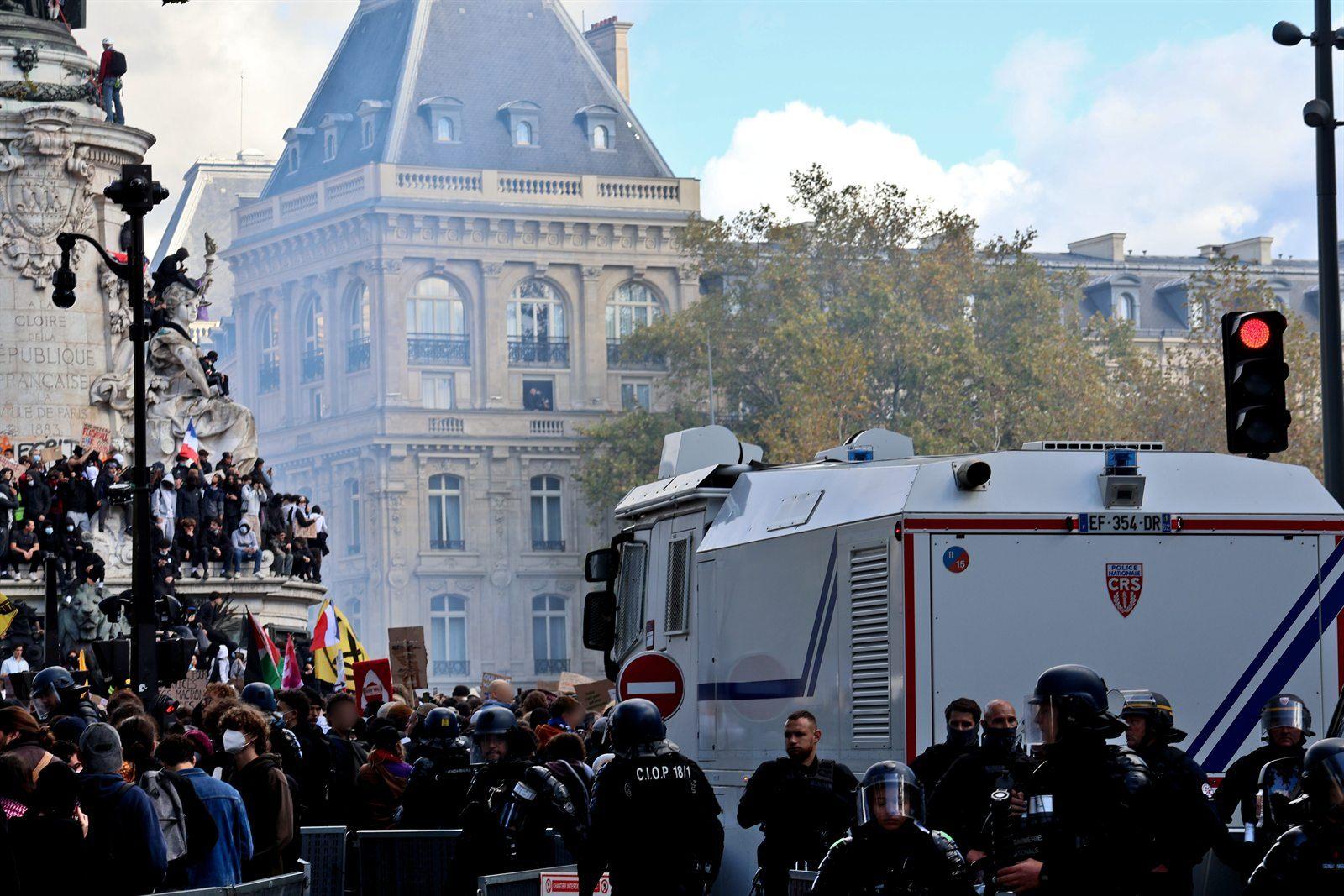
Across France, 550,000 people marched on Oct. 17 against the cost of living, the Interior Ministry said. The organizers counted 800,000. Paris alone had 110,000 marchers, the ministry said. Some 60,000 police and gendarmes were deployed across the country. The daytime belonged to the marchers. The night belonged to the wreckers. Then night fell on Limoges.
Masked men broke into the Hôtel de ville at 6 p.m. They smashed the windows. They set it on fire. The building was 143 years old. It had survived 2 world wars. Its 43-meter clock tower fell in flames. The roof crashed onto the floors below.
“The roof has collapsed onto lower floors, except the west wing, and two-thirds of the exterior has already disappeared.” Maurice Barate, prefect of Haute-Vienne, to AFP
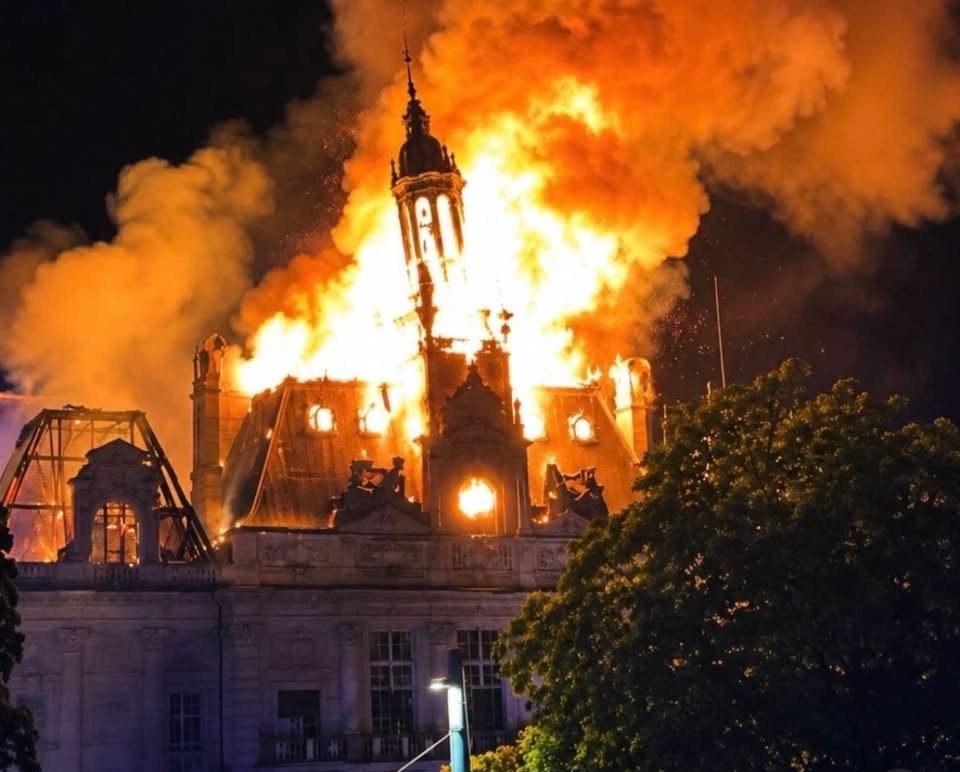
Barate called the fire “a deliberate act by hooligans” and “a catastrophe for heritage”. The mayor of Limoges, Guillaume Guérin, said the attackers were “people organised for war”. Not demonstrators. Not people with a cause. They told a building caretaker he would be killed. They told elected officials they would “burn”. Then he said the part that matters:
“Around 3.30pm our municipal police, although present in number, found themselves no longer able to fight against the violence of rioters, because they had run out of ammunition.” Guillaume Guérin, Mayor of Limoges
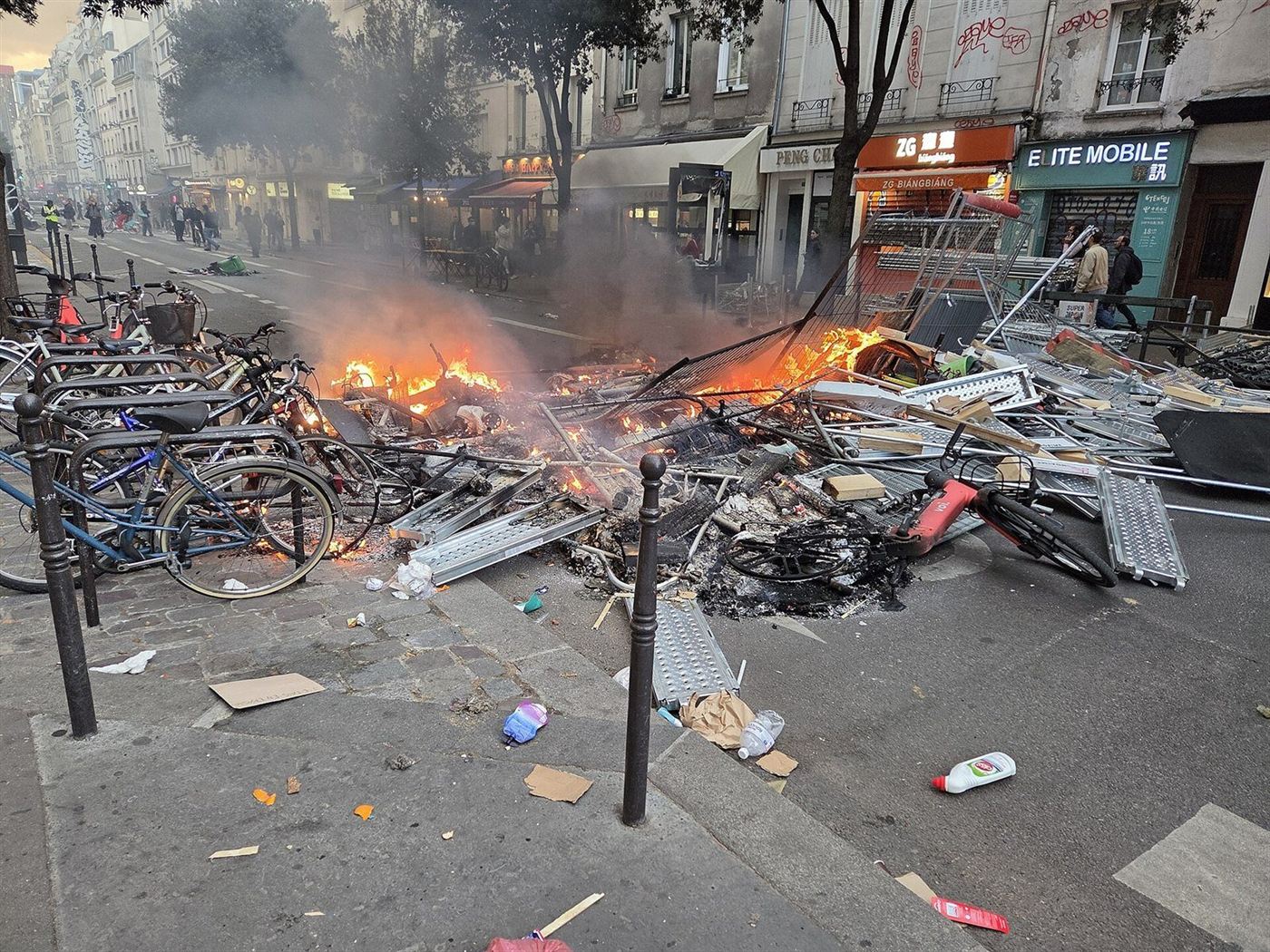
Guérin called the response “a colossal failure of the state”. Limoges was not alone. In Lille, a crowd forced its way into the town hall and 2 shops burned; 56 officers and a firefighter were hurt in the region. In Lyon, the tourist office went up. In Marseille, masked groups stormed the city hall and a police station. In Bordeaux, they attacked the prefect’s residence. In Paris, a burning barricade blocked the rue Beaubourg.
“I have no words … I never thought I’d ever live through something like this. Hordes of rioters and looters attacked our common [state] buildings … with no real demands, but with the sole aim to wreck the demands of those who had demonstrated legitimately.” Benoît Payan, Mayor of Marseille, to BFMTV
Payan said the policing questions needed answers. He also made the case for the marchers who never touched a shop window: “People have the right to demand the end of Parcoursup without getting hit by a grenade.” In Lyon, the Green mayor, Grégory Doucet, said it his own way.
“I’m stunned by the violence against public and state property. I saw and heard fear and anger. Shop owners felt abandoned.” Grégory Doucet, Mayor of Lyon, to Le Monde
Marseille also produced the most contested number of the night. The prefecture said “more than 30,000 looters” had been active at the peak, including 8,000 rioters. It reported 99 people taken into custody, 118 officers hurt, and 4,000 tear gas canisters fired. Payan said 5 officers were hospitalised. He dismissed the headcount as “farfelu”, nonsense. The police prefect, Jacques Witkowski, had put the moving crowd at “between 7,000 and 8,000” on Saturday evening. One state, two numbers. The smoke was not in dispute.
By Sunday evening, the toll was this: 2,397 arrests. 997 police officers and gendarmes hurt, 7 of them seriously. About 1,500 businesses looted or damaged over the weekend. Retail groups put the losses in the hundreds of millions of euros. Lamia El Aaraje, the deputy mayor of Paris, said the capital had been hit by “a level of violence that I believe we had never seen before”. By Monday, the chambers of commerce network, CCI France, said the count would pass 2,000 shops, and the damage would reach “hundreds of millions of euros”. In Paris alone, at least 30 more shops were looted on Sunday and into the night, said Mayor Emmanuel Grégoire. This time, the looters did not hide their faces. Police counted 351 arrests in the capital over that day and night. On the Saturday alone, Paris police made a record 855 arrests, the highest ever for a single event, AFP reported. One demonstrator died of cardiac arrest during the Saturday march in Paris; prosecutors opened an investigation. In Nantes, a 22-year-old auxiliary police officer was killed by a car around 1 a.m. while chasing suspects. Police said that case had no link to the protests.
The prime minister, Sébastien Lecornu, said the damage bill would be heavy “everywhere in the country”. The government named its enemy before the embers cooled. “It is time to choose your camp, either the Republic or the rioters,” he said, visiting officers in central Paris. He called the moment a “point of non-return”. The interior minister, Laurent Nuñez, listed the toll of “exactions”: Marseille, Paris, Lyon, Bordeaux, Rennes, Strasbourg, Grenoble, Nice, Limoges. He called the rioters “opportunistic delinquents who had seen a chance to pillage and loot” and warned: “we will find them and deal with them firmly.” His post read: “Demonstrating is a fundamental right. Sowing disorder with violence, in concert, is not.”
The anger crossed oceans. In Guadeloupe, the prefect imposed a curfew on minors in Pointe-à-Pitre and Les Abymes after urban violence in which 3 police officers were wounded by gunfire.
The violence cut into the young on both sides. In Saint-Étienne, a 17-year-old lost his right hand to a police grenade during the Oct. 17 clashes. In Mulhouse, a 17-year-old lost the sight in her left eye. On Oct. 5 in Lens, a 15-year-old lost a hand when a grenade went off during a school blockade. Before that: on Sept. 30 in Tours, a 16-year-old lost the use of an eye. On Sept. 28 in Saint-Ouen-l’Aumône, a 14-year-old’s jaw was broken by a tear gas round fired at close range. At least 10 cases had reached the IGPN, the national police inspectorate, by early October. The interior minister says officers acted proportionately “in almost all cases”.
The bill will be fought over too. The 2026 finance law created a mandatory riot-insurance scheme, the “garantie émeutes”. But it is frozen until the European Commission clears it on state-aid rules. So most of the October damage lands on insurers. France Assureurs has not priced the weekend yet. Its yardsticks: 730 million euros in insured losses after the 2023 riots, against 204 million after 2005 and about 250 million after the Yellow Vests.
As La Croix wrote on Monday: not since the Yellow Vests had France known violence like this.
How a high school blockade became a national revolt
It began with empty desks. On Sept. 17, 2026, teachers at the Lycée Antoine-de-Saint-Exupéry in Créteil, east of Paris, struck over posts no one had been hired to fill. The next day, the pupils blockaded the building. Their list was specific: missing teachers, no school nurses or counselors, classes stuffed past 30 students, crumbling buildings, fear of the future. In Sevran, protesters said they were “not asking for luxury” and that “nobody is listening to us”. By Sept. 21, other schools had joined. The system was being audited from the inside. It had cut 4,018 teaching posts in the 2026 budget. 3,256 of them in public schools: 1,891 in primary, 1,365 in secondary. 762 in private schools under contract.
The government called the escalation “irresponsible”. It did not stop it. On Sept. 28, police detained 164 people and the ministry counted 180 schools disrupted. On Sept. 29, a public-sector strike day, about 400 of France’s 3,700 high schools were disrupted and 440 people were detained, most of them pupils. The mayor of Saint-Denis, Bally Bagayoko, said on BFM TV that violence could “at a given moment” be legitimate. The Paris police prefect sent the remark to prosecutors. Jean-Luc Mélenchon told his activists to “step in” between pupils and police.
On Sept. 30, the count was 625 detentions and 83 officers hurt, with 356 schools disrupted. On Oct. 1, university students joined. About 30 campuses were blockaded. The ministry counted 1,027 high schools affected, 222 of them blocked, and 1,949 arrests. That day Matignon accused the far left of “instrumentalising” student unions, and the Paris prefect banned gatherings at 13 schools.
Then came the images that changed everything. On Oct. 5 in Lens, a 15-year-old’s hand was blown off at a school blockade. Ministers said 24 schools had been “burned or ransacked” since the start. The photos of maimed children did what the blockades could not: they pulled parents, unions and the political left into a fight the children had carried alone.
Then came Oct. 6, the unions’ “Act 3”. The Interior Ministry counted 256,000 marchers. The organizers said 450,000, including 100,000 in Paris. By then the Justice Ministry counted 5,060 arrests since the movement began. 87 percent of them minors. More than 1,800 facing prosecution.
| When | The moment | The scale |
|---|---|---|
| Sept. 18 | Pupils blockade the Lycée Antoine-de-Saint-Exupéry in Créteil | 1 school; demands on staff, buildings, timetables, Parcoursup |
| Sept. 29 | Public-sector strike day | About 400 of 3,700 high schools disrupted; 440 detained |
| Oct. 1 | Universities join the movement | 1,027 high schools affected; 222 blocked; 1,949 arrests in a day |
| Oct. 6 | “Act 3” | 256,000 by the ministry’s count, 450,000 by organizers; 100,000 in Paris |
| Oct. 8 | 4th day | 71,500 marchers plus 55,000 students outside schools |
| Oct. 13 | 5th day | 161,500 by the ministry, 480,000 by organizers; 214 schools closed |
| Oct. 17 | National day of action | 550,000 by the ministry, 800,000 by organizers; 2,397 arrests; 997 officers hurt |
On Oct. 13, Greta Thunberg visited a lycée in Saint-Denis. The education minister, Édouard Geffray, said the state had begun deploying 3,000 substitute teachers. By Oct. 16, about a third of France’s 3,700 high schools were still significantly disrupted. Then the two-week half-term holiday did what the police could not. It emptied the streets. Organizers called the pause a breather, not a retreat.
Two things made this movement different. First, its origin: no reform to fight. Just daily conditions. The CNRS sociologist Olivier Galland called it “more spontaneous, more eruptive” than past school waves. Second, its staying power. It survived a police offensive and a government campaign to discredit it. It was still standing when the school holiday arrived.
The government answered with police and paperwork. Lecornu sent ministers a road map with 5 workstreams and promised school decisions by the end of October. The “casseurs-payeurs” bill, approved by the Council of Ministers on Sept. 16, would make anyone who knowingly stays in a violent crowd jointly liable for damage. The cap: 10,000 euros, with family benefits open to seizure. The Senate starts reading it Oct. 27. In Île-de-France, regional president Valérie Pécresse put the damage above 1 million euros and said she would send a 100,000-euro bill to the mayor of Saint-Denis, Bally Bagayoko, for the Paul-Éluard gate, guarding and cleaning. She accused him of encouraging the people who damaged it. And the 2027 budget draft the Assembly opened on Oct. 1 adds 1.1 billion euros to education while still cutting 1,588 teacher posts. Both sides are careful not to shout about that contradiction.
The crackdown drew its own charges. By early October, lawyers and unions described pupils beaten in police custody. Amnesty International, the Human Rights League and France’s rights advisory commission called the force against minors disproportionate. Human Rights Watch reported serious injuries to children. The UN human rights office urged de-escalation. Nuñez insisted officers acted proportionately “in almost all cases”. The sociologist Robi Morder called the scale of repression “unprecedented for a high-school movement”.
Public opinion did not follow the government’s line. An Elabe poll for BFMTV on Oct. 14-16 found 69 percent of French people approved the Oct. 17 mobilization: 36 percent in firm support, 33 percent with sympathy, 10 percent opposed, 7 percent hostile. A Le Figaro poll found 62 percent considered the school movement justified, while 78 percent said LFI was exploiting it. The students were popular. Their loudest allies were not.
28 months without a majority
The current crisis is not a school story. It is a parliament story.
On June 9, 2024, the far right topped the European vote. Macron dissolved the National Assembly.
“I have decided to give you back the choice of our parliamentary future by voting.” Emmanuel Macron, President of France, June 2024
The voters answered with a hung parliament. No bloc reached the 289 seats a majority needs. None has found a partner since.
What followed was a chain of short governments. Michel Barnier took office on Sept. 5, 2024. On Dec. 4, 2024, the Assembly censured him on 331 votes, the first prime minister toppled that way since 1962. François Bayrou took over on Dec. 13, 2024. On Sept. 8, 2025, he lost a confidence vote 364-194, the first government to fall that way since 1958. He resigned the next day. On Sept. 9, 2025, Macron named Sébastien Lecornu, his 5th prime minister in under 2 years. Lecornu resigned after 26 days, then came back 4 days later.
Each budget became a siege. In December 2025, to survive, the government paid the Socialists’ price. The 2023 pension reform was suspended until January 2028 inside the Social Security budget, adopted 247-232. Workers born between 1964 and 1968 can retire 3 months sooner than the reform planned. A real concession, won by negotiation. And it worked.
The 2026 budget passed only on Feb. 2, 2026, after 3 uses of the 49.3 power. The final censure motions gathered 260 and 135 votes. Both fell short of the 289 needed. The text became law. Its revenue half had been rejected 404 votes to 1 in November 2025, before the government forced it through.
The voters got one clean test in the spring. In the municipal elections of March 15 and 22, 2026, the left held Paris, Marseille and Lyon. Benoît Payan took more than 54 percent in Marseille against the National Rally’s Franck Allisio. Éric Ciotti won Nice on a union ticket of the right and far right. The RN took 310 smaller towns with its allies. The big cities stayed out of its reach.
Then the courts wrote the next act. On July 7, 2026, a Paris appeals court upheld Marine Le Pen’s conviction for embezzling European Parliament funds, but cut her election ban to 15 months, already served. One year of her sentence stands, with an electronic tag. That evening she told TF1: “Je suis candidate” - I am a candidate. She is appealing to the Court of Cassation, which plans to rule by early April 2027. The first round is April 18, 2027.
Meanwhile, the 2027 budget, which Le Monde called “the last budget of the Macron presidency”, reached the floor on Oct. 1, 2026. The Finance Committee threw out its revenue half on Oct. 9, 31 votes to 3. On Oct. 13, the Socialists’ rejection motion failed 236-149. The deputies kept deleting government articles anyway. By Oct. 16, 2 government articles were gone, including the pensioners’ tax allowance cut. More than 2,800 amendments still wait. The first solemn vote comes Oct. 20.
Fuel, debt, and a war France did not join
The streets have a second engine: prices. On Feb. 28, 2026, the United States and Israel launched a war against Iran. The Strait of Hormuz has been largely closed to shipping since. Global oil prices jumped. Brent traded above $100 a barrel in late September. France was not at war. But it buys fuel at war prices.
Diesel hit a record 2.41 euros a liter on Sept. 20, up about 41 percent from the day before the war. SP95-E10, the best-selling grade, climbed above its 2022 peak. In September, consumer prices rose 3.1 percent year on year, the highest since January 2024. Energy rose for the third month in a row. The government renewed aid for high-mileage workers. It refused to cut fuel taxes.
Its answer, on Oct. 7, was to open the emergency stocks. After Macron called a G7 emergency meeting, Lecornu announced the release of 10 million barrels of diesel from France’s strategic reserves. The government expects pump prices to fall 12 to 18 cents a liter over 3 months from November.
The pump anger also woke an older movement. Yellow-vest groups listed 768 actions for Oct. 17, 2026, calling for roundabout pickets and service-station blockades. The map of 2018, redrawn. Organizers even put out a TikTok safety guide for the streets. Their message to the establishment was blunt: “Finish what we started”. Now they march with the unions. Next stop: Nov. 5.
The public books make everything harder. France owed 3,595.5 billion euros at the end of June. That is 119.0 percent of GDP. Fitch cut the country to A+ in September 2025. On Oct. 1, 2026, the 10-year bond yield touched 4.96 percent, the highest since 2002. The 2027 budget targets a deficit of 5.0 percent of GDP. It needs to borrow 339.7 billion euros just to run.
| Pressure point | Latest figure | When |
|---|---|---|
| Public debt | 3,595.5 billion euros, or 119.0 percent of GDP | End of Q2 2026 |
| Bond market | 10-year yield at 4.96 percent, highest since 2002 | Oct. 1, 2026 |
| Diesel | 2.41 euros a liter, up about 41 percent since February | Sept. 20-21, 2026 |
| Inflation | 3.1 percent year on year; energy up 3 months in a row | September 2026 |
| 2027 target | Deficit at 5.0 percent of GDP; 339.7 billion euros to borrow | Oct. 1, 2026 |
This is why the fuel anger and the school anger merged. The 2027 draft tries to walk the line: 54 billion euros of overall effort, 43 billion of it in concrete measures, defense up 6.4 billion to 63.4 billion, the interior ministry up 1 billion, and a cap on the pensioners’ tax allowance at 3,000 euros that deputies have already deleted. The Social Security draft beside it targets a deficit of 12.7 billion euros. A state that borrows at 4.96 percent cannot buy peace with spending. Its voters know it.
What Macron said, and what it changed
On Sunday evening, Oct. 18, Macron spoke from the Élysée. About 8 minutes, after a meeting with Lecornu and the crisis ministers. An average of 16.7 million people watched.
“Watching these images, we have all asked ourselves: What are they thinking? How can French people do this to France? … Nothing justifies it, nothing explains it. Nothing excuses it.” Emmanuel Macron, televised address, Oct. 18, 2026
He said “we all feel anger and shame”. He described “unbridled violence” and split peaceful marchers from “factious groups from the ultra-left, joined by numerous delinquents”. He pledged “full transparency” on how police had been deployed. Prefects gained power to ban gatherings “when necessary”. He asked parties and unions to condemn the violence and promised talks with students, teachers and employers’ groups. “Those who destroyed must pay,” he said. A day earlier, he had already made the argument on X: “No place for violence in our Republic. Those who broke, attacked prefectures and shops, looted even our town halls, will be prosecuted and punished.”
The reaction was brutal from every direction. Édouard Philippe, the former prime minister running for president, said he would have preferred “decisions and initiatives that would allow for a return to order”. Bruno Retailleau, the interior minister until September 2025, said Macron “appears completely overwhelmed” and demanded a state of emergency. The Greens’ Marine Tondelier accused him of summoning opponents “like children to the blackboard”. RN leader Jordan Bardella said the government “has nothing left to say to the French people”. LFI’s Manuel Bompard said Macron “spoke without saying anything”. Marine Le Pen said “legitimate social demands have once again been taken hostage by the far left”, and accused Mélenchon’s deputies of legitimising violence. Mélenchon himself blamed government “organisational failings” that “opened the door to chaos”. Lecornu shot back: “Laying the responsibility for violence on heads of police is a dangerous and cynical reversal of responsibilities.”
“Instead of even a semblance of an apology, Emmanuel Macron summons us to Matignon like children to the blackboard at school.” Marine Tondelier, leader of the Greens and presidential candidate, on X
On Monday morning, the government’s own account hardened. Nuñez admitted a “lack of anticipation” and a shortage of forces. Then he said the words out loud: “Yes, there was a loss of control” in some cities. Gérald Darmanin, the justice minister, told France 2: “We incontestably failed this weekend. There was a defect in intelligence, and you do not do good policing without good intelligence.” He said the services did not know how to “fight the ultra-left correctly”. He announced 2,331 people taken into custody over the weekend, 70 percent of them adults “very often known to police”. More than 80 percent face prosecution. “Dozens” are already in pre-trial detention, 13 of them in Marseille.
Macron refused Nuñez’s resignation, which the minister had offered on Sunday. He said the moment required “continued leadership of law enforcement”. He ordered him to “put in place new operational methods” against rioters, and to ensure transparency about “the failures in planning and intelligence that led to the violence”. Nuñez headed to Marseille, the city worst hit. The Paris prosecutor, Laure Beccuau, promised: “We will not let go.” She described probes under way and warned looters that investigators would look for blood, DNA and fingerprints.
The about-face was easy to weaponize. Ten days earlier, Nuñez had said on France Inter that the government had “not lost control”. He defined a loss of control as “hordes pillaging shops and committing exactions”. Éric Ciotti and RN deputy Jérôme Buisson put the 2 statements side by side. Politicians on the left and right called for Nuñez’s resignation. The Assembly’s speaker, Yaël Braun-Pivet, proposed a commission of inquiry.
By mid-morning, the machine was in gear. Lecornu opened an interministerial crisis cell on 3 tracks: economy and commerce, insurance, and the judicial follow-up. Bercy gathered retailers, hotels, restaurants, banks and insurers. Lecornu was also charged with convening parties, unions, local authorities and parliamentarians. The mayors’ association, the AMF, called rallies outside town halls at noon, “against the grave attacks on democratic institutions”.
The mayors of Paris, Marseille and Lyon, all from the left, demanded a meeting with Lecornu. They said the state had left them short of police. Grégoire, the Paris mayor, called the new looting “unbearable”. He blamed a “form of rotting” in the social movement that “the government organised”. At least 30 shops were hit again in Paris on Sunday night, he said. This time, they did not cover their faces.
The world watches
The images crossed borders within hours, and so did the politics. On Sunday, U.S. President Donald Trump posted on Truth Social:
“France is burning! The immigration of people from an entirely different world, people with hatred in their hearts, has shattered that once great country. … Close your Borders and take control, before it is too late!” Donald Trump, President of the United States, on Truth Social, Oct. 18, 2026
Vice President JD Vance used the weekend to argue that “Western liberals imported the third world into France and other countries in the name of diversity and compassion” while ignoring “fundamental questions of assimilation and compatibility”. He told Americans: “This is the future congressional Democrats seek for your country.” Both interventions landed 2 weeks before U.S. midterm elections.
Europe stirred too. Solidarity marches took place in Spain, Italy and Portugal. Cost-of-living protests shook Lisbon and Milan, where demonstrators said they were “suffocating” under rents and prices. The Guardian’s Europe desk asked the obvious question: why was this autumn burning from Paris to the Mediterranean?
One stranger subplot. On Oct. 7, France summoned Iran’s ambassador in Paris over what the foreign ministry called a “disinformation campaign” about the student protests. Iranian officials had used the unrest to attack France’s human rights record. The fight over the image of France had gone global.
What comes next
The calendar does not wait.
- Oct. 20: The National Assembly votes on the revenue half of the 2027 budget. The pensioners’ tax allowance cut is already dead, and 2,800 amendments are still queued.
- Oct. 20-27: The Social Security budget is debated, with its solemn vote set for Oct. 27.
- End of October: The government owes “decisions” on the schools where the movement began.
- Nov. 5: Unions (CFDT, CGT, FO, Unsa, FSU) and yellow-vest groups call a national day of strikes and marches over wages, fuel, and public services. Organizers of the Oct. 17 marches say they are “not giving up the fight”.
- Nov. 17: Vote on the whole 2027 budget. The 40-day constitutional window closes the same day; after 70 days, Dec. 17, the government can pass the text by ordinance.
- April 18, 2027: First round of the presidential election. Marine Le Pen leads first-round polling. The Odoxa-Backbone survey published Oct. 14 put her at 37 percent, with Mélenchon at 18 and Philippe at 17, and projected her winning a runoff against both. An Elabe poll for BFMTV on Oct. 18 put Philippe at 15.5-16.5, Glucksmann at 15-16.5 and Mélenchon at 15-16.
The school half-term holiday gives the streets 2 weeks of quiet. The stakes do not shrink in that time. The Assembly needed emergency powers, and time until February, to pass the 2025 and 2026 budgets. The 2027 text lands in the same chamber, with the far right and the hard left stronger than ever in the polls. Three numbers frame the trap: 17 percent of French people trust Macron to handle the country’s problems, an Elabe reading published Oct. 1. Lecornu sits at 19 percent, per Odoxa-Backbone on Oct. 14. And 69 percent approved the movement their police fought in the streets.
Said plainly: every camp fed this fire
Start at the top. Macron dissolved a working parliament on a personal bet in June 2024. He lost, then governed as if he had not. 5 prime ministers in under 2 years. 3 uses of 49.3 for a single budget. And no coalition building until the Socialists extracted the pension pause in December 2025. His Oct. 18 address gave France firmness, transparency, and dialogue. It gave the drivers nothing. It gave the schools nothing. Words are cheaper than diesel. By Monday, his own ministers were conceding the charge from inside: “We incontestably failed this weekend,” said Darmanin. Nuñez admitted a “loss of control” in some cities.
The rioters earned no sympathy here. They burned a 143-year-old town hall. They looted at least 1,500 businesses. They left 997 officers and gendarmes hurt. Their violence handed the government the exact images it needed to separate peaceful marchers from wreckers. As Payan said, they wrecked “the demands of those who had demonstrated legitimately”. A burned town hall is not a blow against the powerful. It is a blow against the neighbors.
The police doctrine failed twice in the same month. After a grenade maimed a 15-year-old in Lens on Oct. 5, the interior ministry suspended stun-grenade use within days. Nuñez restored it on the eve of Oct. 17, telling officers that “all types of intermediate weapons” could be used if clashes turned heavy. That day, a 17-year-old in Saint-Étienne lost his hand. A 17-year-old in Mulhouse lost an eye. Riot control that maims teenagers while shops burn a block away is not control. The 997 injured officers tell the other half: in some cities, the police were too few to protect anything. Both truths belong in the same report. So do the 10-plus IGPN files.
The opposition played its usual double game. The RN let Lecornu’s governments survive by refusing to censure them, then called the government hopeless. Retailleau demanded a state of emergency and blamed LFI “words”. He offered no proof of organization. LFI called to widen the school blockades, then washed its hands of the violence that followed. Its allies handed the government real ammunition: a mayor of Saint-Denis saying violence could at a given moment be legitimate, activists told to stand between pupils and police. Insults are not programs. A protest movement is not a shield.
One thing did work. The December 2025 deal. The Socialists traded non-censure for a real pension pause, priced at 100 million euros in 2026 and 1.4 billion in 2027. The 2026 budget then passed, late but legal. The system can still negotiate when the alternative is collapse. It just waits until after the fire.
No republic can be run on 49.3. No speech can put out a fire. On Monday, as Limoges swept ash out of its wrecked town hall, the government admitted it never saw the match coming. The match was lit on June 9, 2024. In 6 months, the voters decide who pays for it.
What has happened since June 2024
- June 9, 2024 - After the far right’s European win, Macron dissolves the Assembly and calls elections for June 30 and July 7
- July 7, 2024 - The snap election ends in a hung parliament; no bloc reaches 289 seats
- Sept. 5, 2024 - Michel Barnier becomes prime minister
- Dec. 4, 2024 - The Assembly censures Barnier on 331 votes, the first such fall since 1962
- Dec. 13, 2024 - François Bayrou takes office
- Sept. 8, 2025 - Bayrou loses a confidence vote 364-194 and resigns; Sébastien Lecornu is named the next day
- Oct. 6, 2025 - Lecornu resigns after 26 days; Macron brings him back on Oct. 10
- Dec. 16, 2025 - The Social Security budget passes 247-232 with the pension reform suspended until January 2028; law signed Dec. 30
- Feb. 2, 2026 - After 3 uses of
49.3, the Assembly rejects the last censure motions and the 2026 budget passes - Feb. 28, 2026 - War between Israel and the United States and Iran begins; the Strait of Hormuz blockade starts the fuel shock
- March 15-22, 2026 - Municipal elections: the left holds Paris, Marseille, and Lyon; Ciotti takes Nice; the RN wins 310 towns with allies but no big city
- July 7, 2026 - An appeals court upholds Le Pen’s conviction, cuts her ban to 15 months, and she declares her candidacy on TF1
- Sept. 17, 2026 - Teachers at the Lycée Antoine-de-Saint-Exupéry in Créteil strike over unfilled posts; pupils blockade the school the next day and the movement is born
- Sept. 20-21, 2026 - Diesel hits a record 2.41 euros a liter, up about 41 percent from February
- Sept. 28, 2026 - First mass detentions: 164 arrests, 180 schools disrupted; Lecornu calls the escalation “irresponsible”
- Sept. 29, 2026 - Public-sector strike day: about 400 of 3,700 high schools disrupted, 440 detained; the Saint-Denis mayor’s “legitimate violence” remark goes to prosecutors
- Sept. 30, 2026 - 625 detentions and 356 schools disrupted; a 16-year-old loses the use of an eye in Tours
- Oct. 1, 2026 - Universities join; 1,027 high schools affected, 1,949 arrests in one day; Matignon blames far-left “instrumentalisation”
- Oct. 2, 2026 - 564 schools disrupted and about 400 closed; fires at lycées; the government pushes parental liability
- Oct. 5, 2026 - A 15-year-old loses a hand in Lens; 24 schools “burned or ransacked” since the start; stun-grenade use suspended
- Oct. 6, 2026 - “Act 3” of the movement: 256,000 to 450,000 march; more than 6,000 detained since Sept. 28
- Oct. 7, 2026 - Lecornu releases 10 million barrels of diesel from strategic reserves; France summons Iran’s ambassador over a “disinformation campaign”
- Oct. 8, 2026 - 4th national day: 71,500 marchers and 55,000 students outside schools
- Oct. 13, 2026 - 5th national day: 161,500 by the ministry’s count, 480,000 by organizers; Greta Thunberg visits a lycée in Saint-Denis
- Oct. 16, 2026 - About a third of high schools still disrupted as the half-term holiday begins
- Oct. 17, 2026 - 550,000 march; 60,000 police deployed; 2,397 arrests; 997 police and gendarmes hurt; Limoges town hall, the Lyon tourist office, and shops go up in flames; 1 marcher dies of cardiac arrest
- Oct. 18, 2026 - Macron’s address: “anger and shame”, ban powers for prefects, calls for talks; Nuñez offers his resignation; looting continues in Paris
- Oct. 19, 2026 - Nuñez admits a “loss of control” and a “lack of anticipation”; Darmanin says the state “incontestably failed”; Macron refuses the resignation and orders “new methods”; the crisis cabinet meets; Bercy convenes retailers and insurers; mayors rally outside town halls; budget vote set for Oct. 20
Bottom line: On Oct. 20, the 2027 budget gets its first vote. The man in charge of the police admits he could not protect entire cities. The government owes the schools a decision by the end of October, the Assembly a budget by mid-November, and the voters an answer in April 2027. The last 2 budgets needed emergency powers and ran into February. Nothing about this one looks faster.
Sources
Tap to open the 43 sourcesTap to close
- Reuters, June 9, 2024 - Macron dissolves the National Assembly; “give you back the choice” quote; vote set for June 30 and July 7.
- Reuters / Le Monde, July 7-8, 2024 - hung parliament; no bloc near the 289-seat majority.
- Reuters (Sept. 5) and Reuters (Dec. 4), 2024 - Barnier appointed prime minister; censured on 331 votes; first prime minister ousted by censure since 1962.
- Vie publique / BBC, Sept. 2025 - Bayrou took office Dec. 13, 2024; loses confidence vote 364-194 on Sept. 8, 2025, the first government to fall on a confidence vote since 1958; Lecornu named Sept. 9.
- BBC (Oct. 6) and BBC (Oct. 10), 2025 - Lecornu spent 26 days in office, resigned Oct. 6, reappointed Oct. 10.
- Vie publique / CFDT Retraités, Dec. 2025 - Social Security budget adopted 247-232 on Dec. 16; pension reform suspended until January 2028 (law of Dec. 30, 2025); cost of 100 million euros in 2026, 1.4 billion in 2027.
- Assemblée nationale, Feb. 2, 2026 - 2026 budget adopted definitively after
49.3and rejection of 2 censure motions (260 and 135 votes). - RFI / Le Monde / POLITICO, March 22-23, 2026 - left holds Paris (Grégoire), Marseille (Payan, more than 54 percent), Lyon (Doucet); Ciotti wins Nice; RN wins 310 municipalities with allies.
- BBC / Le Figaro / France Inter, July 7-8, 2026 - appeal court upholds Le Pen’s conviction, cuts ban to 15 months (served), 1 year with electronic tag; TF1 candidacy declaration; Court of Cassation ruling expected by early April 2027; first round on April 18, 2027.
- Ouest-France / Le Monde / France 24 / The Guardian, Sept. 17 to Oct. 2, 2026 - movement begins Sept. 17-18 at the Lycée Antoine-de-Saint-Exupéry in Créteil; blockades spread from Sept. 21; staff-shortage demands; Galland’s “more spontaneous, more eruptive” line to Le Monde.
- franceinfo / France 24, Oct. 6, 2026 - “Act 3”: 256,000 (Interior Ministry) vs 450,000 (organizers), 100,000 in Paris; more than 6,000 detained since Sept. 28.
- franceinfo / Euronews, Sept. 20-21, 2026 - diesel at a record 2.41 euros a liter, up about 41 percent since Feb. 27; SP95-E10 above its 2022 peak.
- Assemblée nationale / NosParlementaires / franceinfo, Oct. 2026 - Finance Committee rejects revenue half 31-3 on Oct. 9; PS rejection motion fails 236-149 on Oct. 13; 2026’s same vote failed 404-1; solemn votes Oct. 20 and Nov. 17; 70-day deadline Dec. 17.
- Interior Ministry via RFI / BFM TV / Le Figaro, Oct. 18, 2026 - 2,397 arrests; 997 police and gendarmes injured, 7 seriously; 550,000 marchers nationwide, 110,000 in Paris.
- AFP / France 24 / BBC / Euronews, Oct. 17-18, 2026 - Limoges town hall fire: 143-year-old building, roof collapse, 43-meter clock tower falls; Barate quotes, including “catastrophe for heritage”.
- The Guardian, Oct. 18, 2026 - Guérin’s “people organised for war”, the ammunition account and “colossal failure of the state”; caretaker death threats; Payan, Doucet and El Aaraje quotes; record 855 arrests in Paris; “level of violence we have never seen”; Macron’s “unbridled violence” framing and “factious groups from the ultra-left”; solidarity protests in Spain, Italy and Portugal; Mélenchon-Lecornu exchange.
- The Week / Vanity Fair / Le Figaro, Oct. 18-19, 2026 - Macron address quotes and reactions (Philippe, Retailleau, Tondelier, Bardella, Bompard).
- AP, Oct. 18, 2026 - organizers’ 800,000 figure; a demonstrator died of cardiac arrest during the Paris march.
- Ouest-France / RTL, Oct. 17, 2026 - 22-year-old auxiliary officer killed by a third-party vehicle in Nantes; police said the case was not linked to the protests.
- TF1 / Midi Libre / RTL / France 3, Oct. 5-18, 2026 - Lens 15-year-old loses hand (Oct. 5); Saint-Étienne 17-year-old loses right hand; Mulhouse 17-year-old loses eye; IGPN inquiries opened.
- INSEE, Oct. 15, 2026 - September inflation at 3.1 percent year on year; energy prices up for a third straight month.
- INSEE / FXStreet / Fitch Ratings, Sept. 2025 to Oct. 2026 - debt at 3,595.5 billion euros, 119.0 percent of GDP at end-Q2 2026; 10-year yield 4.96 percent on Oct. 1, highest since 2002; downgrade to A+ on Sept. 12, 2025.
- Banque de France / Euronews, Feb. 28 to Oct. 13, 2026 - start of the war with Iran; Strait of Hormuz closure; Brent above $100 a barrel.
- Agence France Trésor, Oct. 1, 2026 - 2027 budget presented; deficit target 5.0 percent of GDP; financing requirement 339.7 billion euros.
- franceinfo, Oct. 5, 2026 - CFDT, CGT, FO, Unsa, and FSU call a national strike and march for Nov. 5.
- LCP / Europe 1 / BFMTV, Sept. 16 to Oct. 5, 2026 - “casseurs-payeurs” bill presented in Council of Ministers Sept. 16; Senate reading from Oct. 27; joint civil liability capped at 10,000 euros.
- Elabe for BFMTV via Le Figaro, Oct. 18, 2026 - Le Pen leads the first round; Philippe 15.5-16.5, Glucksmann 15-16.5, Mélenchon 15-16 percent.
- Photos: Place de la République by FreCha (CC BY-SA 4.0); Limoges town hall fire by Wydiwye (CC0); rue Beaubourg barricade by Lechat (CC BY-SA 3.0). All via Wikimedia Commons.
- Public Sénat / M6 / franceinfo, Oct. 16-17, 2026 - stun-grenade use reauthorized for Oct. 17 after the post-Lens suspension; officers told “all types of intermediate weapons” could be used in heavy clashes; 60,000 police and gendarmes mobilized Saturday (Nuñez on France Inter, Oct. 19, via RTL.be and Ouest-France).
- La Provence / actu.fr / Le Figaro / Linternaute, Oct. 17-18, 2026 - Marseille: prefecture’s “more than 30,000 looters” at the peak including 8,000 rioters; Payan’s “farfelu” rejection and his Parcoursup line; prefect Witkowski’s “between 7,000 and 8,000”; 99 garde à vue; 118 officers hurt; 4,000 tear gas canisters; 5 officers hospitalised per Payan.
- La Croix with AFP, live, Oct. 19, 2026 - Nuñez’s “manque d’anticipation” and “perte de contrôle”; Darmanin’s “Nous avons failli incontestablement” and 2,331 garde à vue, 70 percent adults, 13 pre-trial detentions in Marseille; Grégoire on 30-plus shops looted and “pourrissement”, 351 Paris arrests Sunday and overnight; CCI France’s “more than 2,000” businesses and “hundreds of millions”; AMF midday rallies; the crisis cell’s 3 tracks; the Bercy meeting; Beccuau’s “Nous ne lâcherons rien”; 16.7 million viewers for the 8-minute address; Guadeloupe minors’ curfew after officers wounded by gunfire; Nuñez due in Marseille; next mobilization around Nov. 5; “never since the Yellow Vests”.
- Wikipedia, “2026 French student protests” (accessed Oct. 19, 2026), aggregating AFP, Le Monde, franceinfo, ICI, Le Parisien, BBC and CNN - expanded chronology: Sept. 17-18 origin; Sept. 28-30 figures; Oct. 1-2; Oct. 5; Oct. 8; Oct. 13; Oct. 16; Justice Ministry totals (5,060 arrests, 87 percent minors; 1,800-plus prosecuted); policing criticism (10-plus IGPN investigations, Amnesty, LDH, CNCDH, HRW, UN); Bagayoko case; Morder’s “unprecedented”; Pécresse’s 100,000-euro bill; Le Figaro poll (62 percent justified, 78 percent say LFI exploiting).
- The Guardian series, Oct. 6-13, 2026 - dilapidated-schools reporting; Sevran protesters “not asking for luxury”; “nobody is listening to us”; Thunberg in Paris; 160,000-plus in the 3rd week.
- Sud Ouest / Europe 1 / CNews / Les Échos, Oct. 17-18, 2026 - Lecornu’s “choose your camp” and “point de non-retour”; Le Pen’s “taken hostage by the far left”; Nuñez’s “exactions” list and “fundamental right” post; Macron’s Oct. 17 X post; Ciotti and Buisson posts; Nuñez’s Oct. 6 “not lost control” claim.
- BFMTV / Elabe, Oct. 14-16, 2026 - 69 percent approve the Oct. 17 mobilization (36 percent support, 33 percent sympathy, 10 percent opposed, 7 percent hostile); inflation at its highest since January 2024.
- France 24 / The Connexion / EUobserver, Oct. 16-19, 2026 - Yellow Vests’ return; “Finish what we started”; 768 actions listed; roundabouts and service stations; TikTok safety guide.
- The Hindu (AFP) / POLITICO / The Guardian, Oct. 18-19, 2026 - Trump’s “France is burning” post; Vance’s attack on “Western liberals”; solidarity protests in Spain, Italy and Portugal; Lisbon and Milan (“We are suffocating”); Europe-wide explainer.
- IranWire / French foreign ministry, Oct. 7-8, 2026 - Iranian ambassador summoned over a “disinformation campaign” about the protests.
- Vie publique / budget.gouv.fr / Touteleurope / Le Monde / Reuters / France Inter, Oct. 1-7, 2026 - 2027 budget contents (54 billion euro effort, 43 billion in measures, deficit at 5.0 percent; defense to 63.4 billion; interior plus 1 billion; education plus 1.1 billion while cutting 1,588 teacher posts, per Le Monde; pension allowance capped at 3,000 euros; Social Security deficit target 12.7 billion); Lecornu’s Oct. 7 diesel release (10 million barrels, 12-18 cents, from November, G7 coordination).
- Mediapart, Oct. 16, 2025 - 4,018 teacher posts cut in the 2026 budget (1,891 first degree, 1,365 second degree, 762 private under contract).
- France Assureurs / Le JDD / CNews, 2023-2026 - riot insurance: 730 million euros in insured losses after the 2023 riots; 204 million after 2005; about 250 million after the Yellow Vests; the 2026 “garantie émeutes” scheme suspended pending EU state-aid clearance; “casseurs-payeurs” acceleration.
- franceinfo / Le Monde, Oct. 18-19, 2026 - mayors of Paris, Lyon and Marseille deplore a “manque de moyens” and ask to be received by Lecornu.
- Elabe for Les Échos, Oct. 1 / Odoxa-Backbone for Public Sénat, Oct. 14, 2026 - Macron trust at 17 percent (down 3 points in a month); Lecornu at 19 percent; Le Pen at 37 percent in the first round, ahead of Mélenchon 18 and Philippe 17, winning projected runoffs against both.


